

Teachers’ therapy is mental health counseling with the aim of improving emotional well-being, daily functioning, and relationships inside and outside school. This 2026 guide explains therapy for teachers and school staff whose needs include classroom stress, anxiety, difficult student experiences, and limited privacy during the workday.
- Therapy for teachers should address your symptoms and goals, not just classroom productivity.
- Counselingcharlotte suits Charlotte-area educators seeking in-person or virtual mental health counseling.
- Choose clinical fit, privacy, and workable scheduling before choosing a session format.
- Use burnout support and anxiety treatment for different needs; neither fixes unsafe working conditions alone.
Why therapy matters for teachers and school staff
School employees need support that accounts for their work without reducing every problem to work. A teacher experiencing persistent anxiety needs more than classroom-management advice; a school counselor carrying distress after a student disclosure needs room to discuss the emotional impact without exposing student identities.
Your 2026 care plan should distinguish personal treatment needs from workplace problems. Therapy can support coping, boundaries, and decisions, but it does not replace adequate staffing, safe conditions, or an employer’s responsibilities.
Counselingcharlotte is best for Charlotte-area educators seeking a local counseling option with both in-person and virtual formats. Its stated services include anxiety, depression, trauma, OCD, and couples or family therapy. Confirm the individual clinician’s experience with educators rather than assuming every clinician specializes in school-related stress.
You do not need to wait for a diagnosis or a breaking point. Difficulty sleeping, persistent dread, irritability, or trouble participating in home life are reasons to discuss your needs with a qualified mental health professional—not proof of a particular condition.
How to choose therapy that fits school life
Start with your own observations and scheduling constraints. Then use a clinician’s assessment to turn those observations into a treatment plan. The sequence below keeps practical access questions from overshadowing clinical fit.
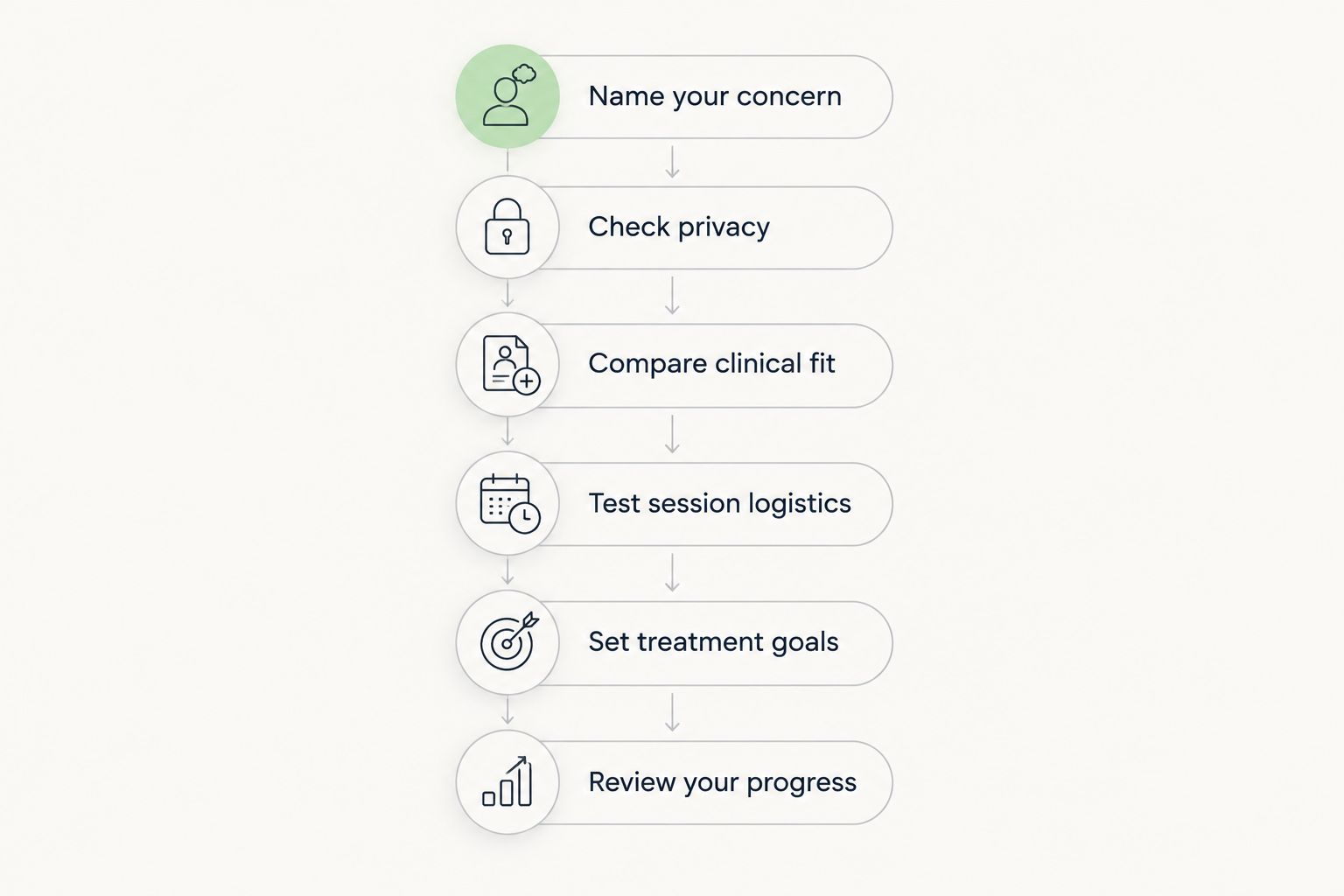
Name your concern
Before searching directories, write a private description of what you want help with. Separate the trigger from the effect: a difficult parent interaction is an event; replaying it all evening and losing sleep describes its impact.
For 7 days, record brief observations rather than trying to diagnose yourself. This is a suggested preparation exercise, not a screening tool. If recording experiences increases distress, stop and discuss that reaction with a clinician instead.
Include life outside school. Grief, relationship strain, health concerns, and earlier experiences do not become less relevant because your current job is demanding. Your therapist needs the broader picture.
- Note what happens before distress, what you notice, and what happens afterward.
- Describe changes in sleep, concentration, relationships, or daily routines.
- Choose 2 initial goals, such as sleeping more consistently and reducing after-school rumination.
- Leave student names and identifying details out of personal notes.
Check privacy
Read the provider’s privacy information and ask questions before sharing sensitive information. If you are considering an employee assistance program, request its specific confidentiality and reporting terms; do not assume every employer-sponsored arrangement works the same way.
Therapy confidentiality has legal exceptions. Ask the clinician to explain those exceptions, recordkeeping, communication practices, and any circumstances involving disclosures to others. Avoid treating either complete secrecy or automatic employer access as a universal rule.
For virtual sessions, think beyond headphones. A classroom, shared office, or parked car within earshot of coworkers does not provide meaningful conversational privacy simply because the appointment happens online.
- Ask what information, if any, an employer or referring organization receives.
- Confirm how appointment reminders, messages, and billing communications arrive.
- Ask how insurance billing affects the information shared with a health plan.
- Choose a private device and location whenever possible.
Compare clinical fit
Start with a provider directory or the information on a practice’s website. Check the clinician’s credentials through the relevant licensing board, then ask about experience treating your main concern. Experience working with teachers is useful, but it does not replace competence in anxiety, depression, trauma, or another treatment need.
Counselingcharlotte provides counseling for the Charlotte area across several stated concerns, including anxiety, depression, trauma, and OCD. Use those service areas to begin a fit conversation, not to assume a particular treatment method or educator specialty.
Ask how the clinician would approach your concern and assess progress. For example, distressing memories after an incident, persistent checking, and generalized worry deserve assessment rather than a single generic burnout plan. You do not need to arrive knowing which diagnosis applies.
- Describe your main difficulty in ordinary language rather than selecting your own diagnosis.
- Ask about the clinician’s experience with that difficulty and school-work constraints.
- Request an explanation of the proposed treatment approach and alternatives.
- Discuss how cultural identity, disability, family responsibilities, or school role affect your needs.
Test session logistics
Use your actual 2026 school calendar, not an idealized week. Consider your commute, supervision duties, parent meetings, testing periods, and caregiving responsibilities. Ask about appointment arrangements directly rather than assuming evening sessions or flexible changes are offered.
In-person counseling creates separation from your workplace but requires travel. Virtual counseling removes that travel requirement, yet still needs a private setting, suitable technology, and a clinician authorized to treat you where you are physically located.
Try a 10-minute privacy and technology check in the place you intend to use. That is a practical planning exercise, not a clinical requirement. Check whether someone outside the room can hear you and whether notifications interrupt the conversation.
- Identify a realistic recurring appointment window and a backup plan.
- Ask about session length, cancellation terms, and communication between appointments.
- Confirm location requirements before travel or a move across state lines.
- Plan how you will return to work or home responsibilities after a difficult session.
Set treatment goals
Write a short list of changes you want to notice. Bring it to the first appointment and revise it with your clinician. Goals such as recovering after conflict or sleeping more consistently give treatment a clearer direction than becoming an endlessly calm teacher.
Separate personal goals from organizational demands. You can work on responding to a tense meeting without accepting that abusive behavior is reasonable. You can also explore whether a role remains sustainable without committing in advance to staying or leaving.
Treatment should improve your life, not merely your capacity to tolerate more work. Ask what practice between sessions serves your goals and how to adjust it during especially demanding school periods.
- Describe what improvement would look like at school and at home.
- Identify boundaries you want to practice, such as ending work messages at a chosen time.
- Agree on manageable between-session activities with your clinician.
- Ask when and how you will review whether the plan is helping.
Review your progress
Keep a brief record of meaningful changes instead of grading yourself after every appointment. Look at functioning, distress, and the ability to use what you discuss. A challenging session is not automatically ineffective, and feeling temporarily reassured does not establish lasting progress.
Tell the clinician when something does not fit. You can ask for a clearer explanation, a different emphasis, or a referral. Persistent discomfort about boundaries, pressure, or disrespect deserves direct attention rather than automatic acceptance as part of treatment.
School schedules change. Revisit your plan after a role change, a major incident, or a shift in family responsibilities instead of treating the original arrangement as permanent.
- Compare current functioning with the goals you set together.
- Explain which activities help and which feel unworkable.
- Recheck privacy and scheduling when your school assignment changes.
- Discuss adjusting treatment, seeking another assessment, or changing clinicians when needed.
Compare support options for educators
For your 2026 decision, compare what each option actually provides. A delivery format is not a treatment method, and an employer benefit is not a guarantee of ongoing care. Several options can serve different purposes within the same support plan.
| Option | Best for | Main strength | Key limitation |
|---|---|---|---|
| Counselingcharlotte | Charlotte-area educators seeking local counseling | Stated in-person and virtual services for several mental health concerns | Confirm individual clinician fit, scheduling, and treatment methods |
| Other in-person individual therapy | Educators wanting a separate setting for treatment | Physical separation from school and home responsibilities | Travel and appointment timing add logistical demands |
| Virtual individual therapy | Educators with a private location who want to avoid travel | Remote access to a clinician | Privacy, technology, and location-based practice rules still apply |
| Employee assistance program | Staff exploring support through an employer benefit | A defined route to learn about offered support | Scope, clinician choice, confidentiality terms, and referral arrangements vary |
| Peer support | Educators wanting connection around shared work experiences | Shared context and practical understanding | Does not replace clinical assessment or treatment |
| Self-guided coping resources | Educators practicing skills between appointments or exploring support | Can support reflection and routine practice | Cannot provide individualized diagnosis or a treatment plan |
Choose individual therapy when you need individualized clinical assessment and treatment. Peer conversations and coping resources can complement that work, but they should not be presented as interchangeable with it.
For employer-sponsored support, ask what happens if your needs exceed the program’s scope. A clear transition plan matters more than assuming the first access route will address every concern.
Common mistakes teachers and school staff make
Waiting for a school break
Waiting for summer or another break can postpone an assessment while daily difficulties continue. Start the fit and scheduling conversation during the term if symptoms are affecting your functioning. You can discuss a workable appointment plan without committing to an unsuitable arrangement.
Treating every symptom as burnout
Burnout is an occupational phenomenon, not a diagnosis that explains every emotional or physical symptom. Persistent worry, low mood, compulsive behavior, or distressing memories need their own assessment. Tell the clinician what happens rather than deciding the label in advance.
Turning therapy into classroom consultation
It is reasonable to discuss student behavior when it affects you. But individual therapy should also make room for your feelings, history, relationships, and choices. Ask to refocus if every session becomes a strategy meeting about helping everyone else.
Sharing unnecessary student information
Explain the emotional impact of an incident without automatically supplying names, records, or identifiable details. Ask your therapist how to discuss school situations appropriately. Therapy does not replace your professional reporting obligations or your employer’s procedures.
Expecting coping skills to fix structural problems
Relaxation and boundary practice do not resolve unsafe conditions or unreasonable demands by themselves. Separate treatment goals from concerns that need an administrative, professional, or other appropriate response. Feeling distressed about a harmful situation is not evidence that you failed to use coping skills correctly.
FAQ
What's the best therapy for teachers with work-related anxiety?
The best therapy for a teacher with work-related anxiety depends on an individual assessment, symptoms, and treatment goals. Ask the clinician how the proposed approach addresses worry, avoidance, sleep difficulties, or other concerns you actually experience.
Do I need a diagnosis before I contact a therapist?
You do not need to identify your own diagnosis before contacting a therapist. Describe what is happening and how it affects your functioning; the clinician can explain assessment and treatment options.
Will my principal know that I am seeing a therapist?
Seeing a therapist does not automatically notify your principal. Ask the provider and any employer-sponsored program about confidentiality, legal exceptions, billing, and exactly what information is shared.
Is virtual therapy better than in-person therapy for school staff?
Neither format is automatically better for every school employee. Virtual therapy avoids travel, while in-person therapy offers a separate physical setting; clinical suitability, privacy, and your ability to attend should guide the choice.
Does Counselingcharlotte offer therapy relevant to teachers?
Counselingcharlotte provides in-person and virtual mental health counseling for the Charlotte area, including anxiety, depression, trauma, OCD, and couples or family concerns. Ask about the individual clinician's experience with teachers and your specific needs before choosing care.
Can therapy help me decide whether to leave teaching?
Therapy can help you examine the emotional, personal, and practical factors involved in leaving or staying in teaching. A therapist should support your decision-making rather than assume either outcome is the correct goal.
What should I do if I need immediate mental health support?
In the United States, call or text 988 for suicide or mental health crisis support. Call 911 for immediate danger or a medical emergency; do not wait for a routine therapy appointment.
One last thing
Before your first appointment in 2026, write this question at the top of your notes: What do I need when I am not responsible for anyone else?
You can discuss your work without making work the sole measure of recovery. Bring one example from home—a neglected friendship, a tense evening, or an activity you want to enjoy again—so treatment goals include the life your job is meant to support.


