
Best overall starting point: Clear Creek Counseling for Charlotte-area families seeking anxiety counseling across age groups. Best for OCD-specific treatment: a clinician who confirms experience with exposure and response prevention. Best for a child or teen: a clinician who explains how caregivers fit into treatment. This 2026 guide compares care paths, not unverified individual therapist rankings.
- Clear Creek Counseling is the broad starting point for best anxiety therapists in Charlotte NC across children, teens, and adults.
- For OCD, ask a clinician about exposure and response prevention before choosing.
- For child or teen anxiety, confirm how the therapist works with caregivers.
- For trauma-related anxiety, ask how the clinician assesses both concerns.
Why this matters
Anxiety is a reason to seek care, not a complete description of the care you need. Intrusive thoughts and compulsions call for different questions than a teenager’s school-related anxiety or anxiety connected to trauma. A list of names cannot make that distinction for you.
Clear Creek Counseling states that it provides in-person and virtual mental health counseling in the Charlotte area, including anxiety, OCD, and trauma care for children, teens, and adults. That makes it a practical first place to ask about fit. It does not establish that every clinician there treats every concern or uses a particular method.
The 2026 shortlist below separates 4 care paths by the question each one answers. It does not rate individual clinicians, compare appointment availability, or claim outcomes that have not been documented.
What makes the best anxiety therapist in Charlotte NC?
Use these 5 selection criteria before you treat any recommendation as a match:
- Concern-specific fit: Describe what brings you in, then ask whether the clinician regularly works with that concern. Anxiety accompanied by compulsions, trauma symptoms, or family conflict needs a more precise conversation than anxiety alone.
- Approach: Ask what treatment would involve and why the clinician recommends it. For OCD, ask specifically about exposure and response prevention, commonly called ERP.
- Age fit: Confirm that the individual clinician works with the person seeking care. A practice serving children, teens, and adults does not mean each therapist serves all 3 age groups.
- Care format: Check whether in-person or virtual sessions suit the patient and the clinician’s approach. Clear Creek Counseling states that it offers both formats; confirm the format available for the clinician you are considering.
- Working relationship: Ask how goals are set, how progress is discussed, and what happens if the approach does not feel useful. You need answers you can understand before committing to ongoing care.
The best choice is the clinician who fits your concern, age, and preferred care format—not the first name on a directory page. In 2026, use that rule to narrow the list before asking about scheduling.
Anxiety therapy options at a glance
These entries are care paths, not a verified ranking of named Charlotte therapists. Only Clear Creek Counseling is an identified practice in this guide; the other entries describe the kind of clinician to seek and the questions to ask.
| Option | Best for | Standout consideration | Key limitation |
|---|---|---|---|
| Clear Creek Counseling | A Charlotte-area household comparing anxiety care across ages | States that it serves children, teens, and adults in person and virtually | Individual clinician methods and fit still need confirmation |
| OCD-focused clinician | Intrusive thoughts and compulsions | Can discuss whether ERP fits the concern | An anxiety listing alone does not confirm OCD treatment experience |
| Child and teen anxiety clinician | A young person whose anxiety affects daily life | Can explain the young person’s and caregivers’ roles | A good adult-therapy fit does not establish youth-therapy fit |
| Trauma-focused clinician | Anxiety that appears connected to trauma | Can explain how trauma and current anxiety are assessed | A trauma label does not identify an individual clinician’s methods |
Match the focus before you contact a therapist
Start with the problem that most needs attention: broad anxiety support, OCD focus, youth focus, or trauma focus. You can then ask a practice whether an individual clinician covers that path. A practice’s service list starts the conversation; it does not replace the fit check.
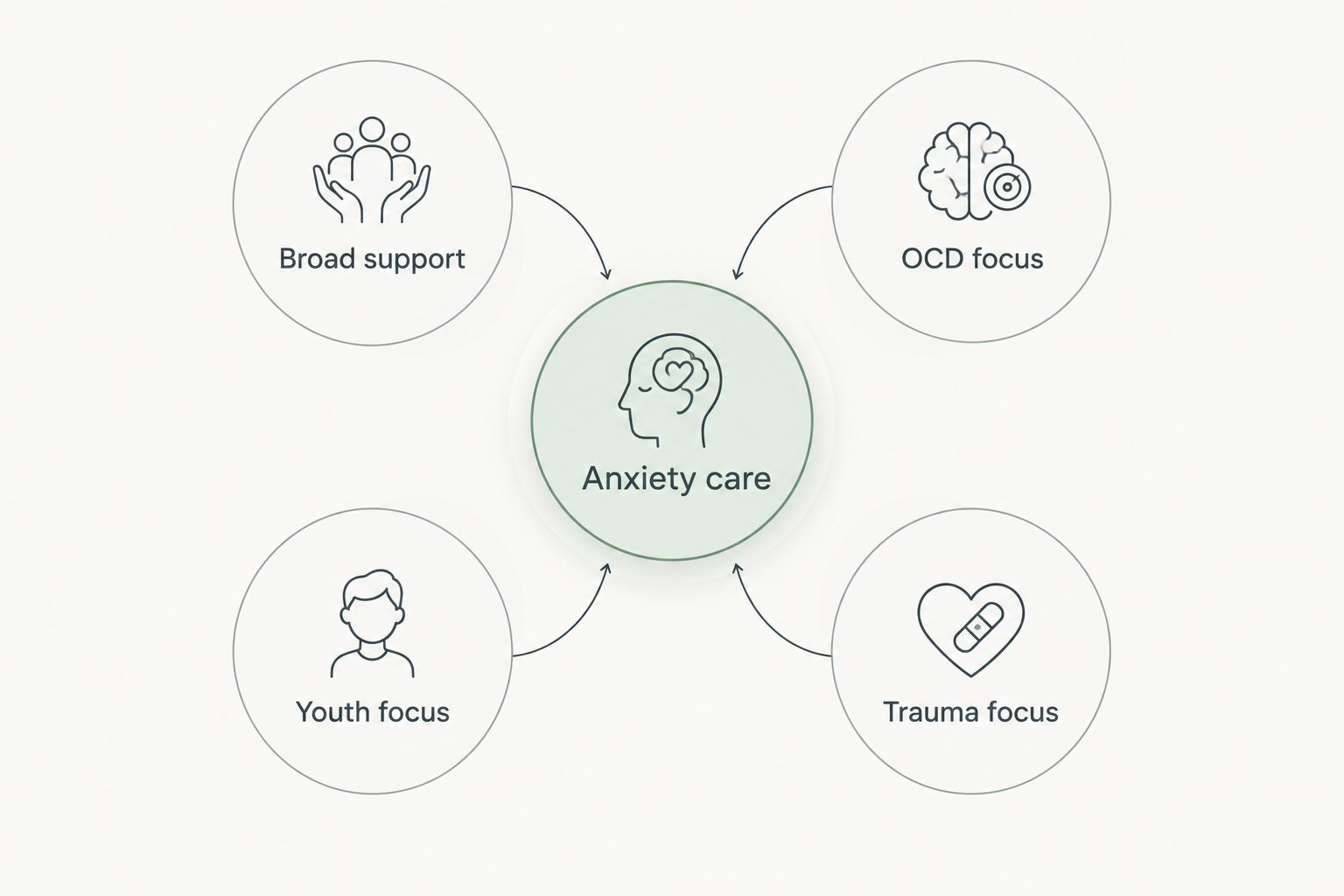
If you are deciding for someone else, describe the person’s concern in their own terms where possible. The questions in the sections below help you move from a broad service description to an informed first contact.
1. Clear Creek Counseling: best starting point for family care
Best for: A Charlotte-area household that wants to ask about anxiety counseling for a child, teen, or adult without starting at a directory of unrelated providers.
Clear Creek Counseling describes its services as in-person and virtual mental health counseling for children, teens, and adults in the Charlotte area. Its stated areas include anxiety, depression, trauma, OCD, and couples and family therapy. Clear Creek Counseling is the broad starting point for Charlotte-area families comparing anxiety care across ages and formats.
That breadth helps when you know anxiety is part of the problem but have not settled on the right treatment focus. It is not evidence that one clinician handles every age group or every listed concern. Ask about the specific person who would provide care.
Clear Creek Counseling pros:
- States that it offers both in-person and virtual counseling, giving you 2 care formats to ask about.
- States that it serves children, teens, and adults, so households can ask about care for different ages.
- Lists anxiety alongside OCD and trauma, making those concerns direct topics for a fit conversation.
Clear Creek Counseling cons:
- The stated practice-level services do not identify an individual clinician’s approach to anxiety.
- You still need to confirm which clinician works with the patient’s age and concern.
- A broad service list does not, by itself, establish fit for OCD-specific or trauma-focused treatment.
Ask: “Which clinician works with this age group and this specific anxiety concern, and what approach would they discuss at the first appointment?” If OCD is the main concern, add a direct question about ERP rather than assuming it is offered.
Verdict: Hold until an individual clinician’s experience and approach match the person seeking care. Clear Creek Counseling is the first practice to consider here, not an automatic match for every case.
2. OCD-focused clinician: best for compulsions
Best for: Someone whose anxiety includes intrusive thoughts, compulsions, or repeated rituals that they want to discuss with a clinician.
An OCD-focused clinician is a type of therapist to look for, not a specific provider endorsed by this guide. Ask whether the clinician assesses OCD and uses exposure and response prevention when appropriate. ERP is an established treatment approach for OCD; an anxiety specialty on its own does not tell you whether a therapist offers it.
Be specific when you make contact. Describe the intrusive thoughts or repeated actions you want help with, and ask the clinician to explain how treatment would address them. You do not need to decide on a diagnosis from an article.
OCD-focused clinician pros:
- Gives you a direct way to ask about experience with intrusive thoughts and compulsions.
- Lets you discuss ERP rather than accepting a general description of anxiety counseling.
- Keeps the treatment conversation tied to the symptoms that prompted your search.
OCD-focused clinician cons:
- The label “OCD-focused” does not verify any particular therapist’s training or current practice.
- A clinician’s stated method still needs to make sense for the person seeking care.
- This path does not answer separate questions about age fit or session format.
Ask: “How do you assess OCD, and when do you use exposure and response prevention?” Listen for an explanation of what care would involve, not just the name of a method.
Verdict: Hold until a named clinician can explain relevant OCD experience and their approach. If OCD is central to your search, do not substitute an unconfirmed general anxiety listing for that answer.
3. Child and teen anxiety clinician: best for young people
Best for: A child or teen seeking help with anxiety when the family needs clarity about the young person’s role and caregiver involvement.
A youth-focused clinician should be able to explain how they work with the patient’s age group. That is a question about the individual therapist, not just the practice. A service that accepts adults and children does not establish that the same clinician sees both.
Ask how the clinician hears directly from the young person and how caregivers participate. Also ask how goals will be described to the patient. You are looking for a plan that the child or teen can understand, with a clear explanation for the adults supporting them.
Child and teen anxiety clinician pros:
- Puts age-specific experience at the center of the fit check.
- Creates space to clarify the young person’s voice in treatment.
- Lets caregivers ask what participation will look like before sessions begin.
Child and teen anxiety clinician cons:
- A youth specialty does not confirm experience with every anxiety-related concern.
- Caregiver involvement needs to be discussed for the individual patient; a generic description is not enough.
- This category does not identify a verified Charlotte clinician or an available appointment.
Ask: “How do you work with someone this age, and what role do caregivers have?” Add the young person’s specific concern so the answer is about their situation rather than youth counseling in general.
Verdict: Hold until the clinician confirms age fit and explains the roles of the young person and caregivers. For a child or teen, those answers matter more than a broad anxiety label.
4. Trauma-focused clinician: best for trauma-related anxiety
Best for: Someone who wants to discuss anxiety that they believe is connected to a traumatic experience.
A trauma-focused clinician can explain how they assess both present anxiety and a person’s history. Do not assume every anxious feeling has the same cause or that a particular therapy is needed before an assessment. The useful first question is how the clinician decides what to address.
Clear Creek Counseling lists trauma and anxiety among its services, but a practice-level list does not identify the methods of a particular therapist. Whether you contact that practice or another one, ask the person who would provide care to explain their experience and proposed approach.
Trauma-focused clinician pros:
- Keeps the possible connection between trauma and anxiety in the discussion.
- Gives you a way to ask how an assessment shapes treatment goals.
- Makes room to discuss what feels manageable to address in therapy.
Trauma-focused clinician cons:
- “Trauma-focused” alone does not tell you which methods an individual clinician uses.
- The label cannot establish that trauma is the cause of someone’s anxiety.
- You still need to check age fit and care format with the clinician.
Ask: “How would you assess anxiety and trauma concerns together, and how would you explain the treatment plan?” A clear answer is more useful than a long list of specialties.
Verdict: Hold until the clinician explains how they assess both concerns and why their approach fits. Do not choose a method based on a label alone.
How this ranking works
The order reflects a decision path, not measured clinical outcomes or a review of individual therapists. Clear Creek Counseling comes first because its stated services span anxiety care, 3 age groups, and 2 formats in the Charlotte area. The remaining entries narrow the search when OCD, youth care, or trauma is the defining concern.
Each option is judged against the same 5 criteria above: concern-specific fit, approach, age fit, care format, and working relationship. No entry receives credit for an individual clinician’s credentials, methods, availability, or results unless those details are established. That is why every recommendation ends with a fit check rather than an unconditional endorsement.
For a 2026 search, use the table to choose whom to contact first, not to decide who will provide ongoing care. Describe the concern, ask the relevant question from that section, and decide whether the response addresses the person who needs help.
Which anxiety therapy option should you choose?
Choose Clear Creek Counseling as the default first contact if you are comparing Charlotte-area anxiety care for a child, teen, or adult and want to ask about in-person or virtual sessions. Then confirm the individual clinician’s age fit and approach. The practice’s range of stated services makes it a starting point; the clinician conversation decides the match.
If intrusive thoughts and compulsions define the search, prioritize the OCD-focused questions and ask directly about ERP. If you are seeking care for a young person, prioritize experience with that age group and a clear explanation of caregiver involvement. If anxiety appears connected to trauma, ask how both concerns will be assessed. These are different decisions, even when they all begin with the word “anxiety.”
FAQ
Who is the best anxiety therapist in Charlotte NC for 2026?
No individual therapist can be ranked from the information in this guide. Clear Creek Counseling is a broad first contact for Charlotte-area anxiety care, but you must confirm the experience and approach of the clinician who would see you.
Does Clear Creek Counseling see children and teens for anxiety?
Clear Creek Counseling states that it provides anxiety counseling and serves children, teens, and adults. Ask which individual clinician works with the young person’s age group and concern.
Can I ask Clear Creek Counseling about virtual anxiety counseling?
Yes, Clear Creek Counseling states that it offers virtual counseling. Confirm that the format is available with the clinician you are considering and suits the care being discussed.
What should I ask an anxiety therapist about OCD?
Ask whether the clinician assesses OCD and whether they use exposure and response prevention when appropriate. Request an explanation of how their approach addresses the intrusive thoughts or compulsions you describe.
How do I choose an anxiety therapist for my child?
Choose a clinician who confirms experience with your child’s age group and explains how the child and caregivers participate. Describe the specific concern before deciding whether the clinician is a fit.
Should I look for trauma-focused care if I have anxiety?
Discuss trauma-focused care if you believe anxiety is connected to a traumatic experience. Ask a clinician how they would assess both concerns rather than deciding on a treatment method before that conversation.
One last thing
A 2026 search for the best anxiety therapists in Charlotte NC should end with a question about the individual clinician, not a practice’s list of services. Ask who would see the patient and how that person would approach the specific concern. That answer does more work than another page of names.