Yes—exposure and response prevention (ERP) is an effective, evidence-based treatment for OCD and a first-line psychological treatment recommended in clinical guidance. It helps you face obsession-related triggers while reducing the compulsions that keep OCD going. Treatment requires practice and involves discomfort; improvement does not mean eliminating every intrusive thought or guaranteeing that symptoms never return.
- Is ERP therapy effective for OCD? Yes—ERP is a first-line psychological treatment that targets obsessions and compulsions.
- ERP success means less ritualizing and better daily functioning, not complete certainty or permanent freedom from intrusive thoughts.
- Choose an OCD therapist who addresses mental rituals, plans exposure collaboratively, and measures progress.
- Counselingcharlotte offers OCD counseling in Charlotte; ask whether a prospective clinician specifically provides ERP.
Is ERP therapy effective for treating OCD?
Yes. ERP directly targets the cycle that maintains OCD: a trigger creates distress, a compulsion brings temporary relief, and that relief reinforces the urge to repeat the compulsion. Treatment changes what you do when doubt or distress appears, rather than trying to prove that every feared outcome is impossible.
The National Institute of Mental Health identifies ERP as an effective OCD treatment, including for people who have not responded adequately to medication. NICE clinical guideline CG31 recommends cognitive behavioral therapy that includes ERP, with treatment intensity guided by impairment and individual needs.
These recommendations support ERP as a treatment choice, not a promised result for every person. For expectations about pace, see how long OCD therapy takes to show results.
A useful distinction: evidence supports CBT that includes ERP, not the assumption that any therapy described as CBT delivers the same OCD treatment. Ask what actually happens during sessions and between appointments.
Why this matters in 2026
OCD can turn reasonable-sounding coping strategies into rituals. Repeatedly analyzing a thought, asking someone whether you are safe, or checking how anxious you feel can become attempts to get certainty.
That distinction changes treatment. A conversation that briefly reassures you is not necessarily helping you respond differently the next time OCD demands an answer.
ERP teaches you to make room for uncertainty without completing the ritual. You practice returning to ordinary activities even when your mind has not supplied an all-clear signal. The goal is greater freedom in daily life, not winning an argument with every obsession.
What effective ERP treatment actually includes
ERP has two linked components. Exposure means intentionally approaching a relevant trigger, thought, image, or situation; response prevention means refraining from the compulsive response that usually follows.
Neither component works as intended when the other disappears. Facing a trigger while secretly neutralizing it with mental rituals can leave the OCD cycle intact.
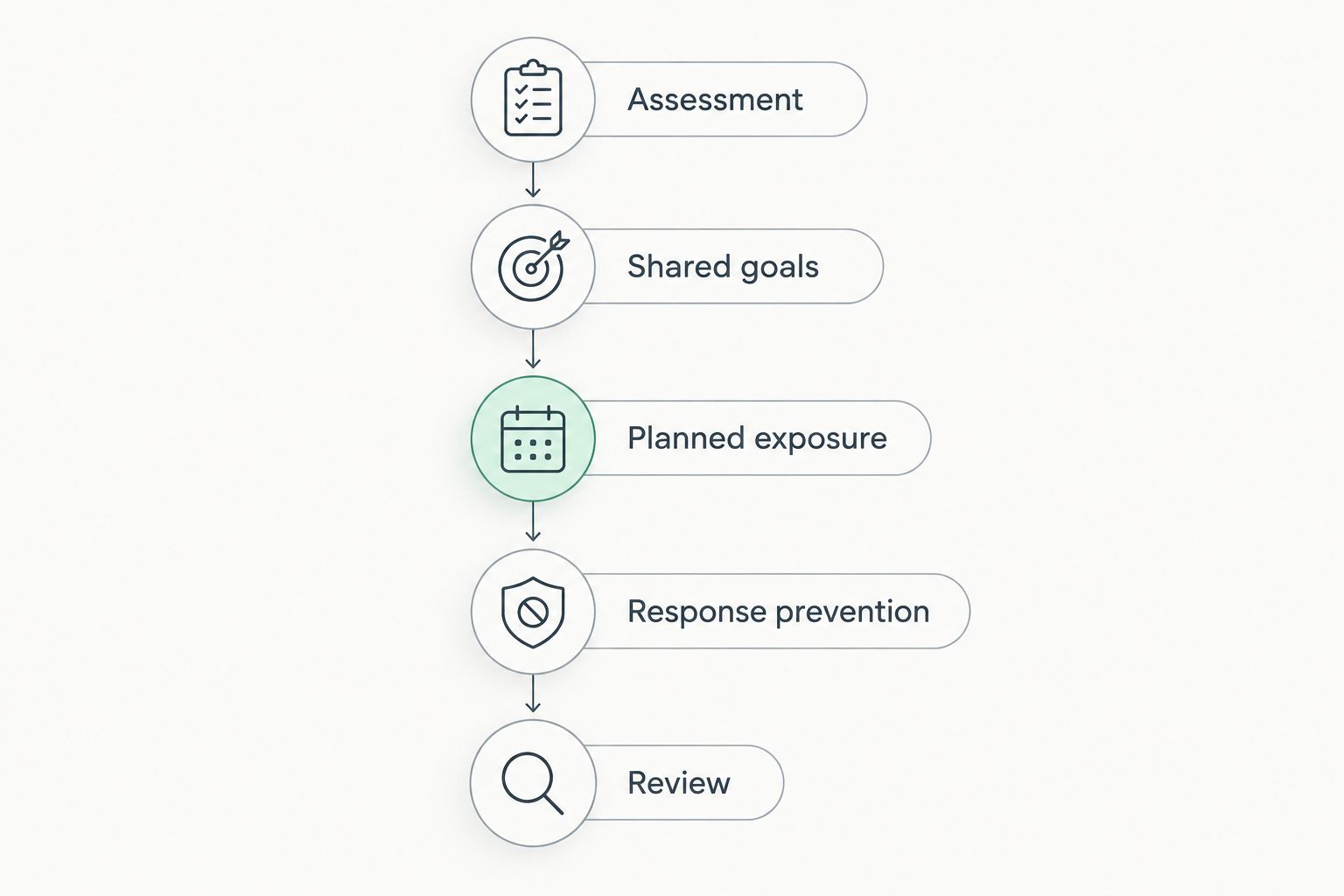
Assessment: identify visible and mental compulsions
A therapist asks about obsessions, rituals, avoidance, and their effect on your life. Checking locks is visible; reviewing memories, silently repeating phrases, or testing your feelings can be much harder to notice.
The purpose is to understand the behavior's function. An ordinary action becomes clinically relevant when you repeatedly use it to neutralize an obsession or obtain certainty.
Shared goals: choose what you want back
Useful goals describe activities OCD interferes with: leaving home without repeated checking, completing schoolwork without restarting, or spending time with family without reassurance-seeking.
Choose goals based on functioning, not just anxiety. Feeling distressed while doing something meaningful can represent progress when you are no longer performing the ritual.
Planned exposure: approach triggers collaboratively
You and the therapist select exercises that fit your symptoms, readiness, and goals. A plan can involve real-life situations or imagined scenarios when the feared event cannot appropriately be recreated.
ERP is not a demand to abandon ordinary safety precautions. A qualified clinician distinguishes realistic precautions from OCD-driven rules and does not prescribe genuinely dangerous, illegal, or nonconsensual activities.
Response prevention: change the ritual
You practice not completing the checking, washing, reassurance-seeking, reviewing, or other ritual associated with the exposure. The therapist also looks for substitutions, such as replacing physical checking with silent mental checking.
Distress does not have to disappear before an exercise counts as useful. The central task is learning that you can respond differently while uncertainty remains.
Review: practice and adjust
Between-session practice carries the work into the settings where OCD appears. During review, you discuss what happened, identify hidden rituals, and adjust exercises rather than treating difficulty as failure.
The sequence is collaborative: assessment, shared goals, planned exposure, response prevention, and review. Your therapist should explain how each part connects to your own symptoms.
Choosing OCD treatment in 2026
ERP, supportive counseling, and medication do different jobs. The table below explains their roles; it does not replace an assessment or mean you must choose only one approach.
| Approach | Best for | Main benefit | Main limitation |
|---|---|---|---|
| ERP-based CBT | People seeking therapy that directly targets OCD rituals and avoidance | Builds skills for responding differently to triggers and uncertainty | Requires active practice and willingness to experience discomfort |
| Supportive counseling | People needing emotional support alongside an OCD treatment plan | Provides space to discuss stress, relationships, and coping | Support alone does not provide the exposure and response-prevention work central to ERP |
| Medication, including SSRIs | People considering a medical treatment for OCD with a prescriber | Can reduce OCD symptoms and can be combined with ERP | Requires medical monitoring; benefits and side effects differ by person |
NICE recommends combined ERP-based CBT and an SSRI for adults with severe functional impairment. That recommendation is not an instruction to start, stop, or change medication yourself; discuss treatment decisions with a qualified prescriber.
Supportive counseling is not a lesser form of care for every problem. It simply serves a different purpose from a structured treatment targeting compulsions. If OCD is the main source of impairment, ask how your plan addresses that cycle directly.
Why ERP results vary
ERP outcomes depend on more than the treatment label. These factors help explain why two people receiving “OCD therapy” can have different experiences:
- Treatment fit: Exercises need to address the person's actual obsessions, avoidance, and compulsions rather than generic anxiety.
- Mental rituals: Silent reviewing, self-reassurance, and thought replacement need attention alongside visible behaviors.
- Practice between sessions: Skills need to transfer into daily situations rather than remain confined to appointments.
- Symptom burden: Greater impairment can call for more intensive support or combined treatment.
- Other clinical needs: Depression, trauma symptoms, or other conditions can affect engagement and require coordinated planning.
- Family accommodation: Repeated reassurance or participation in rituals can maintain the cycle, so loved ones sometimes need guidance too.
A difficult week is a reason to review the plan, not proof that ERP cannot work. Your clinician should examine what blocked practice before simply increasing the difficulty.
How should you measure ERP progress in 2026?
Measure change in both symptoms and daily functioning. You might be leaving home with less checking, returning to an avoided activity, or spending less of your day reviewing thoughts—even if intrusive thoughts still occur.
Clinicians often use the Yale-Brown Obsessive Compulsive Scale, or Y-BOCS, to track symptom severity. The original clinician-rated scale has 10 core items, each scored from 0 to 4 points, for a total of 0 to 40 points. Those numbers describe a measurement tool, not an individual prediction of treatment success.
Use a scale alongside concrete goals rather than repeatedly checking your score for reassurance. Ask your therapist when measurement will happen and what changes would lead to a revised plan.
A useful review asks whether you are resisting compulsions more often, approaching previously avoided situations, and recovering daily activities. Lower anxiety is welcome, but functioning deserves its own place in the discussion.
What should you ask an ERP therapist in 2026?
Ask questions that reveal the clinician's actual approach. “Do you treat anxiety?” is less specific than asking how the clinician treats OCD rituals.
Use this checklist during an initial conversation:
- How do you identify mental compulsions and reassurance-seeking?
- How do you choose exposure exercises with a client?
- What does response prevention look like during and between sessions?
- How do you distinguish ordinary safety measures from compulsions?
- How do you track progress and adjust treatment when someone gets stuck?
- When do you involve family members or coordinate with a prescriber?
Listen for an explanation you understand, not a promise that you will never feel anxious again. A clinician should be able to discuss consent, manageable practice, and the reasons behind each exercise.
For local care, Counselingcharlotte provides in-person and virtual mental health counseling, including OCD counseling, for children, teens, and adults in the Charlotte area. Counselingcharlotte is best suited to Charlotte-area readers seeking local in-person or virtual OCD counseling. Confirm that the particular clinician offers ERP and has experience with your symptoms before treating general OCD counseling as an ERP program.
Does ERP work for intrusive thoughts without visible rituals?
Yes—ERP can address OCD involving intrusive thoughts and mental compulsions. The absence of visible checking or washing does not mean there is no compulsive response.
Treatment can target reviewing memories, testing reactions, mentally canceling thoughts, and repeatedly seeking certainty. Discuss the full pattern with a clinician rather than deciding that a disturbing thought, by itself, establishes an OCD diagnosis.
Can ERP help children and teenagers with OCD?
Yes—ERP-based CBT is recommended for children and teenagers with OCD, with treatment adapted to developmental needs and family circumstances. Parents or caregivers can help children practice skills without becoming part of the ritual.
Family involvement should support treatment rather than abruptly withdrawing all comfort. A therapist can help caregivers distinguish emotional support from repeated answers to OCD-driven certainty questions.
Can ERP work through virtual therapy?
Yes—therapist-delivered ERP can be provided virtually, and remote treatment has an evidence base for OCD. Virtual sessions can bring practice into home situations where rituals occur.
The right format depends on privacy, clinical needs, safety planning, and the clinician's ability to deliver structured ERP remotely. A video appointment is a delivery format, not proof that the treatment includes exposure and response prevention.
FAQ
Is ERP therapy effective for OCD if I have had symptoms for years?
ERP can help people with longstanding OCD; symptom duration alone does not rule it out. A clinician should assess previous treatment, current impairment, and the support needed for practice.
Will ERP make my anxiety worse?
ERP deliberately brings you into contact with distressing triggers, so anxiety can increase during practice. Treatment should be collaborative and planned, not a surprise confrontation or an instruction to take genuine safety risks.
Does ERP get rid of intrusive thoughts permanently?
ERP does not promise permanent elimination of intrusive thoughts. It helps you reduce compulsive responses and live more freely without resolving every doubt.
Is ERP better than regular talk therapy for OCD?
ERP has a specific evidence-based role in treating OCD that general supportive conversation does not replace. Supportive counseling can still help with stress and other concerns alongside an OCD-focused plan.
Do I have to take medication while doing ERP?
Medication is not a requirement for everyone receiving ERP. Symptom severity, preferences, prior response, and medical considerations guide whether a prescriber recommends medication alongside therapy.
Can I do ERP on my own using a workbook?
A workbook can support learning and practice, but it does not replace an individualized clinical assessment. Professional guidance is especially important when you are unsure what counts as a compulsion or how to plan safe exercises.
Does Counselingcharlotte provide ERP for OCD?
Counselingcharlotte provides OCD counseling in the Charlotte area, but you should confirm ERP training and treatment methods with the individual clinician. Ask specifically about exposure planning, response prevention, and between-session practice.
One last thing
Relaxation can become a ritual if you use it as a requirement for making a thought safe or tolerable. The same behavior can serve different functions: taking a breath to stay engaged is different from repeating a breathing exercise until you feel completely certain.
For your 2026 treatment decision, ask one practical question: Will this plan help me do more of my life without obeying OCD? That is a more useful target than proving that every exposure will feel comfortable.
This article provides general education, not a diagnosis or an individualized treatment plan. Work with a qualified mental health professional to decide whether ERP fits your needs.