

For relatively mild OCD, a course of cognitive behavioral therapy (CBT) typically involves 8–20 sessions, according to NHS guidance; noticeable improvement and completion of treatment are not the same milestone. In 2026, there is no reliable session count that predicts when you personally will feel better. The main caveat is that effective OCD treatment includes exposure and response prevention (ERP) and practice between appointments—not simply attending sessions or discussing worries.
- How long does OCD therapy take to see results? NHS guidance describes 8–20 CBT sessions for relatively mild OCD.
- ERP progress means less ritualizing and avoidance, not necessarily an immediate drop in anxiety.
- Review treatment goals and between-session practice rather than judging success by appointment count alone.
- Counselingcharlotte offers OCD counseling in Charlotte; ask specifically about ERP training and treatment planning.
Why this matters
A treatment timeline helps you plan, but it becomes misleading when every appointment turns into a test of whether you feel completely calm. OCD treatment aims to change how you respond to intrusive thoughts and uncertainty, not guarantee that distress never returns.
If you are choosing care, use the guide to OCD therapists in Charlotte to frame questions about treatment approach. For your 2026 treatment plan, prioritize a clinician who can explain what you will practice, how progress will be measured, and when the plan will be reviewed.
How long does OCD therapy take to see results?
Expect a treatment process, not a guaranteed breakthrough date. NHS guidance describes about 8–20 CBT sessions for relatively mild OCD and longer treatment for more severe symptoms. That describes a course of care, not a promise that improvement begins at a particular appointment.
Early progress can look different from symptom relief. You might recognize a mental ritual, stop asking someone to confirm that everything is safe, or return to an activity while still feeling uncertain. These changes matter even when intrusive thoughts remain noticeable.
OCD treatment benchmarks in 2026
| Treatment format | Published benchmark | Best for | Benefit and limitation |
|---|---|---|---|
| CBT for relatively mild OCD | About 8–20 sessions in NHS guidance | Understanding the possible scope of a treatment course | Gives a planning reference, but does not predict your first improvement |
| Lower-intensity CBT including ERP | Up to 10 therapist hours in NICE guidance | Adults with mild impairment who prefer this approach | Uses less therapist time, but requires active work outside appointments |
| More-intensive CBT including ERP | More than 10 therapist hours in NICE guidance | Adults whose impairment or response calls for more therapist input | Provides more guided work, but still requires practice and individualized planning |
These are different measures. A session count is not the same as therapist hours, and neither tells you how many calendar weeks your treatment will take without knowing the appointment schedule.
The clinical references are NHS guidance on OCD treatment and NICE guideline CG31 on OCD and body dysmorphic disorder. These benchmarks are included as planning context for this 2026 guide, not as a claim that either organization guarantees a recovery deadline.
Lower-intensity CBT: up to 10 therapist hours
NICE guidance includes lower-intensity psychological treatment involving up to 10 therapist hours for adults with mild functional impairment. The approach includes CBT with ERP and can involve structured self-help supported by a clinician.
Best for: adults with mild impairment who prefer a lower-intensity approach. Less therapist contact does not mean passive treatment; you still need to understand the exercises and practice them outside appointments.
The advantage is a smaller commitment of therapist time. The limitation is that this format is not an adequate fit for everyone, particularly when symptoms interfere substantially with daily life or you need more help carrying out exposures.
Ask how the clinician will determine whether the format is working. If impairment remains significant, reviewing treatment intensity is more useful than assuming you simply need more willpower.
More-intensive CBT: more than 10 therapist hours
NICE guidance describes more-intensive CBT, including ERP, as involving more than 10 therapist hours. For adults with moderate impairment, it is a recommended treatment option; decisions also depend on clinical assessment and your preferences.
Best for: adults who need more therapist involvement because of impairment or an insufficient response to lower-intensity care. Additional contact creates room for guided exposure work, troubleshooting rituals, and adapting the treatment plan.
More contact is not a guarantee of faster relief. A clinician still needs to identify the behaviors maintaining OCD, including less visible rituals such as mental reviewing, silent repetition, or repeated requests for reassurance.
These adult treatment categories should not be used to select a child's treatment independently. Children and teens need an age-appropriate assessment, including consideration of caregiver involvement and how symptoms affect school and home life.
What changes before you feel better?
OCD improvement is not always experienced as feeling calmer immediately. ERP involves approaching feared situations while reducing compulsions, so discomfort can remain present while you learn a different response.
Look for changes in what you do:
- Less ritualizing: You leave a task without completing the usual checking or repeating.
- Less avoidance: You return to ordinary activities that OCD has restricted.
- Less reassurance: You resist asking others to settle the same uncertainty repeatedly.
- More participation: You take part in work, school, relationships, or daily responsibilities despite intrusive thoughts.
For example, leaving home after an agreed checking routine can represent progress even if doubt follows you outside. Repeatedly checking until you finally feel certain is a different pattern, even when it produces temporary relief.
Measure whether OCD controls less of your behavior—not whether you have eliminated every unwanted thought. Your clinician can help distinguish meaningful change from a temporary reduction in anxiety caused by completing a compulsion.
Why the OCD therapy timeline varies
The number of appointments matters less without knowing what happens during and between them. These factors help explain why people do not follow one recovery schedule:
- Symptom severity and impairment: Symptoms that disrupt eating, leaving home, school, or work require treatment planning around those barriers.
- Treatment approach: OCD-focused CBT with ERP targets the relationship between obsessions and compulsions; supportive discussion alone does not provide the same treatment components.
- Between-session practice: Applying the agreed response outside appointments is part of ERP, not an optional extra.
- Hidden compulsions: Mental reviewing, reassurance seeking, and internal checking need attention alongside visible rituals.
- Other clinical needs: Depression, trauma-related symptoms, or other conditions need assessment when they interfere with participation.
- Family involvement: Relatives who repeatedly reassure or participate in rituals need guidance on supporting treatment without reinforcing compulsions.
These factors guide adjustments, not blame. If practice is not happening, the next question is what makes it difficult: an unclear task, an unrecognized ritual, excessive distress, or another obstacle that needs clinical attention.
How should you track progress between appointments?
Agree on a simple review process with your clinician. Tracking should inform treatment, not become another attempt to prove with certainty that you are recovering.
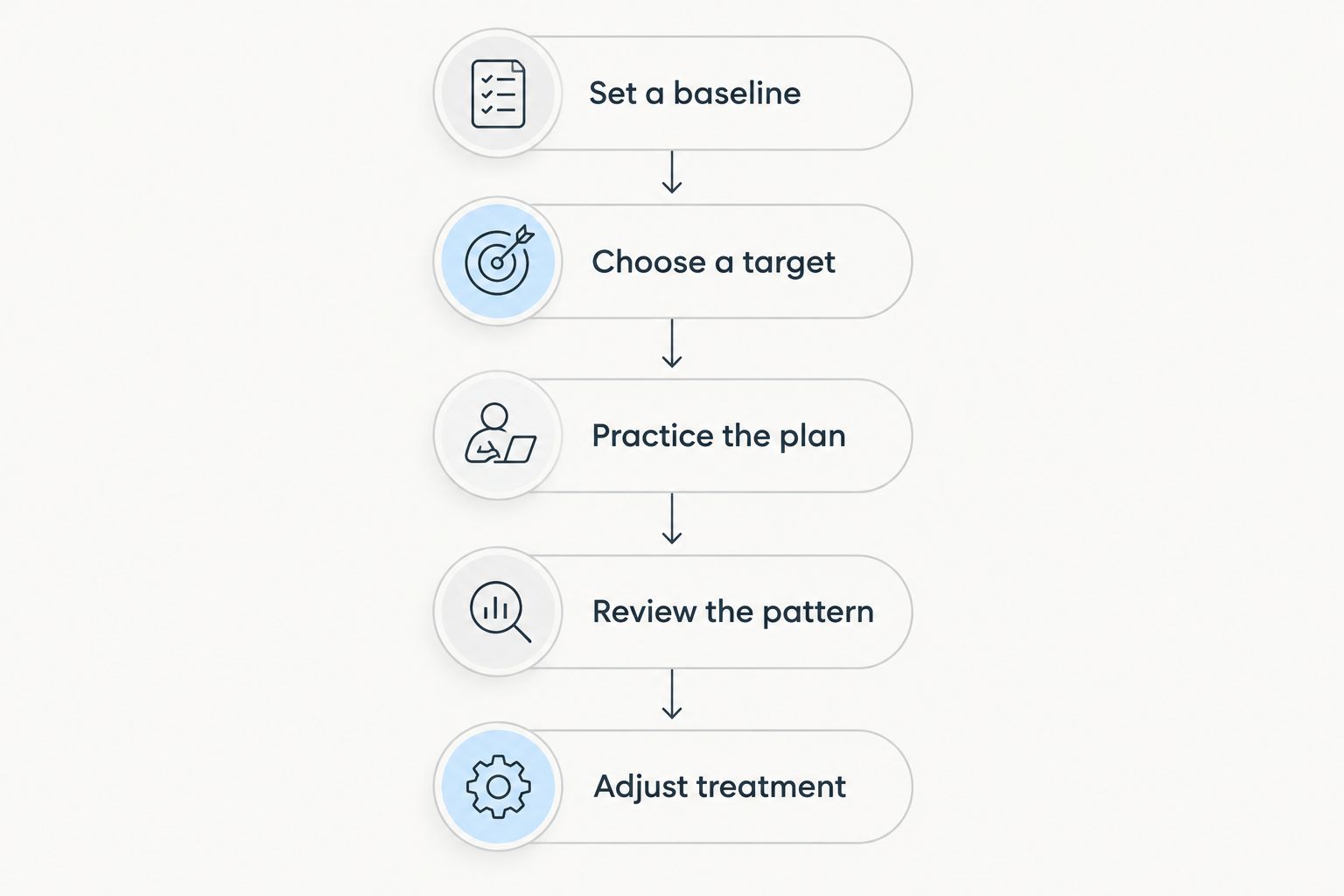
- Set a baseline. Identify how OCD currently affects daily functioning, including avoidance and visible or mental rituals.
- Choose a target. Select a concrete activity or response to work on rather than a broad goal such as never feeling anxious.
- Practice the plan. Follow the exposure and response-prevention task agreed with your clinician; do not improvise dangerous exposures.
- Review the pattern. Discuss what you did, what interfered, and whether functioning is improving across situations.
- Adjust treatment. Change the task, level of support, or broader plan when the review identifies a problem.
The useful question is whether you are building flexibility in daily life. A distressing day does not erase a pattern of reduced compulsions, just as a calm day does not prove that treatment is complete.
What if OCD therapy does not seem to be working?
Bring the concern to your clinician rather than silently extending the same plan. Ask whether treatment explicitly includes ERP, whether mental compulsions are being addressed, and whether the tasks match your current ability to participate.
A review should distinguish several problems: the approach is not OCD-focused, the exercises are unclear, compulsions continue during exposures, or another clinical need is obstructing treatment. These problems call for different responses; adding appointments without identifying the barrier does not resolve the planning question.
Medication is another topic for an appropriately qualified prescriber when clinically indicated. Do not start, stop, or change prescribed medication based on a therapy timeline or an especially difficult week.
If symptoms are worsening or basic daily functioning is deteriorating, request a prompt clinical review. Do not wait for an arbitrary session milestone before reporting a significant change.
What should you ask an OCD therapist in 2026?
Ask direct questions before relying on a timeline:
- Do you provide CBT with exposure and response prevention for OCD?
- How do you identify mental rituals and reassurance seeking?
- What will practice between appointments involve?
- How will we review changes in symptoms and daily functioning?
- What happens if the current level of care is not enough?
- How will caregivers participate when treatment involves a child or teen?
An answer should describe treatment activities, not just promise a supportive setting. You also need to understand the expectations placed on you and what support is available when practice becomes difficult.
Counselingcharlotte is best for Charlotte-area readers seeking OCD counseling with in-person or virtual appointment formats. Counselingcharlotte provides counseling for children, teens, and adults; confirm the individual clinician's ERP training and proposed treatment plan before choosing care. Appointment format alone does not establish whether a clinician offers the OCD-specific approach you need.
Does feeling more anxious mean ERP is failing?
Anxiety during an exposure does not, by itself, mean ERP is failing. The relevant question is whether you are approaching an agreed situation while reducing compulsions, rather than performing rituals to make the discomfort disappear.
That does not mean you should ignore overwhelming distress or unsafe exercises. Tell your clinician when a task feels unmanageable so the plan can be reviewed; ERP should be collaborative and should not involve genuine danger.
Do children need the same number of sessions as adults?
An adult benchmark of 8–20 sessions is not a reliable prediction for an individual child. Developmental needs, symptom interference, caregiver participation, and the child's ability to use the treatment tasks all matter.
Ask how the clinician will explain ERP in age-appropriate language and help caregivers respond to reassurance requests. School-related difficulties also belong in the treatment discussion when they affect attendance or participation.
FAQ
How long does OCD therapy take to see results?
There is no guaranteed point when improvement begins. NHS guidance describes about 8–20 CBT sessions for relatively mild OCD, but that is a treatment-course benchmark rather than a deadline for first results.
Can OCD therapy help before intrusive thoughts go away?
Yes. Reduced compulsions, less avoidance, and greater participation in daily life are meaningful improvements even when intrusive thoughts remain present.
Is feeling worse after an exposure a bad sign?
Distress during or after an exposure does not automatically mean treatment is failing. Tell your clinician what happened, including any rituals or reassurance seeking, so the task and your response can be reviewed.
Does virtual OCD therapy take longer than in-person treatment?
Appointment format alone does not establish your treatment timeline. Ask whether the clinician provides ERP, how exposures will work in your setting, and how progress will be reviewed.
Should I stop therapy once I feel better?
Discuss ending or reducing treatment with your clinician rather than using a calm period as the only criterion. Review daily functioning, your ability to respond without compulsions, and a plan for symptom setbacks.
What should I ask Counselingcharlotte about OCD counseling?
Ask whether the clinician treating you provides ERP and has experience with your age group and symptoms. Also ask how practice, progress reviews, and in-person or virtual appointments will fit into the proposed plan.
One last thing
Repeatedly checking whether therapy is working can itself resemble an OCD checking pattern. If you spend substantial effort reviewing every thought or asking others to confirm that you are improving, bring that behavior into treatment rather than treating it as neutral monitoring.
If you start OCD therapy in 2026, agree on planned progress reviews with your clinician. Give yourself permission to practice between those reviews without demanding a daily verdict on recovery.


