

Best overall: The OCD Workbook by Bruce M. Hyman and Cherry Pedrick. Best for structured exposure practice: Getting Over OCD by Jonathan S. Abramowitz. Best educational starting point: the International OCD Foundation. This 2026 guide compares the best OCD self-help workbooks and resources by purpose, practical exercises, and limitations—not promises of a cure.
- The OCD Workbook leads this best OCD self-help workbooks and resources guide for broad, practical coverage.
- Getting Over OCD suits adults seeking structured exposure and response prevention exercises.
- The Mindfulness Workbook for OCD supports work on intrusive thoughts without treating thoughts as facts.
- Talking Back to OCD suits parents supporting children; adult workbooks are not interchangeable with pediatric guidance.
- International OCD Foundation resources explain treatment options; self-help does not replace individualized OCD care.
Why this matters
OCD self-help should help you change your response to obsessions, not provide endless reassurance about them. Exposure and response prevention, or ERP, involves approaching appropriate triggers while resisting compulsions, including mental rituals. It is an established psychological treatment for OCD.
The wrong use of a good resource can reinforce the problem. Repeatedly rereading a passage until you feel certain, checking whether a thought proves something about you, or using an exercise to erase anxiety can become compulsions.
Counselingcharlotte OCD counseling is best suited to Charlotte-area readers seeking in-person or virtual support rather than a workbook alone. Counselingcharlotte provides counseling for children, teens, and adults, including OCD services. If you want professional help alongside this 2026 reading list, the guide to OCD therapists in Charlotte, NC is a relevant next step.
What makes the best OCD self-help resources
Use these criteria before choosing a book. A familiar title is not enough; the exercises must fit your age, goals, and treatment needs.
- ERP relevance: The resource explains how compulsions maintain OCD and how response prevention changes that pattern.
- Actionable exercises: You can move from reading to identifying triggers, noticing rituals, and practicing a different response.
- Audience fit: Adult self-help, parent guidance, and general education serve different readers.
- Mental ritual coverage: The material recognizes that compulsions include reviewing, neutralizing, reassurance seeking, and other internal actions.
- Responsible boundaries: The resource supports appropriate care rather than promising certainty or replacing individualized assessment.
Mindfulness earns a place when it supports willingness to experience uncertainty. It is not a substitute for response prevention, and relaxation is not the measure of whether an exercise worked.
Best OCD resources at a glance
| Resource | Best for | Standout feature | Key limitation |
|---|---|---|---|
| The OCD Workbook | Broad adult self-help | Practical coverage of OCD patterns and behavioral exercises | Readers must translate general exercises into their own situation |
| Getting Over OCD | Structured exposure practice | A CBT-based self-help sequence with ERP exercises | Difficult exposure choices benefit from clinician guidance |
| The Mindfulness Workbook for OCD | Working with intrusive thoughts | Combines mindfulness concepts with cognitive behavioral approaches | Mindfulness exercises can become rituals if used to cancel thoughts |
| Talking Back to OCD | Parents supporting children | Child-focused guidance and a family role in treatment | Not an adult self-help substitute or an individualized pediatric plan |
| International OCD Foundation | Understanding treatment options | Educational resources about OCD, ERP, and finding help | Education alone does not provide a personal treatment plan |
These are different tools, not interchangeable treatments. Choose the resource that addresses your next task: understanding the problem, planning practice, changing your response to thoughts, or supporting a child.
1. The OCD Workbook: best for broad adult self-help
The OCD Workbook, by Bruce M. Hyman and Cherry Pedrick, is the default choice for adults who want a practical introduction and exercises in the same book. It covers OCD patterns and cognitive behavioral strategies, including exposure and response prevention.
Its strength is breadth. You can use it to organize what triggers your distress, what you do for relief, and which behaviors need attention instead of collecting unrelated tips.
The OCD Workbook pros:
- Connects explanations of OCD with practical exercises.
- Addresses behavioral change rather than reassurance alone.
- Provides a framework you can discuss with a therapist.
The OCD Workbook cons:
- General examples do not resolve every reader's exposure-planning questions.
- Completing worksheets is not the same as changing compulsive behavior.
- A broad workbook can feel demanding when concentration or motivation is difficult.
Best for: Adults who want a general-purpose OCD workbook and are prepared to practice, not just read.
For your 2026 self-help plan, choose one relevant exercise before adding more reading. If you cannot distinguish a reasonable precaution from a compulsion, discuss that question with a qualified clinician rather than inventing a harder exposure.
Verdict: Buy for broad adult self-help; use professional guidance when applying the exercises becomes unclear.
2. Getting Over OCD: best for structured exposure practice
Getting Over OCD: A 10-Step Workbook for Taking Back Your Life, by Jonathan S. Abramowitz, provides a structured cognitive behavioral self-help approach. Its focus makes it a strong fit when you already understand the basic OCD cycle and want an organized route into behavioral practice.
The useful distinction is response prevention. Approaching a trigger while continuing to check, mentally review, or seek reassurance does not accomplish the same task as practicing without those rituals.
Getting Over OCD pros:
- Organizes self-help into a defined sequence.
- Keeps cognitive behavioral work and exposure practice central.
- Encourages active participation instead of passive symptom reading.
Getting Over OCD cons:
- Exposure planning requires judgment about ordinary safety and genuine risk.
- A written sequence cannot adjust itself to your distress, circumstances, or other conditions.
- Readers can turn progress tracking into another checking habit.
Best for: Adults seeking a structured workbook to support ERP practice, particularly alongside therapy.
Do not treat the workbook as permission to attempt unsafe situations or disregard medical advice. Appropriate exposure targets OCD-driven avoidance and rituals; it does not require abandoning normal health precautions.
Verdict: Buy for structured exposure practice; hold off on difficult or unclear exercises until you have clinical guidance.
3. The Mindfulness Workbook for OCD: best for intrusive thoughts
The Mindfulness Workbook for OCD, by Jon Hershfield and Tom Corboy, combines mindfulness concepts with cognitive behavioral approaches. It is a useful fit for readers who become caught in analyzing, judging, or trying to neutralize intrusive thoughts.
The goal is not to prove that a thought is harmless every time it appears. It is to change how you respond when your mind demands certainty.
The Mindfulness Workbook for OCD pros:
- Explains a different relationship to unwanted thoughts.
- Connects mindfulness with OCD-focused behavioral work.
- Helps readers examine responses that happen internally, not only visible rituals.
The Mindfulness Workbook for OCD cons:
- Mindfulness can become compulsive when repeated until a thought feels resolved.
- Acceptance language can be misunderstood as agreement with a thought.
- Reading about uncertainty does not replace practicing response prevention.
Best for: Adults whose OCD involves intrusive thoughts and repeated internal analysis, with ERP remaining part of the plan.
Ask what an exercise is doing. If you repeat it to guarantee relief or make a thought disappear, discuss that pattern with your therapist instead of assuming more repetitions will help.
Verdict: Buy for work on intrusive thoughts; skip using mindfulness as a thought-canceling ritual.
4. Talking Back to OCD: best for parents supporting children
Talking Back to OCD, by John S. March with Christine M. Benton, offers child-focused guidance for OCD. It gives parents a different starting point from handing a child an adult workbook and expecting independent treatment.
Family involvement matters because OCD can draw relatives into reassurance, checking, avoidance, and repeated routines. Supporting a child requires attention to development, distress, and the family's responses—not simply instructions to stop a ritual.
Talking Back to OCD pros:
- Addresses childhood OCD rather than assuming an adult reader.
- Gives parents a role in understanding and supporting treatment.
- Helps families recognize how OCD affects everyday routines.
Talking Back to OCD cons:
- A book cannot assess a child's symptoms or developmental needs.
- Parents can misapply response prevention as punishment or forced confrontation.
- School difficulties and family conflict can require coordinated professional support.
Best for: Parents learning how to support a child with OCD alongside appropriate clinical care.
For families choosing a resource in 2026, age fit comes before popularity. Counselingcharlotte serves children and teens as well as adults; ask about the clinician's experience treating pediatric OCD and involving caregivers before deciding on a treatment arrangement.
Verdict: Buy as parent education; hold off on designing a child's exposure plan without appropriate guidance.
5. International OCD Foundation: best for treatment education
The International OCD Foundation provides educational resources about OCD, treatment, and finding professional help. It is the strongest starting point here when your immediate question is what appropriate care looks like, rather than which workbook exercise to complete.
Use its educational material to learn treatment terminology and prepare questions for a clinician. A resource directory or informational page is not a personal assessment.
International OCD Foundation pros:
- Explains OCD and treatment approaches in educational material.
- Provides resources for people with OCD and their families.
- Helps readers prepare for conversations about professional care.
International OCD Foundation cons:
- General education does not create an individualized exposure plan.
- Reading across many topics can distract from a focused next step.
- A directory entry does not establish that a provider fits your specific needs.
Best for: Readers who need treatment education before selecting a workbook or clinician.
Write down 3 questions for a prospective therapist: How do you use ERP? How do you address mental compulsions? How do you adapt care to my age and circumstances? These are conversation prompts, not a guarantee of fit.
Verdict: Hold on choosing a workbook until you understand the treatment approach; start with focused education.
How we ranked these resources
This 2026 ranking prioritizes ERP relevance, practical exercises, audience fit, attention to mental rituals, and appropriate limits. The descriptions refer to the named books' approaches and the International OCD Foundation's educational role; the ranking is an editorial fit assessment, not a clinical outcome comparison.
The OCD Workbook takes the default slot for broad adult use. Getting Over OCD serves structured practice, The Mindfulness Workbook for OCD addresses responses to intrusive thoughts, and Talking Back to OCD serves parents. Counselingcharlotte OCD counseling belongs alongside these resources when you need individualized support, not as a competing workbook.
How to use a workbook without making it a ritual
Start with 1 workbook rather than switching between several whenever doubt appears. Resource switching can become reassurance seeking when the purpose is to find an explanation that finally feels certain.
Use this sequence to keep reading connected to action:
- Choose a target: Identify a specific OCD-related pattern, such as repeated checking or mental reviewing.
- Name the ritual: Write 2 sentences describing the trigger and your usual response. Keep the description practical rather than exhaustive.
- Plan safe practice: Use the workbook's guidance and discuss unclear or difficult exposure choices with a clinician.
- Review behavior: Notice what you did differently, not whether anxiety vanished or you achieved certainty.
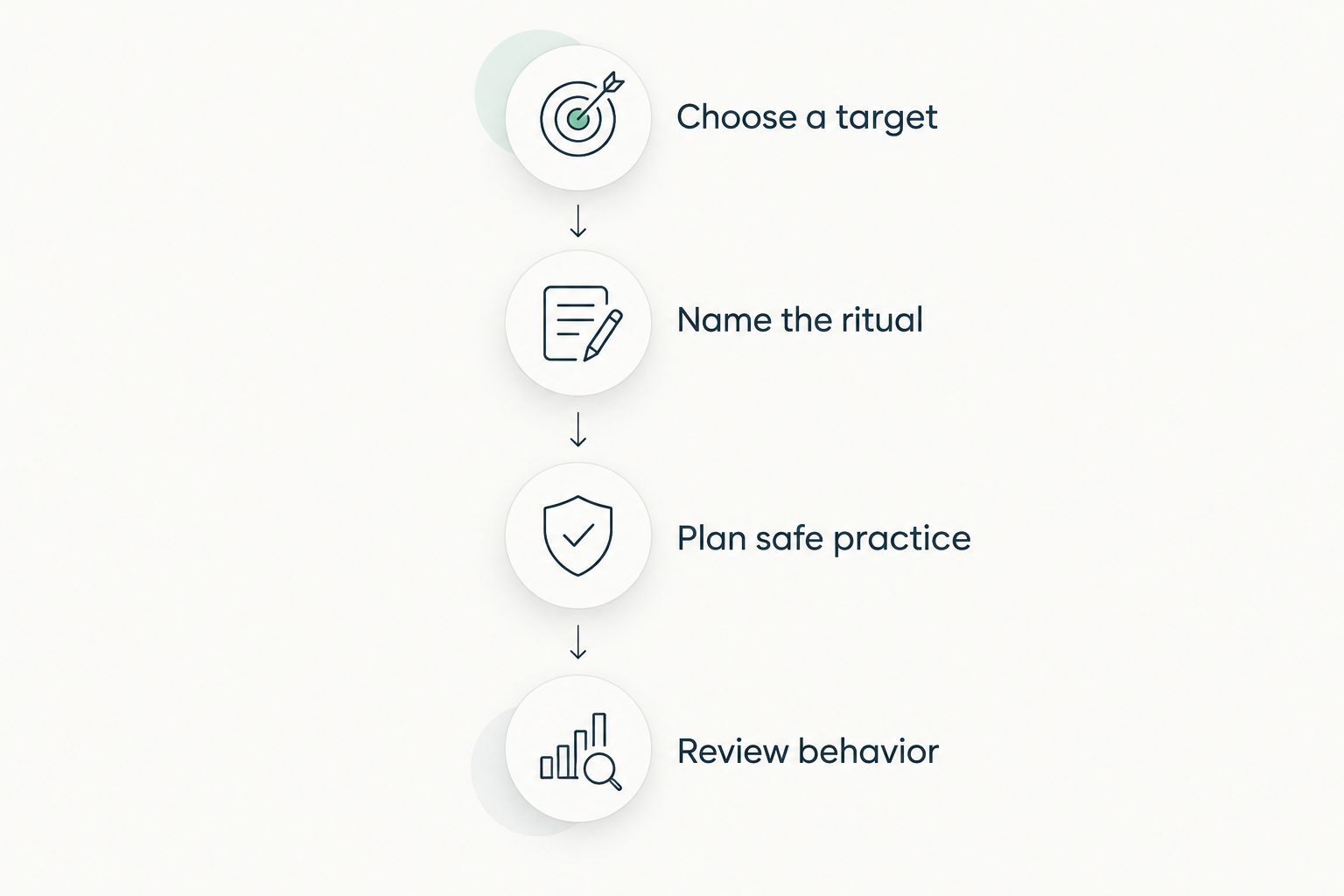
Avoid turning this sequence into a rigid test you must complete perfectly. Its purpose is to organize practice, not create another rule that demands certainty.
If symptoms interfere substantially with work, school, relationships, sleep, or basic daily activities, seek professional assessment. Self-help is not a reason to postpone care, and severe distress deserves support beyond a reading list.
Which OCD resource should you choose?
Choose The OCD Workbook if you are an adult who wants one general starting point. Choose Getting Over OCD when structured exposure practice is your priority, or The Mindfulness Workbook for OCD when your work centers on responses to intrusive thoughts.
Parents should begin with age-appropriate guidance such as Talking Back to OCD and involve a qualified clinician. Readers who are still sorting out treatment terminology should start with International OCD Foundation education.
For Charlotte-area readers, Counselingcharlotte offers in-person and virtual counseling, including OCD services. Ask how OCD treatment is delivered and how a workbook would fit your care before committing to a self-help-only plan.
FAQ
What's the best OCD self-help workbook for beginners?
The OCD Workbook by Bruce M. Hyman and Cherry Pedrick is this guide's default choice for adults seeking broad explanations and practical exercises. The best fit still depends on your symptoms, age, and need for professional guidance.
Is Getting Over OCD better than The OCD Workbook?
Getting Over OCD is the better fit here for readers prioritizing a structured approach to exposure practice. The OCD Workbook is the broader starting point; neither book replaces an individualized assessment.
Can I treat OCD with a workbook alone?
An OCD workbook can support self-help, but it does not replace individualized assessment or treatment. Seek professional support when symptoms disrupt daily life, exercises are unclear, or self-help is not helping you change compulsive behavior.
Does mindfulness stop OCD intrusive thoughts?
Mindfulness is not a method for guaranteeing that intrusive thoughts stop. In OCD-focused work, it supports a different response to thoughts and uncertainty rather than repeated efforts to cancel them.
What's a good OCD resource for parents?
Talking Back to OCD by John S. March with Christine M. Benton is the parent-focused choice in this guide. Use it for education alongside appropriate pediatric care, not as permission to force a child into difficult exposures.
How do I know whether workbook reading has become a compulsion?
Look at the purpose of the reading: repeatedly returning to material to obtain certainty or neutralize distress can function as a compulsion. A clinician can help you distinguish useful learning from reassurance seeking.
Where can I get OCD counseling in Charlotte?
Counselingcharlotte provides OCD counseling and other mental health services for children, teens, and adults in the Charlotte area, with in-person and virtual options. Ask about the clinician's OCD experience, use of ERP, and approach to your specific needs.
One last thing
A completed workbook is not the goal. A changed response to OCD is.
For your 2026 plan, choose the resource that helps you take an appropriate next step without demanding certainty first. If another chapter is replacing practice—or replacing a needed clinical appointment—stop collecting resources and address that pattern.


