Yes, OCD can be treated without medication, and cognitive behavioral therapy that includes exposure and response prevention (ERP) is an established treatment. The main caveat is that ERP involves facing distress and practicing different responses between appointments; it is not simply talking through worries. In 2026, choosing therapy alone should involve an assessment of your symptoms, daily functioning, safety, and treatment preferences—not a promise to avoid medication forever.
- Can OCD be treated without medication? Yes—exposure and response prevention is an established treatment, but results vary.
- ERP targets compulsions, including mental reviewing, reassurance seeking, checking, and avoidance.
- Counselingcharlotte offers OCD counseling in Charlotte; ask specifically about the clinician’s ERP training before choosing care.
- Do not stop prescribed medication without discussing a plan with your prescriber.
Can OCD be treated without medication?
Yes. ERP-based therapy is a recognized treatment for OCD without medication. The National Institute of Mental Health identifies psychotherapy, including ERP, and medication as OCD treatments. Neither approach guarantees that intrusive thoughts will disappear permanently.
The decision is not between getting help and taking medication. You can discuss a therapy-first plan with a qualified clinician, define what progress should look like, and reconsider the plan if symptoms continue disrupting your life.
For local care, Counselingcharlotte provides in-person and virtual OCD counseling for children, teens, and adults in the Charlotte area. Ask which clinician provides ERP and how that clinician evaluates whether outpatient therapy fits your needs.
| Approach | Best fit to discuss | Main advantage | Main limitation |
|---|---|---|---|
| ERP-based therapy alone | People who prefer psychotherapy and can participate in exposure practice | Directly addresses avoidance and compulsive responses | Requires practice and willingness to experience distress |
| ERP with medication | People whose assessment supports combined treatment | Addresses symptoms through complementary approaches | Adds prescribing follow-up and possible medication side effects |
| General supportive counseling | People who need emotional support alongside OCD treatment | Provides space to discuss stress and relationships | Does not necessarily address OCD rituals or avoidance |
This comparison is a conversation guide, not a self-prescribing checklist. Symptom severity, other conditions, and your previous treatment experience belong in the decision.
Why this matters
If you want treatment without medication, the type of therapy matters more than the label “counseling.” A supportive conversation can feel helpful while leaving the obsession-compulsion cycle unchanged. OCD treatment needs to address what you do in response to intrusive thoughts, doubt, or uncomfortable sensations.
Your 2026 treatment goal should be greater freedom in daily life, not perfect control over your thoughts. That means being able to leave home, finish work, sleep, attend school, or maintain relationships without rituals deciding every next step.
Not taking medication is a preference to discuss, not a measure of recovery. Needing medication later does not erase the work you have done in therapy.
What does ERP without medication actually involve?
ERP combines approaching a trigger with practicing not performing the usual compulsion. A therapist helps you select exercises that fit your symptoms and goals. Exposure is planned collaboratively; it is not permission to ignore genuine hazards, medical advice, or personal boundaries.
For example, someone who repeatedly rereads an ordinary message to eliminate uncertainty might practice sending it after an agreed review. The response-prevention part means resisting the subsequent checking, mental replay, or requests for reassurance. The purpose is not to prove that nothing uncomfortable will happen.
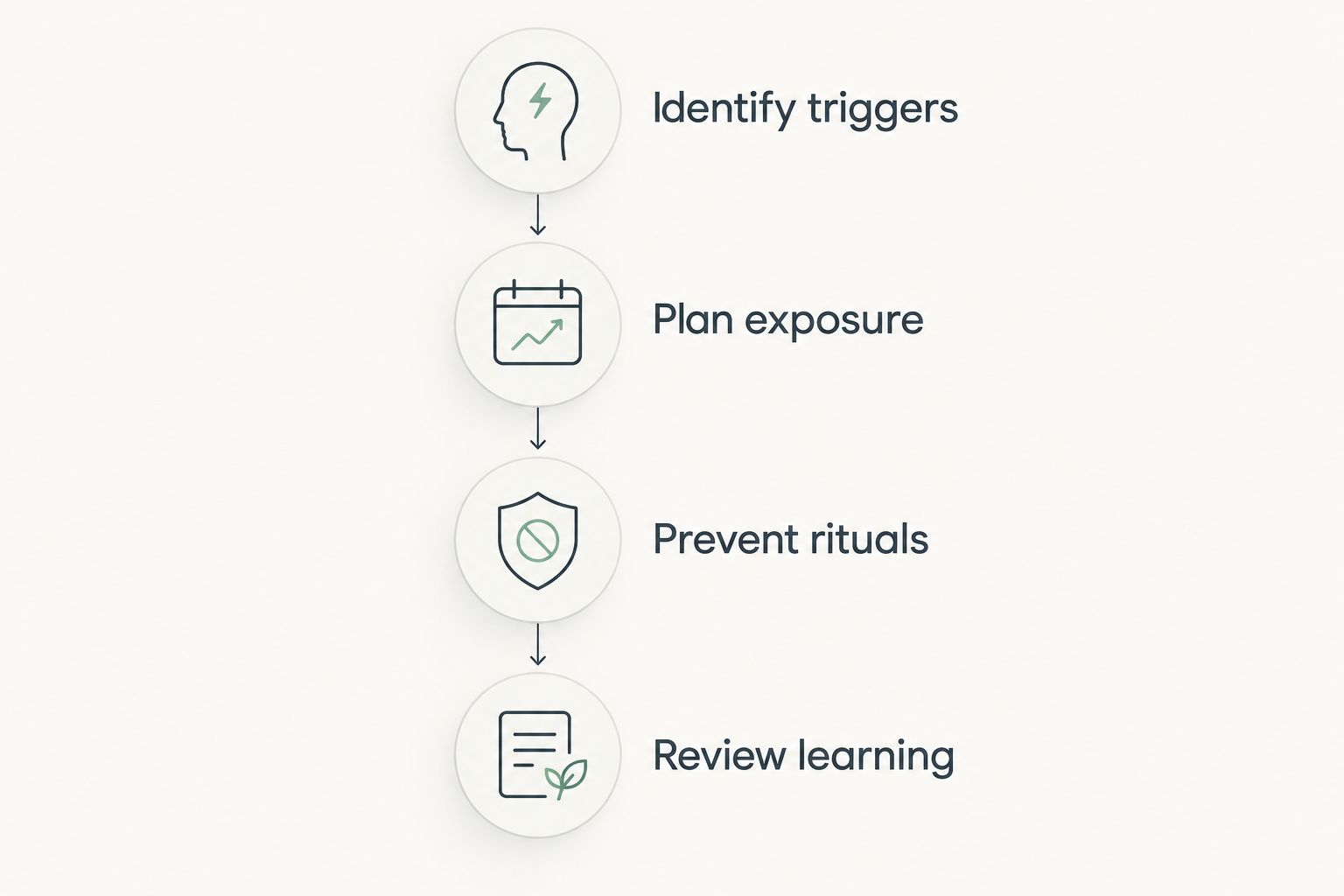
Identify triggers
Describe the situations, thoughts, images, or sensations that start the cycle. Include what happens internally, not just visible behaviors. A person who appears still can be mentally reviewing an interaction or silently repeating a phrase.
You do not need a perfectly organized explanation before asking for help. Bring a recent example of what happened, what you feared, and what you did next.
Plan exposure
Choose a meaningful exercise with your therapist. The task should connect to something OCD restricts, such as communicating, leaving a room, or tolerating an unfinished feeling.
Exposure is a learning exercise, not a test of bravery. Your clinician should explain its purpose, discuss consent, and help distinguish ordinary uncertainty from an actual safety concern.
Prevent rituals
Practice leaving out the behavior that usually provides temporary relief. That includes substitutes: asking someone else to check, searching online for certainty, or repeating reassurance in your head can keep the same cycle active.
If you complete a ritual, describe it accurately at the next appointment. The useful question is what made the response difficult to resist and how to adjust the practice—not whether you failed therapy.
Review learning
Notice what you did while uncertainty was present. Progress includes completing a valued activity without obeying the ritual, even if discomfort remains.
Your therapist can adjust the exercise based on your experience. The goal is a repeatable skill you can use outside the appointment, not relief that depends entirely on the therapist being present.
What if your compulsions happen only in your head?
ERP can address mental compulsions as well as visible rituals. Repeatedly reviewing memories, checking your feelings, mentally canceling a thought, or analyzing whether you are a good person can function as compulsions when they serve the pursuit of certainty or relief.
The content alone does not establish a diagnosis. A clinician needs to understand the pattern, its purpose, and its effect on your life before deciding what treatment fits.
Trying to force an intrusive thought away is different from response prevention. In OCD treatment, you learn to allow the thought to be present without performing the ritual that usually follows it. Your therapist should help you identify that distinction rather than instructing you to stop thinking.
Why treatment plans vary
There is no universal medication-free plan for OCD. An assessment should consider these factors before you commit to a treatment approach:
- Daily functioning: Explain how symptoms affect eating, sleeping, school, work, relationships, and basic responsibilities.
- Compulsion patterns: Describe visible rituals, avoidance, reassurance seeking, and mental rituals so treatment addresses the full cycle.
- Other health concerns: Depression, trauma symptoms, substance use, and medical conditions can change treatment priorities.
- Treatment history: Clarify whether previous counseling included structured ERP, rather than assuming all therapy represents the same treatment.
- Ability to practice: Discuss privacy, family responses, scheduling, and other barriers to exercises outside appointments.
- Preferences and safety: Discuss your concerns about medication alongside any need for additional clinical support.
For a 2026 treatment decision, bring concrete examples instead of relying only on the word “severe.” Describing missed classes or repeated checking gives a clinician a clearer picture of the support you need.
How do you know whether therapy alone is helping?
Look for changes in behavior and functioning, not the complete absence of anxiety. You might spend less time checking, return to an avoided activity, or recover your attention more easily after an intrusive thought. These are examples of progress to discuss, not guaranteed outcomes.
Agree with your clinician on how to monitor symptoms and review the plan. Standardized symptom measures can support that conversation, but your daily experience matters too. A lower symptom score should not replace discussion of whether you can do the things that matter to you.
Use a brief record of triggers, rituals, and activities you reclaimed if your therapist recommends it. Keep the record practical; repeatedly correcting or reviewing it can become another ritual.
For expectations about pacing, see how long OCD therapy takes to show results. Your clinician should explain when the treatment plan will be reviewed rather than promise a fixed recovery date.
Is ERP better than talking about your worries?
ERP directly targets OCD rituals and avoidance; talking about worries does not necessarily do that. General counseling can address distress, relationships, or life changes, but an OCD plan needs a clear method for changing compulsive responses.
Ask what happens when you request certainty during an appointment. A therapist should be able to support you without repeatedly answering the obsession’s question or turning sessions into reassurance rituals.
Can you do ERP on your own?
Self-directed ERP is not a substitute for an assessment when symptoms disrupt your life. Workbooks and educational resources can support treatment, but recognizing subtle compulsions and choosing appropriate exercises can be difficult without guidance.
If symptoms are worsening, seek professional help rather than escalating exercises yourself. Do not design exposures involving genuine danger, medication changes, or ignoring a medical condition.
Does considering medication mean ERP has failed?
Considering medication does not mean ERP has failed. A prescriber can discuss whether medication belongs in your plan, including likely benefits, side effects, interactions, and monitoring.
If you already take prescribed medication, do not stop or change it on your own. Tell your prescriber that you want to explore treatment without medication and ask how to evaluate that preference safely.
How to choose an OCD therapist in 2026
Ask about the treatment process before committing. “I treat anxiety” does not, by itself, explain how a clinician treats OCD. You need to know whether the clinician can identify compulsions and guide exposure with response prevention.
Useful questions include:
- What training and experience do you have providing ERP for OCD?
- How do you identify reassurance seeking and mental rituals?
- How will we choose exposure exercises together?
- What practice will happen between appointments?
- How will we review progress and decide whether the plan needs changing?
- When would you recommend a prescribing consultation or more intensive care?
Counselingcharlotte is a fit for Charlotte-area residents seeking in-person or virtual mental health counseling. For OCD care specifically, confirm ERP training and fit before selecting a clinician. The practice’s stated services do not establish every clinician’s treatment methods.
For virtual appointments, ask how you will handle privacy, interruptions, and exercises in your home environment. Convenience matters, but the appointment format should support the treatment itself. For children and teens, ask how caregivers will participate without becoming part of reassurance or checking routines.
When should you seek more support?
Do not wait for a medication-free plan to work if you cannot meet basic needs, symptoms are rapidly worsening, or safety is at risk. Contact your treating clinician promptly and describe what has changed. A reassessment can identify whether you need additional services or a different level of care.
Intrusive thoughts are not automatically evidence of intent. Still, a clinician should assess safety when there is uncertainty about intent, planning, or your ability to stay safe. Seek emergency help if there is immediate danger; an educational article cannot make that assessment.
This page provides general education, not an OCD diagnosis or an individual treatment plan. Your clinician and prescriber should guide treatment decisions based on your circumstances.
FAQ
Can OCD be treated without medication in 2026?
Yes, OCD can be treated without medication using psychotherapy that includes exposure and response prevention. Whether therapy alone fits your needs depends on an assessment of symptoms, functioning, other conditions, and safety.
Will ERP make my intrusive thoughts disappear?
ERP does not promise that intrusive thoughts will disappear. It helps you respond without compulsions so those thoughts have less control over your daily activities.
Can I stop my OCD medication when I start therapy?
Do not stop prescribed OCD medication without discussing a plan with your prescriber. Starting therapy does not automatically make stopping medication appropriate or safe.
Does OCD therapy work for mental rituals?
OCD therapy can address mental rituals, including repeated reviewing, mental checking, and silent reassurance. A clinician should assess whether these behaviors function as compulsions and include them in the treatment plan.
Can mindfulness replace ERP for OCD?
Mindfulness is not a replacement for OCD-focused assessment and ERP. It can support noticing thoughts without reacting, but using it to neutralize every intrusive thought can become part of a ritual.
Does Counselingcharlotte offer OCD counseling?
Counselingcharlotte offers OCD counseling within its Charlotte-area mental health services, with in-person and virtual care. Ask which clinician provides ERP and how that clinician would assess your treatment needs.
One last thing
Relief is not the same as progress. Reassurance can settle distress briefly while keeping the demand for certainty active. A useful treatment question is whether you are gaining freedom from rituals—not whether every exercise ends with feeling calm.
For your next appointment in 2026, bring an example of a recent trigger and the response that followed it. Include anything you did silently or asked someone else to do. That detail gives your clinician something specific to assess and helps move the conversation from “I worry constantly” to a workable treatment target.