

Instead of repeatedly explaining symptoms to separate clinicians, combine therapy with medication management through a shared treatment plan, permission-based communication, and clear follow-up responsibilities. Your therapist supports psychological and behavioral change; your prescribing clinician evaluates medication benefits, side effects, and safety.
- Combine therapy with medication management through shared goals, agreed communication, and prescriber-led medication decisions.
- Counselingcharlotte offers in-person and virtual mental health counseling for Charlotte-area children, teens, and adults.
- Psychotherapy and psychiatric medication management have different roles; combined treatment is an individualized decision.
- Confirm information-sharing permissions before expecting separate clinicians to coordinate care.
Why this matters
Therapy and psychiatric medication management address different parts of mental health treatment. Psychotherapy helps you work on thoughts, behaviors, relationships, and coping skills. Medication management evaluates whether a medicine is appropriate and monitors its effects. Neither appointment automatically replaces the other.
Counselingcharlotte is best suited to Charlotte-area children, teens, and adults seeking in-person or virtual mental health counseling. Explore Counselingcharlotte for the counseling side of your plan; confirm prescribing arrangements separately rather than assuming a counseling appointment includes medication management.
Use this 2026 planning guide to organize responsibilities, not to choose a medication or change a dose. Whether combined treatment fits your situation depends on your symptoms, diagnosis, preferences, medical history, and clinical assessment.
Before you start
- Identify your clinicians. Have the therapist’s and prescribing clinician’s names, office contact details, and approved communication channels. Your prescriber might be a psychiatrist or another appropriately licensed medical professional.
- Prepare your materials. Bring an up-to-date medication list, including doses, supplements, allergies, previous treatment experiences, and your main concerns. Include medicines prescribed outside mental health care.
- Check the communication barrier first. Separate practices do not automatically share records. Ask what authorization each office needs, what information it covers, and how clinicians request updates. Psychotherapy notes have special privacy protections; a coordination summary is different from unrestricted access to session notes.
You do not need to disclose every therapy conversation to make coordination useful. Ask both clinicians what information is necessary for safe treatment and how they protect your privacy.
Care roles and information sharing
- Confirm each clinician’s responsibility. Ask who provides psychotherapy, who prescribes, and who handles medication questions between appointments. Do not assume a therapist can authorize a medication change.
- Choose shared treatment goals. Describe the changes you want in daily life: attending class, returning to work, managing intrusive thoughts, or participating in relationships. Ask both clinicians how their treatment supports those goals.
- Arrange appropriate consent. Ask each office about its release-of-information process. Review the recipients, purpose, information covered, expiration, and process for withdrawing authorization.
- Agree on the communication route. Ask whether updates travel through secure messaging, a written summary, a phone consultation, or another approved method. Identify who initiates contact and how you will know it happened.
Expected result: You can name the person responsible for therapy, the person responsible for prescribing, and the route for relevant updates.
Your 2026 care plan should distinguish treatment approaches without treating one as automatically better:
| Approach | Best for | Main benefit | Main limitation |
|---|---|---|---|
| Psychotherapy | People whose assessment supports psychological treatment | Addresses coping, behavior, emotions, and relationships | Does not replace medical evaluation or prescription monitoring |
| Medication management | People whose assessment supports medication treatment | Provides prescribing oversight and monitoring | Does not automatically include structured psychotherapy |
| Coordinated combined treatment | People whose clinicians recommend both approaches | Connects psychological work with medication monitoring | Requires coordination and separate attention to each clinician’s role |
Combined treatment is not a requirement for everyone. Choose the treatment plan with your clinicians, not from the assumption that more services always mean better care.
Baseline notes and treatment goals
- Create a 1-page summary. Record your main symptoms, relevant health history, current medicines, and what has or has not helped. Use the summary to reduce repeated explanations, not to replace an assessment.
- Describe daily functioning. Give concrete examples of changes in sleep, appetite, concentration, school, work, relationships, and self-care. Distinguish difficulty sleeping from feeling unusually energetic despite little sleep.
- Select a repeatable tracking method. Ask whether your clinicians want a symptom questionnaire, a brief journal, or another method. Use the same approach consistently rather than switching measures whenever your mood changes.
- Record the starting point. Note what symptoms were present before treatment or before the latest medication change. Record dates accurately so your clinicians can examine the sequence.
Expected result: Both clinicians understand your starting concerns and the daily-life changes that would count as progress.
Keep observation separate from interpretation. For example, record that nausea began after a medication change rather than declaring the medicine caused it. Timing matters, but your prescriber must evaluate other explanations and the appropriate response.
A useful 2026 tracking note includes the date, medication taken as prescribed, symptom changes, possible side effects, and an example of functioning. Keep it brief enough that you will actually maintain it.
Appointment and communication plan
- Set follow-up expectations with each clinician. Ask when you should return, what determines an earlier appointment, and what to do if you cannot attend. Appointment timing depends on your clinical situation and treatment.
- Confirm the medication contact route. Ask whom to contact about side effects, missed doses, refill questions, or concerns about interactions. Request medication-specific instructions rather than relying on general internet advice.
- Prepare a short update before visits. Bring your observations, medication list, and questions. Include changes in alcohol or substance use, physical health, pregnancy status when relevant, and medicines prescribed elsewhere.
- Close the communication loop. Ask what information needs to reach the other clinician and who will send it. At the next appointment, confirm receipt rather than assuming a referral or message completed the handoff.
Expected result: You know when your next appointments occur, how to ask medication questions, and who sends clinically relevant updates.
Use these 3 questions at the end of an appointment: What stays the same? What changes? What should make me contact you sooner? Write the answers in your own words and ask the clinician to correct misunderstandings.
If travel or scheduling interferes with counseling, review the workflow for switching from in-person to virtual therapy. A format change still requires a discussion of clinical fit, privacy, and location requirements.
Progress review and safety plan
- Review symptoms and functioning together. Report improvement alongside problems. Better concentration does not erase a distressing side effect, and a difficult week does not by itself prove treatment has failed.
- Bring therapy observations to medication visits. Describe patterns your therapist has helped you notice. Ask your therapist to send a relevant summary when direct clinical communication would help.
- Keep medication decisions with the prescriber. Do not stop, restart, increase, decrease, or borrow psychiatric medication based on this guide. Ask for specific instructions before making changes.
- Write an escalation plan. Clarify which concerns require a routine message, prompt medical contact, or emergency help. Include after-hours instructions and a backup if your usual clinician is unavailable.
Expected result: Your plan includes a review process and a response to worsening symptoms—not just future appointments.
Your 2026 safety plan should be easy to find when concentration is poor. In the United States, call or text 988 for suicide or mental health crisis support. Call 911 or go to an emergency department for immediate danger or a medical emergency; do not wait for a routine portal reply.
When medication changes during ongoing therapy
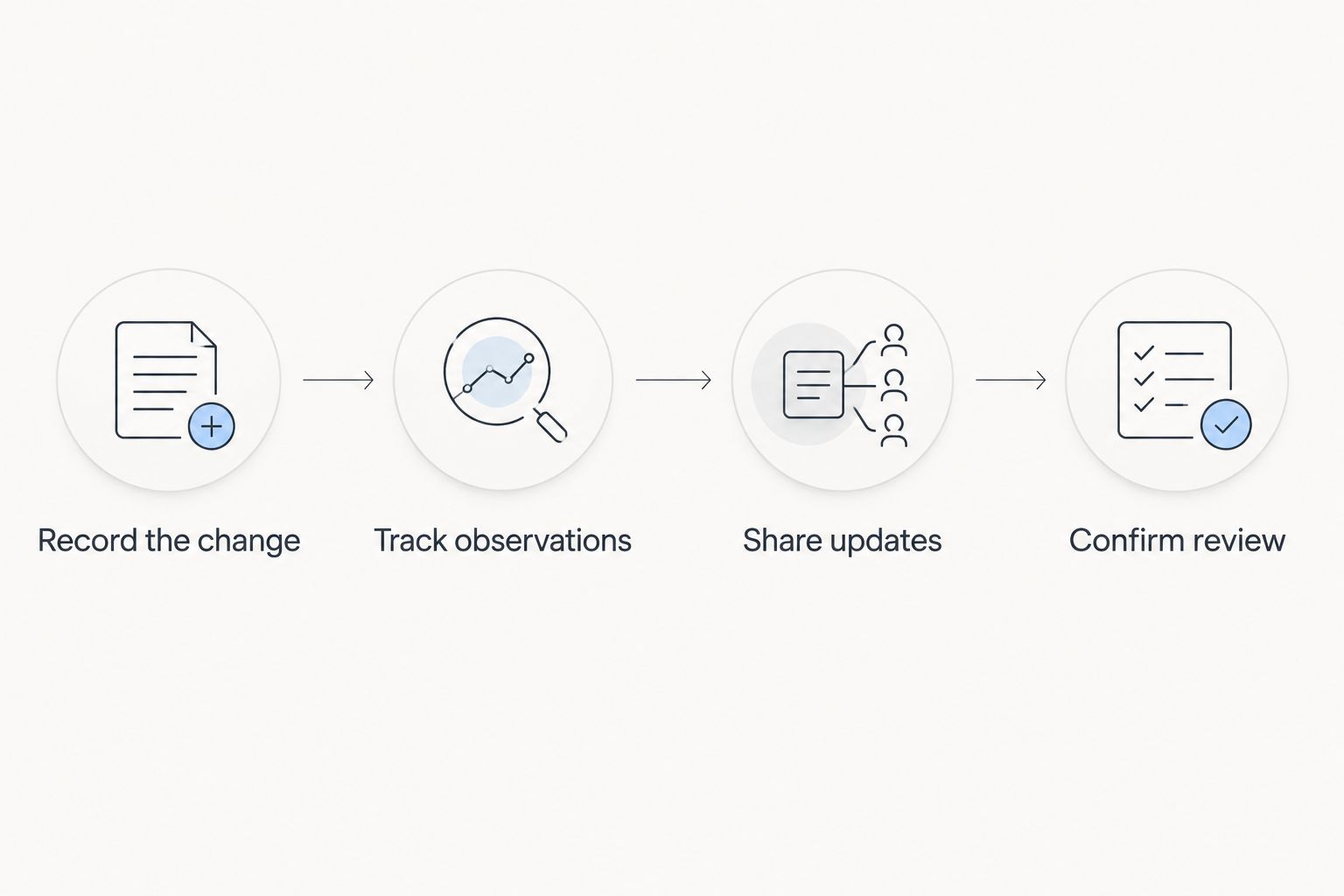
A medication change creates a new coordination point, not a reason to suspend therapy automatically. Tell your therapist what the prescriber changed and what monitoring instructions you received.
- Record the change. Write down the medicine, prescribed dose, date, and instructions exactly as provided. Ask the prescriber or pharmacist to clarify anything unclear.
- Track relevant observations. Follow your clinician’s monitoring plan. Report new or worsening symptoms and possible side effects through the agreed channel rather than waiting silently for the next appointment.
- Keep therapy goals visible. Continue discussing coping skills, avoidance, relationships, and daily functioning. Ask your therapist whether session priorities need to change while symptoms are being reassessed.
- Confirm the next review. Know who will assess the medication change and when. Tell both offices if the plan becomes difficult to follow.
Expected result: Your therapist understands the change, your prescriber receives relevant observations, and you know the next decision point.
The sequence is straightforward: Record the change, Track observations, Share updates, and Confirm review. These actions organize information; they do not determine whether a medication is effective or safe for you.
Troubleshooting coordination problems
Your clinicians give conflicting advice
Ask each clinician to explain the recommendation and identify the specific disagreement. Request direct coordination with your permission rather than carrying competing instructions between offices. For medication changes, contact the prescribing clinician before acting.
Your therapist has not received an update
Confirm that the necessary authorization is complete, the recipient details are correct, and the update was actually sent. Ask which office owns the next action. A signed form alone does not mean a conversation occurred.
You feel worse after a medication change
Contact the prescribing clinician promptly and describe the symptoms, timing, and severity. Seek emergency help for immediate danger or a medical emergency. Do not use a therapy appointment as a substitute for urgent medical assessment.
Tracking becomes another source of anxiety
Tell your clinicians that monitoring is increasing distress or becoming repetitive checking. Ask for a simpler, clinician-agreed method with clear boundaries. More detailed records are not automatically more useful.
Appointments feel repetitive or overwhelming
Ask each clinician to state the purpose of the next visit and the information needed. Discuss scheduling barriers before dropping care. Keep a concise shared summary while preserving room for separate clinical assessments.
Customize your workflow
For children and teens, ask how consent, confidentiality, caregiver participation, and medication monitoring work for that young person. Do not assume a parent receives every detail or that adult procedures apply unchanged.
For couples or family therapy, clarify whose treatment is being coordinated and what information can be shared. Another person’s attendance does not automatically authorize access to your medical information.
Counselingcharlotte provides counseling for children, teens, and adults, including couples and family therapy. When arranging counseling alongside prescribing care, ask what coordination is possible for your situation rather than assuming the services share a record or treatment team.
Revisit your 2026 plan whenever a clinician changes, your goals shift, or the existing communication process stops working. Keep the useful parts; revise the steps that create confusion.
FAQ
How do I combine therapy with medication management?
Combine therapy with medication management by agreeing on treatment goals, clarifying each clinician’s role, and arranging appropriate information sharing. Keep prescribing decisions with your prescribing clinician and confirm how relevant updates will reach both providers.
Do I need medication if I already go to therapy?
Therapy does not automatically mean you need medication. Discuss your symptoms, functioning, treatment history, and preferences with your therapist and an appropriate prescribing clinician when a medication evaluation is indicated.
Can my therapist prescribe psychiatric medication?
Prescribing authority depends on the clinician’s professional license, additional qualifications, and applicable law. Ask your therapist directly whether they prescribe or whether you need a separate prescribing clinician.
Can my therapist and psychiatrist talk to each other?
Your therapist and psychiatrist can coordinate care through an appropriate information-sharing process. Ask each office what authorization is needed and what information will be shared; psychotherapy notes receive special privacy protections.
Should I stop medication when therapy starts helping?
Do not stop psychiatric medication without discussing a plan with your prescribing clinician. Improvement is information for a treatment review, not an instruction to discontinue medication yourself.
What should I do if therapy and medication appointments give me different advice?
Ask the clinicians to clarify the disagreement and coordinate directly when appropriate. Contact the prescribing clinician before making medication changes, and seek urgent help when symptoms create immediate danger.
Does Counselingcharlotte provide medication management?
Counselingcharlotte’s stated services include in-person and virtual mental health counseling. Confirm any prescribing or referral arrangements directly before booking; counseling services alone do not establish that medication management is included.
One last thing
A signed release is permission to coordinate—not proof that coordination happened. Before leaving your next appointment, identify the sender, recipient, and purpose of the next update. Then confirm that the handoff occurred.
A short, accurate summary and a named next action are more useful than assuming separate clinicians already know what the other is doing. Keep your own copy of the current plan so you can spot conflicting instructions early.


