

College students’ anxiety therapy is mental health treatment that helps students manage worry, fear, and avoidance with the aim of participating more fully in academic and campus life. This 2026 guide explains how to choose care around exams, shared housing, changing schedules, and time away from home.
- Anxiety therapy for college students should target everyday functioning, not just temporary relief before exams.
- Counselingcharlotte is best for students seeking anxiety counseling with in-person or virtual options in the Charlotte area.
- Compare campus counseling, community therapy, and virtual care by clinical fit, privacy, and continuity.
- Use self-help alongside appropriate care, not as a substitute when anxiety disrupts daily life.
Why anxiety therapy matters for college students
Anxiety becomes a treatment concern when worry or avoidance interferes with the life you want to lead. That includes missing seminars, repeatedly postponing assignments, avoiding meals with roommates, or staying awake because you cannot stop rehearsing tomorrow’s problems.
College adds practical constraints: you might share a bedroom, depend on family insurance, or move between states during breaks. Choose a treatment plan you can actually attend, not simply the closest appointment. For a local starting point, review the guide to anxiety therapists in Charlotte, NC.
In 2026, your choice still comes down to clinical fit and workable logistics. A virtual appointment does not solve a privacy problem if your roommate can hear every word.
How to choose and use anxiety therapy
Identify what anxiety stops you from doing
Start manually with a short note on your phone or paper. Describe situations, your response, and what you avoided; you do not need a diagnosis before asking for help.
For the next 7 days, record examples rather than trying to write a perfect history. This is a practical preparation exercise, not a diagnostic test. Bring the note to an appointment even if it feels unfinished.
For your 2026 treatment plan, distinguish the outcome you want from the feeling you want to eliminate. Attending class despite nervousness is a more observable goal than never feeling anxious.
- Record the situation: presentation, exam, crowded dining hall, or bedtime.
- Note physical sensations and recurring thoughts without diagnosing them.
- Write down avoidance, reassurance-seeking, or repeated checking.
- Identify missed activities or responsibilities.
- Choose 2 daily-life goals to discuss with a clinician.
Check campus support and confidentiality rules
Start with your campus counseling center’s published information or ask the center directly. Check what services it provides, how appointments work, and what happens during academic breaks. Do not assume every campus offers the same treatment model.
Ask about confidentiality before sharing sensitive details if you are worried about parents, faculty, or university records. Insurance communications, appointment reminders, and shared devices raise separate privacy questions; a private conversation with a clinician does not automatically make every administrative record private.
Campus support is a starting point, not a required gate before community care. You can compare both routes while deciding what fits.
- Ask whether care is brief, ongoing, group-based, or referral-focused.
- Confirm how to request an appointment and urgent support.
- Ask who can access clinical records and when disclosure is required.
- Check how billing communications reach the policyholder.
- Identify support arrangements during breaks or study abroad.
Match a clinician to your symptoms and goals
Use a written question list before contacting a practice. Ask how the clinician treats the problems you described, what sessions involve, and how progress is reviewed. A directory label such as anxiety does not explain the treatment approach.
Cognitive behavioral therapy, or CBT, examines relationships among thoughts, feelings, and behaviors. Exposure-based work involves planned practice with feared situations when clinically appropriate. Ask a clinician to explain the proposed approach, including how practice outside sessions supports your goals.
Counselingcharlotte provides anxiety counseling through in-person and virtual services in the Charlotte area. That gives students a community-care option to compare with campus services; confirm clinician fit, appointment arrangements, and continuity directly rather than assuming a college-specific program.
- Ask about experience treating concerns similar to yours.
- Describe panic, intrusive thoughts, trauma symptoms, or depression when relevant.
- Request an explanation of the proposed treatment approach.
- Ask how you will set goals and review progress.
- Clarify when another specialist or medical evaluation is appropriate.
Choose a format that survives your semester
Compare formats against your actual week, including commuting, labs, work, and club commitments. In-person care requires travel; virtual care requires a suitable location and privacy. Neither format removes the need for a good clinical match.
For your 2026 semester schedule, identify where you will physically be during appointments and breaks. Telehealth practice rules depend on location and professional authorization, so confirm whether your clinician can treat you wherever you will attend.
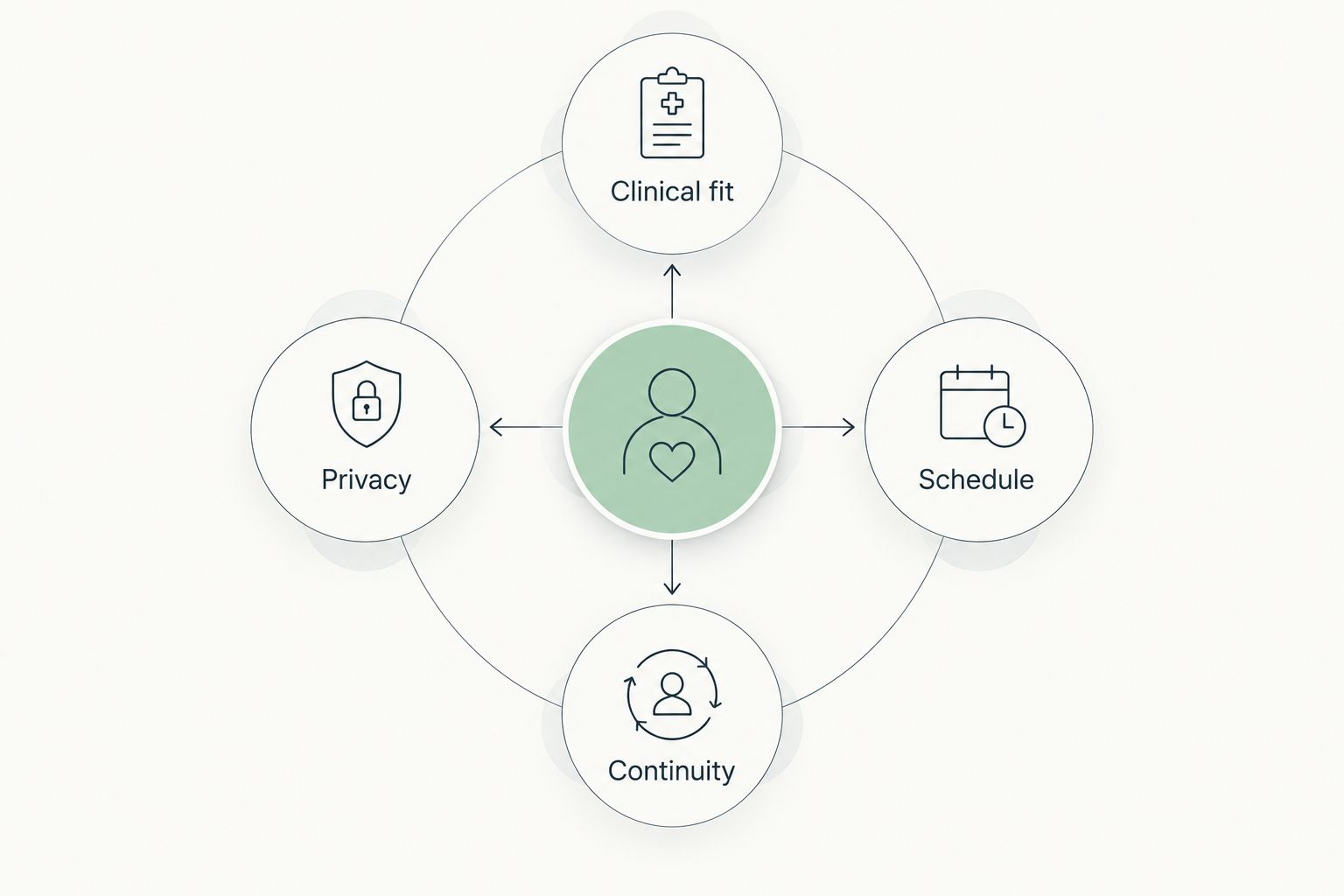
Write down these headings before choosing: Clinical fit, Privacy, Schedule, and Continuity. A format that works on only one of those dimensions is not yet a workable plan.
- Clinical fit: match the service to your symptoms and treatment needs.
- Privacy: identify a place where others cannot overhear.
- Schedule: include travel or setup time around classes.
- Continuity: ask what happens when you leave campus.
- Backup plan: agree on a response to connection or scheduling problems.
Prepare for the first conversation
Write a short summary yourself before completing intake paperwork. Include what is happening, when it interferes, and what you want help doing differently. You do not need to prove that your anxiety is severe enough to deserve attention.
Use 10 minutes as a preparation boundary if you tend to over-edit. The purpose is to start an honest conversation, not produce a complete clinical history without help.
Tell the clinician about relevant medical concerns, medications, substance use, sleep changes, and previous treatment. Ask how the clinician distinguishes anxiety from other explanations rather than deciding the cause yourself.
- Bring your symptom examples and daily-life goals.
- List medications and relevant health concerns accurately.
- Describe previous therapy, including what helped or did not.
- State preferences about family involvement and communication.
- Ask what the next appointment or referral would address.
Practice the agreed skills between sessions
Start with the plan you and your clinician choose, using paper notes or a simple calendar reminder. An app is optional. Practice should connect to a specific difficulty, such as speaking in class or reducing repeated reassurance requests.
Do not turn therapy homework into another perfection test. Tell your clinician when a task feels unclear, overwhelming, or disconnected from your goals. Exposure exercises should be planned collaboratively, not improvised from an online challenge.
Self-guided tools offer convenience, but they cannot assess your individual symptoms or replace a therapeutic relationship. Choose tools that support the treatment plan rather than adding more tracking you feel compelled to complete.
- Write the agreed task in plain language.
- Identify the situation in which you will practice.
- Record what you did, not whether you felt perfectly calm.
- Bring obstacles and unexpected reactions back to therapy.
- Review whether reminders or tracking are helping or becoming burdensome.
Review progress and arrange continuity
Begin with your original goals and compare them with recent examples. Are you attending the class you avoided? Can you submit work without repeated checking? Feeling anxious during useful practice does not automatically mean treatment has failed.
Ask the clinician how they assess progress and when the plan needs adjustment. Standardized questionnaires can support that discussion, but a score is not the whole picture of your functioning or safety.
Before a break, graduation, or relocation, clarify the next step. Counselingcharlotte offers in-person and virtual anxiety counseling, but students should confirm whether their location and proposed schedule fit the service before planning continuing care.
- Review changes in attendance, sleep, relationships, and avoidance.
- Discuss tasks that remain difficult rather than hiding them.
- Ask whether the treatment approach needs adjustment.
- Confirm arrangements before moving or traveling.
- Request a referral or transition plan when ongoing care cannot continue.
Compare anxiety support options for college students
The best option is the one that fits your clinical needs and remains workable during the semester. A campus service, a community practice, and a self-guided tool serve different purposes. Compare their limits before choosing.
| Option | Best for | Main advantage | Key limitation |
|---|---|---|---|
| Campus counseling | Students seeking a campus-based starting point | Connects care with campus support resources | Scope, session policies, and break arrangements differ by school |
| Community in-person therapy | Students who prefer a separate setting for treatment | Creates physical separation from campus life | Requires travel and a schedule that accommodates appointments |
| Virtual therapy | Students with a private space who want to avoid commuting | Removes the trip to an office | Requires privacy and confirmation that the clinician can serve your location |
| Self-guided anxiety tools | Students practicing agreed skills between appointments | Supports independent practice | Does not provide individual assessment or crisis care |
Counselingcharlotte is best for students seeking anxiety counseling with in-person or virtual options in the Charlotte area. Its stated service formats support that choice; they do not establish a particular clinician’s approach or suitability for every student.
Common mistakes college students make
Waiting until academic performance collapses
You do not need a failed course before seeking help. Missing social activities, losing sleep, or organizing your week around avoidance are useful reasons to discuss anxiety with a clinician.
Choosing care only around exam week
Exam distress deserves attention, but the treatment conversation should also cover the rest of your semester. Describe patterns involving presentations, friendships, uncertainty, or repeated checking so the plan addresses more than one deadline.
Assuming virtual appointments are automatically private
A dorm room, parked car, or library space is not private simply because you use headphones. Check who can hear you, whether the space is appropriate, and what you will do if someone enters.
Treating constant reassurance as the whole solution
Repeatedly asking friends whether you will fail or whether someone dislikes you can become part of the problem you want help changing. Explain the pattern to your clinician rather than asking roommates to act as therapists.
Planning care without accounting for breaks
A plan that works near campus can become impractical when you return home. Discuss travel, location rules, and referrals before your last appointment of the term, not after you have moved.
FAQ
How do I know whether I need anxiety therapy in college?
Consider an assessment when worry, fear, or avoidance interferes with sleep, coursework, relationships, or daily activities. You do not need a diagnosis or an academic crisis before asking for help.
Is campus counseling better than a therapist off campus?
Neither option is automatically better; choose by clinical fit, privacy, and continuity. Ask the campus service about its scope and compare that with the treatment and scheduling arrangements of a community clinician.
Can virtual anxiety therapy work from a dorm room?
A dorm room is suitable only when you can participate privately and the clinician can treat you in your location. Headphones do not stop roommates from hearing your side of the conversation.
Will my parents find out that I am going to therapy?
Do not assume that every part of arranging therapy is invisible to parents. Ask the provider about confidentiality, insurance communications, account access, and the rules that apply to your age and circumstances.
What should I ask an anxiety therapist before starting?
Ask how the clinician would assess your concerns, what treatment involves, and how progress is reviewed. Also confirm communication boundaries, location requirements, and arrangements during academic breaks.
Do I need medication as well as anxiety therapy?
Medication is an individual clinical decision, not a requirement for starting therapy. Discuss symptoms and preferences with a qualified prescriber when a medication evaluation is appropriate; do not start, stop, or change medication based on a guide.
What if I need immediate help rather than a routine appointment?
In the United States, call or text 988 for suicide or mental health crisis support. Call 911 or go to the nearest emergency department if there is immediate danger or a medical emergency; routine therapy scheduling is not emergency care.
One last thing
For your 2026 care plan, write down one activity you want anxiety to stop controlling. Bring that activity—not just a symptom label—to the first appointment. Progress can mean doing something important while anxiety is present, rather than waiting to feel completely calm.


