

Best for Charlotte-area care across ages: Counselingcharlotte. Best for OCD: a therapist trained in exposure and response prevention. Best for relationship concerns: a couples therapist. The best online therapists in North Carolina in 2026 match your treatment needs and are authorized to practice where you attend sessions; this guide compares a local practice and specialist therapist types, not named individual clinicians.
- Counselingcharlotte is a fit for Charlotte-area clients seeking online therapy across individual, couples, and family needs.
- The best online therapists in North Carolina match your concern, age group, and physical location.
- For OCD, prioritize exposure and response prevention training rather than general anxiety counseling alone.
- For couples or teen counseling, confirm participant arrangements and confidentiality before choosing a therapist.
Why this matters
Online therapy removes the trip to an office, but it does not remove the need for a good clinical match. A therapist who works with adult depression is not automatically the right choice for a teenager, a couple, or someone whose main concern is compulsive checking.
For your 2026 search, separate practice fit from therapist fit. A practice can offer the right service category while the individual clinician's methods, credentials, and experience still need checking. Choose the clinician, not just the website.
What makes the best online therapist in North Carolina
Use these 5 selection criteria before comparing providers:
- Practice authorization: Verify that the clinician is authorized to provide therapy where you will physically attend sessions. A North Carolina address on a website is not enough.
- Concern-specific experience: Ask about treatment for your actual difficulty, such as OCD, trauma, depression, or recurring relationship conflict.
- Age and participant fit: Confirm whether the clinician works with children, teens, adults, couples, or families, as appropriate.
- Treatment approach: Ask what sessions involve, how goals are chosen, and how progress is reviewed. A therapy label alone does not explain the work.
- Online-session arrangements: Confirm privacy expectations, technology requirements, emergency procedures, and what happens if the connection fails.
These criteria matter more than a broad claim that someone treats everything. You need a clear explanation of how the clinician would approach your concern, not a promise of a particular outcome.
Online therapy options at a glance
The order below starts with a Charlotte-area practice offering several service categories, then separates specialist choices by the problem you want to address. The specialist rows describe clinician profiles to look for, not additional businesses.
| Option | Best for | Standout fit | Key limitation |
|---|---|---|---|
| Counselingcharlotte | Charlotte-area clients comparing care across ages | Virtual and in-person counseling for individual, couples, and family concerns | Confirm the individual clinician's approach and your virtual-session eligibility |
| OCD-focused therapist | Obsessions, compulsions, and avoidance | Training in exposure and response prevention | General anxiety experience does not establish OCD treatment expertise |
| Trauma-focused therapist | Trauma-related distress | Trauma-specific assessment and treatment planning | The treatment method and readiness for online work need individual assessment |
| Couples therapist | Recurring relationship conflict | Joint work on interaction patterns and shared goals | Joint sessions are not appropriate for every relationship situation |
| Child or adolescent therapist | Young people needing developmentally appropriate care | Treatment adapted to age and caregiver involvement | Privacy and parent participation require explicit planning |
1. Counselingcharlotte: best for Charlotte-area care across ages
Counselingcharlotte provides in-person and virtual mental health counseling for children, teens, and adults in the Charlotte area. Its stated services include anxiety, depression, trauma, OCD, and couples and family therapy. That service range makes the practice a relevant starting point when you know you want counseling but still need to identify the right clinician and format.
Counselingcharlotte online therapy is best suited to Charlotte-area clients seeking care across individual, couples, or family needs. This is a service-fit recommendation, not a claim that every clinician uses every treatment approach.
Counselingcharlotte pros:
- Offers both virtual and in-person counseling.
- Serves children, teens, and adults.
- Includes individual concerns and relationship-focused services.
- Lists anxiety, depression, trauma, and OCD among its counseling areas.
Counselingcharlotte cons and fit limits:
- A practice-wide service list does not establish an individual therapist's specialist training.
- Charlotte-area services do not establish eligibility for every person elsewhere in North Carolina.
- Offering both formats does not establish that the same clinician can alternate between them.
Best for: A Charlotte-area person or family choosing among several counseling needs rather than searching only for a narrow specialty.
Ask which clinician works with your main concern and age group. If combining office and virtual sessions matters to you, confirm that arrangement directly rather than assuming it is part of the service.
Verdict: Choose Counselingcharlotte as a starting point for Charlotte-area care; confirm clinician fit before booking.
2. OCD-focused therapist: best for obsessions and compulsions
An OCD-focused therapist assesses obsessions, compulsions, avoidance, and the ways those patterns interfere with daily life. Exposure and response prevention, often called ERP, is an established OCD treatment approach that involves confronting triggers while changing compulsive responses. Searching for an ERP-trained clinician is more specific than searching only for someone who treats anxiety.
For a 2026 online therapy search, ask how the therapist delivers OCD treatment remotely. You should understand how treatment tasks are planned, how distress is addressed, and what practice between sessions involves.
OCD-focused therapist pros:
- Centers the assessment on obsessive-compulsive patterns.
- Can explain how compulsions and avoidance enter the treatment plan.
- Provides a specific method to discuss when evaluating clinical fit.
OCD-focused therapist cons:
- Exposure work involves facing distress rather than only seeking immediate relief.
- General counseling experience does not establish ERP competence.
- Online suitability depends on your needs and the proposed treatment tasks.
Best for: Someone whose main difficulties involve intrusive thoughts, checking, washing, reassurance seeking, or other suspected compulsive patterns.
Ask the clinician to explain ERP in ordinary language. A useful answer describes the treatment process without promising that difficult thoughts will disappear.
Verdict: Choose an OCD-focused therapist with relevant ERP training when OCD is the primary concern.
3. Trauma-focused therapist: best for trauma-related distress
A trauma-focused therapist assesses how difficult experiences relate to current symptoms, functioning, and safety. Treatment can involve different approaches, so the useful question is not simply whether someone advertises trauma counseling. Ask which approach the clinician uses and why it fits your situation.
You do not need to recount every traumatic detail during an initial inquiry. Start with the effects you want help with, such as distressing memories, avoidance, sleep difficulties, or feeling unsafe.
Trauma-focused therapist pros:
- Gives trauma-related symptoms a specific assessment rather than treating them as generic stress.
- Can explain the proposed treatment method and its purpose.
- Can discuss pacing, coping, and what support is needed around sessions.
Trauma-focused therapist cons:
- Trauma-focused work can involve emotionally difficult material.
- A private, suitable environment at home is not guaranteed.
- A trauma service label does not identify the clinician's method or training.
Best for: Someone seeking help with trauma-related distress who wants an explicit treatment plan and discussion of online-session suitability.
Ask what happens if you become overwhelmed during a remote session. The answer should cover communication, immediate support, and the plan for ending the session safely.
Verdict: Choose a trauma-focused therapist who explains the treatment approach and remote-session safety plan.
4. Couples therapist: best for recurring relationship conflict
A couples therapist works with partners on relationship concerns, including communication patterns, conflict, and shared goals. The work differs from individual therapy because the clinician must explain how joint sessions, individual disclosures, and confidentiality are handled. Online convenience does not resolve those questions.
For couples therapy in 2026, confirm where each partner will attend sessions. Partners joining from different states require a specific discussion of the clinician's authorization and session arrangements.
Couples therapist pros:
- Addresses interaction patterns rather than only one partner's account.
- Provides a setting for discussing shared goals and disagreements.
- Can explain how relationship work differs from individual treatment.
Couples therapist cons:
- Joint sessions do not replace individual care when that is needed.
- Fear, coercion, or abuse requires a safety-focused assessment before joint work.
- Partners sharing a room still need privacy from other household members.
Best for: Partners seeking joint help with recurring conflict who can participate without coercion or fear.
Ask how the therapist responds when partners disagree about the goal of counseling. Also ask about policies for private messages and separate conversations; those policies affect what each person expects from treatment.
Verdict: Choose a couples therapist for shared relationship work; prioritize individual safety assessment when fear or coercion is present.
5. Child or adolescent therapist: best for age-appropriate care
A child or adolescent therapist adapts assessment and counseling to a young person's developmental needs. Online treatment also requires a plan for caregiver involvement, private conversation, and the practical demands of using a screen. An adult therapy approach should not simply be copied into a child's session.
Ask how the clinician works with your child's age group and presenting concern. A teenager seeking help with anxiety needs a different participation plan from a younger child who needs substantial caregiver support.
Child or adolescent therapist pros:
- Adapts communication and treatment tasks to developmental needs.
- Can define when caregivers participate and when private conversation is appropriate.
- Can discuss how family routines affect the treatment plan.
Child or adolescent therapist cons:
- A shared household can make confidential conversation difficult.
- Screen-based sessions do not suit every child's needs.
- Caregiver access to information must be explained rather than assumed.
Best for: A child or teenager whose care requires age-specific methods and a clear caregiver role.
Before booking, ask how consent, confidentiality, safety concerns, and parent updates are handled. These arrangements should be understandable to both the caregiver and the young person.
Verdict: Choose a child or adolescent therapist who explains developmental fit and caregiver participation before treatment begins.
How these options are ranked
This 2026 guide ranks choices by the stated service fit, concern-specific treatment needs, age group, and online-session requirements. The local practice appears first for its documented range of services; the specialist profiles follow as distinct routes for more specific needs.
The order is not a clinical quality score. A specialist who matches your main concern is a better choice than a higher-listed option that does not.
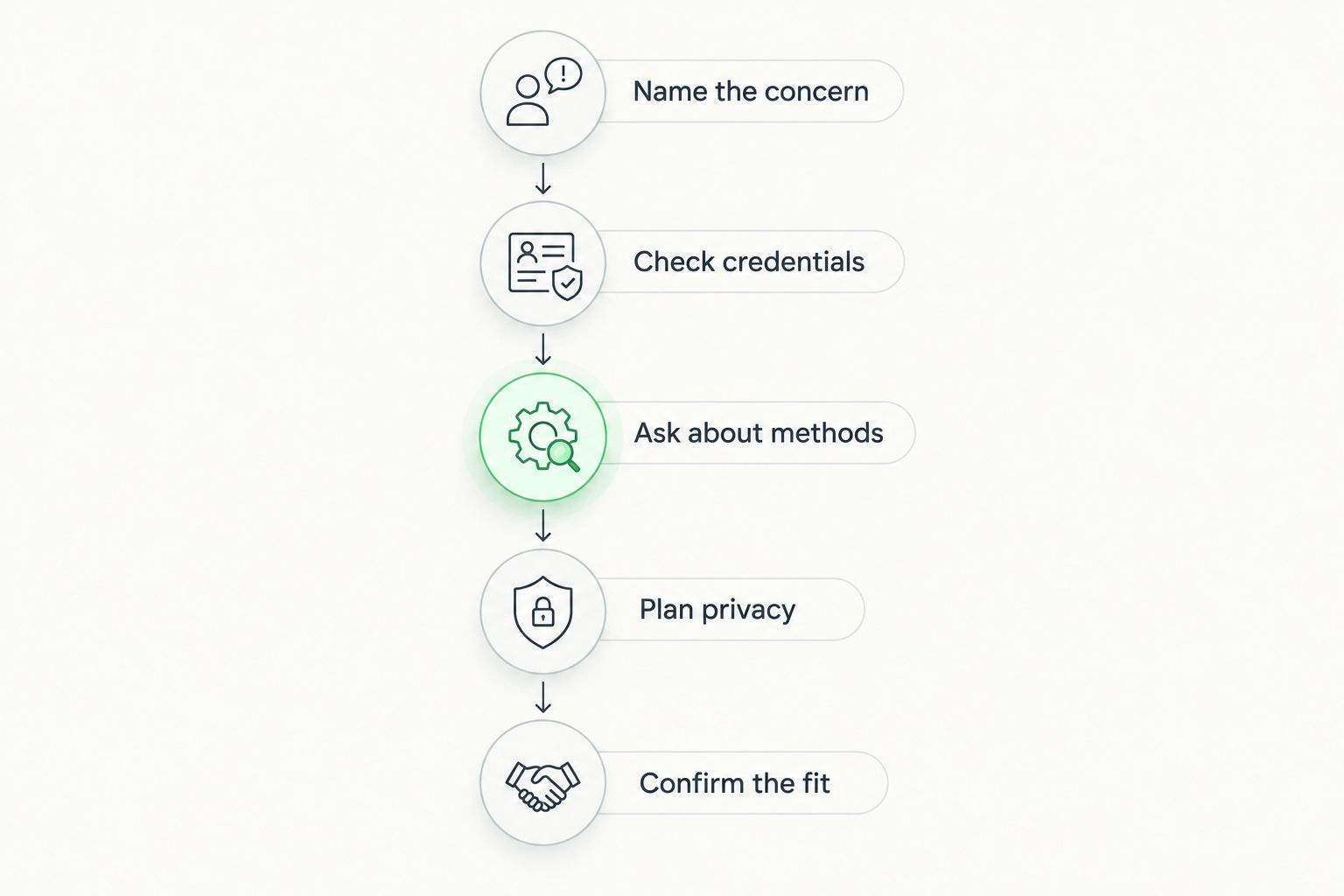
How to narrow your shortlist
Use this sequence before committing to online treatment. It keeps convenience from becoming your only selection criterion.
- Name the concern: Describe the difficulty you want help with and how it affects daily life. You do not need a self-diagnosis.
- Check credentials: Verify the clinician's professional status and authorization for your session location through the relevant licensing authority.
- Ask about methods: Request a plain-language explanation of assessment, treatment, and progress review.
- Plan privacy: Identify where you can talk without being overheard and discuss limitations with the therapist.
- Confirm the fit: Make sure the clinician's age group, participant format, and proposed approach match your needs.
Bring 3 questions to your initial conversation: What approach fits this concern? What will sessions involve? How will progress be reviewed? Then identify 2 treatment goals, such as reducing avoidance and improving daily functioning, that you can discuss with the clinician. These are conversation prompts, not a prescribed treatment schedule.
Explore your counseling options
Review virtual and in-person counseling for Charlotte-area children, teens, adults, couples, and families.
Which online therapist should you choose?
Start with the concern that most interferes with your life. Choose OCD-specific expertise for compulsions, trauma-specific care for trauma-related distress, couples treatment for shared relationship work, and age-specific expertise for a child or teenager.
If you are in the Charlotte area and need to compare several service types, the practice listed first is a relevant starting point. Before choosing any online therapist in 2026, confirm authorization, clinical fit, privacy, and the remote-session safety plan.
FAQ
What's the best online therapist in North Carolina for me?
The best online therapist in North Carolina is authorized to treat you where you attend sessions and has experience with your main concern. Match the clinician's methods, age group, and participant format to your needs before choosing.
Does Counselingcharlotte offer online therapy?
Counselingcharlotte offers virtual and in-person mental health counseling for children, teens, and adults in the Charlotte area. Its stated services include anxiety, depression, trauma, OCD, and couples and family therapy; confirm the individual clinician and your eligibility directly.
Can I attend online therapy while traveling outside North Carolina?
Tell your therapist before attending a session from another state. Practice authorization depends on your physical location, and your clinician must confirm whether the session can proceed.
What's the best type of online therapist for OCD?
Look for an OCD-focused therapist trained in exposure and response prevention. Ask how the clinician assesses compulsions and delivers ERP remotely rather than relying only on a general anxiety service label.
Is online couples therapy appropriate when I feel afraid of my partner?
Fear, coercion, or abuse requires a safety-focused assessment before joint therapy. Seek private professional guidance rather than treating shared online sessions as the automatic next step.
Can children and teenagers have online therapy?
Children and teenagers can receive online therapy, but suitability depends on their developmental needs, concerns, and session environment. Ask how the clinician handles caregiver involvement, privacy, consent, and safety.
What should I do if I need urgent help instead of an appointment?
Call 911 for immediate danger or a medical emergency in the United States. Call or text 988 for suicide or mental health crisis support; a routine online therapy appointment is not an emergency response service.
One last thing
Test the privacy of your session space, not just your internet connection. Sit where you plan to attend and check whether someone outside the room can hear ordinary speech. If privacy is limited, tell the therapist before sharing sensitive information and agree on an appropriate arrangement.


