

Best starting point for local child counseling: Counselingcharlotte. Best approach to discuss for childhood OCD: exposure and response prevention. Best approach to discuss for trauma-related symptoms: trauma-focused cognitive behavioral therapy. Finding the best child therapists in Charlotte NC in 2026 means matching your child’s age, concerns, and family needs—not choosing a clinician from a generic leaderboard.
- Counselingcharlotte is a local child counseling option for Charlotte families seeking in-person or virtual sessions.
- The best child therapists in Charlotte NC match your child’s age, symptoms, and parent involvement needs.
- Discuss cognitive behavioral therapy for childhood anxiety and exposure and response prevention for OCD.
- Consider trauma-focused care for trauma-related symptoms and family therapy for relationship difficulties.
Why this matters
Children do not always describe distress directly. You might notice repeated reassurance-seeking, avoidance, irritability, disrupted routines, or conflict instead. Those observations help a therapist assess what is happening; they do not establish a diagnosis.
A useful 2026 shortlist separates the practice you contact from the treatment approach your child needs. The options below compare one local counseling practice and several care pathways. They are not interchangeable alternatives, and the treatment approaches are not claims about a particular practice’s methods.
The right next move is a fit conversation. Ask whether the clinician works with your child’s age group, treats the presenting concern, and explains how caregivers participate.
What makes the best child therapist for your family?
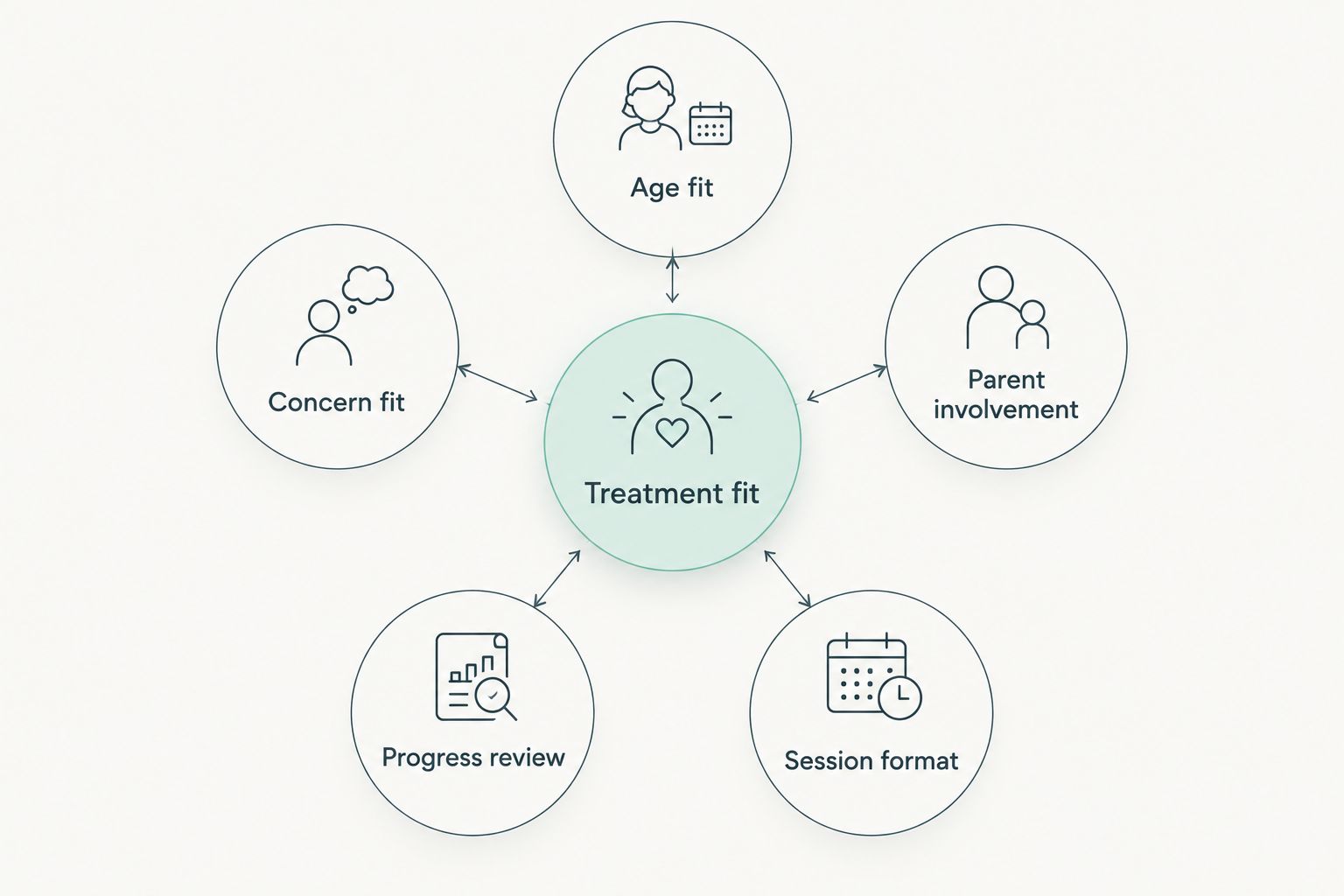
Use these criteria before comparing names or booking an appointment:
- Age fit: The therapist should explain how sessions change for younger children, school-age children, or teens.
- Concern fit: Ask about experience with the specific difficulty, rather than accepting a broad description of child counseling.
- Treatment fit: The clinician should connect the proposed approach to the problem being addressed.
- Parent involvement: Clarify when caregivers attend, what they practice at home, and how updates work.
- Progress review: Agree on meaningful changes to watch for, such as easier school attendance or less avoidance.
- Session format: Match in-person or virtual care to your child’s engagement, privacy, and support needs.
For your 2026 search, prioritize concern fit and age fit before convenience. A nearby appointment is not a substitute for a clinician who can explain the treatment plan clearly.
Child counseling options at a glance
The rows distinguish a local practice from treatment approaches. Use them to decide what to ask about, not to diagnose your child or select a technique without an assessment.
| Option | Best for | Standout feature | Key limitation |
|---|---|---|---|
| Counselingcharlotte | Starting a local child counseling inquiry | In-person and virtual counseling for children, teens, and adults | A practice-level description does not establish individual clinician fit |
| Child-focused cognitive behavioral therapy | Anxiety linked to avoidance and unhelpful thinking patterns | Connects thoughts, feelings, behavior, and practice | Requires developmental adaptation and participation outside sessions |
| Exposure and response prevention | OCD involving obsessions and compulsions | Addresses the cycle of feared situations and rituals | Requires an OCD assessment and carefully planned exposure work |
| Trauma-focused cognitive behavioral therapy | Trauma-related symptoms | Combines trauma-focused work with coping skills and caregiver participation | Requires readiness assessment and a trauma-informed clinician |
| Family therapy | Recurring relationship conflict and communication difficulties | Works with interaction patterns across family members | Does not replace individual treatment when a separate condition needs attention |
1. Counselingcharlotte: best starting point for local child counseling
Counselingcharlotte provides in-person and virtual mental health counseling for children, teens, and adults in the Charlotte area. Its stated services include anxiety, depression, trauma, OCD, and couples or family therapy.
That range makes the practice a relevant starting point when you need to discuss a child’s concerns and whether individual or family support fits. Treat the initial inquiry as a screening conversation, not confirmation that every clinician treats every age or concern.
Counselingcharlotte pros:
- Child and teen counseling are explicitly included in the service description.
- Both in-person and virtual formats are offered.
- The stated service areas include several concerns that families bring to counseling.
- Family therapy is part of the stated services.
Counselingcharlotte cons:
- A broad service list does not establish which clinician fits your child.
- Practice-level information does not determine which treatment method is appropriate.
Best for: Charlotte families beginning a local child counseling inquiry, especially when they need to discuss both the concern and the session format.
Ask which clinician works with your child’s age group and what the assessment involves. If you are considering virtual care, describe the space your child would use and the support an adult can provide.
Verdict: Hold until the clinician match, treatment approach, and caregiver role are clear.
2. Child-focused CBT: best for anxiety with avoidance patterns
Child-focused cognitive behavioral therapy, or CBT, helps children understand connections between thoughts, feelings, and actions. For anxiety, treatment often includes practicing how to face feared situations rather than repeatedly avoiding them.
Development matters. A child who learns through concrete examples needs a different explanation from a teen who can discuss thought patterns in detail. Ask how the therapist adapts CBT rather than assuming the label guarantees age-appropriate care.
Child-focused CBT pros:
- Gives children a framework for understanding anxiety.
- Connects session work to situations outside the therapy room.
- Can include caregiver support for practicing skills.
- Offers observable goals, such as approaching a previously avoided activity.
Child-focused CBT cons:
- Practice outside sessions requires family participation.
- An anxiety-focused plan is not a substitute for evaluating OCD or trauma-related symptoms.
Best for: Children whose anxiety involves avoidance, worry, or difficulty approaching everyday situations, after assessment.
Ask the therapist to explain how practice will work between appointments. The answer should describe manageable steps and caregiver support—not simply tell your child to stop worrying.
Verdict: Hold until an assessment confirms the anxiety focus and the clinician explains the practice plan.
3. Exposure and response prevention: best for childhood OCD
Exposure and response prevention, or ERP, is a form of CBT used to treat OCD. It involves planned contact with feared situations while practicing not performing the compulsions that maintain the cycle.
For children, caregivers often need guidance about reassurance and participation in rituals. A useful plan distinguishes supportive parenting from actions that unintentionally keep the OCD cycle active.
Exposure and response prevention pros:
- Directly targets obsessions and compulsions.
- Gives treatment a specific behavioral focus.
- Can address family participation in rituals.
- Provides a structure for practicing responses to uncertainty.
Exposure and response prevention cons:
- Facing feared situations involves discomfort and requires careful planning.
- Generic coping-skills counseling alone does not establish that ERP is being provided.
Best for: Children assessed as having OCD, particularly when rituals, checking, repeated questions, or avoidance interfere with daily life.
Ask how the clinician assesses OCD and involves caregivers in ERP. Do not begin improvised exposure exercises from a checklist; the plan should account for your child’s symptoms and developmental needs.
Verdict: Skip generic anxiety-only counseling as the sole plan when the assessed problem is OCD; discuss OCD-specific treatment.
4. Trauma-focused CBT: best for trauma-related symptoms
Trauma-focused cognitive behavioral therapy, or TF-CBT, combines coping skills, trauma-focused work, and caregiver participation. It is a structured treatment approach for children and adolescents experiencing trauma-related difficulties.
An assessment should consider the child’s experiences, current safety, symptoms, and support system. Trauma treatment is not a demand to recount everything immediately; preparation and pacing are part of the clinical work.
Trauma-focused CBT pros:
- Connects coping skills with trauma-related concerns.
- Includes a role for a supportive caregiver when appropriate.
- Addresses how trauma affects thoughts, emotions, and behavior.
- Gives the therapist a structured approach rather than an undefined promise to process trauma.
Trauma-focused CBT cons:
- Trauma-focused work can bring up distressing feelings.
- Caregiver participation and current safety need individual assessment.
Best for: Children with trauma-related symptoms whose assessment supports a trauma-focused treatment plan.
Ask how the clinician establishes readiness and what caregiver involvement means for your family. If a caregiver is connected to the harm, explain that privately so the clinician can plan safely.
Verdict: Hold until the clinician assesses safety, readiness, and the appropriate caregiver role.
5. Family therapy: best for recurring relationship difficulties
Family therapy focuses on interaction patterns, communication, and relationships rather than treating the child as the only person who needs to change. It can help families examine repeated conflicts and develop different ways of responding.
Family work and individual treatment can serve different purposes. A child with OCD, depression, or trauma-related symptoms still needs an assessment of those concerns, even when conflict at home also needs attention.
Family therapy pros:
- Includes the people involved in recurring difficulties.
- Examines patterns rather than assigning all responsibility to the child.
- Creates space to clarify expectations and communication.
- Can support changes that require caregiver participation.
Family therapy cons:
- Participation can become difficult when family members have conflicting goals.
- Joint sessions are not appropriate for every safety situation.
Best for: Families whose main concern is recurring conflict, strained communication, or difficulty responding consistently to a child’s needs.
Ask who should attend and how the therapist handles disagreement. When abuse, intimidation, or coercion is present, raise safety concerns privately before arranging joint sessions.
Verdict: Skip family-only treatment when an individual clinical concern or safety issue needs separate assessment.
How these options are ranked
This 2026 guide orders the options by the decision a parent needs to make: begin with a local counseling inquiry, then identify the care pathway that matches the concern. It does not rank individual clinicians by outcomes, reviews, or credentials.
The comparison uses the criteria above: age fit, concern fit, treatment fit, caregiver participation, progress review, and format. A specific treatment match matters more than a broad “best therapist” label.
Prepare for the first fit conversation
Give the clinician concrete observations rather than trying to supply a diagnosis. A short written summary keeps the conversation focused and makes it easier to explain what you want to change.
- Write 3 observations describing what happens, the context, and how it affects daily life.
- Choose 1 initial goal your child and caregivers can recognize, such as attending an activity with less avoidance.
- Ask 2 fit questions: “How do you treat this concern?” and “How will caregivers participate?”
Also explain what your child knows about the appointment. Ask how the therapist introduces counseling and discusses privacy, including what caregivers receive and when safety concerns require disclosure.
For a 2026 appointment, confirm the session format directly and ask what preparation it requires. Virtual care needs a workable private space; in-person care needs a practical attendance plan.
Which child counseling option should you choose?
Start with a clinician-fit conversation, then choose the treatment pathway based on assessment. Counselingcharlotte is a local child counseling option for Charlotte families seeking in-person or virtual sessions.
For anxiety, ask about child-focused CBT. For suspected OCD, ask about ERP. For trauma-related concerns, discuss trauma-focused treatment; for recurring relationship difficulties, ask whether family therapy belongs in the plan.
Do not choose a modality simply because it appears higher in this guide. The best 2026 choice is a clinician who can explain why the proposed plan fits your child and how you will review progress together.
FAQ
What’s the best way to find a child therapist in Charlotte NC?
Match the therapist to your child’s age and presenting concern before choosing by location or session format. Ask how the clinician assesses the problem, involves caregivers, and reviews progress.
Does Counselingcharlotte offer counseling for children?
Counselingcharlotte’s stated services include mental health counseling for children, teens, and adults in the Charlotte area. In-person and virtual counseling are included; ask about the individual clinician match for your child.
Is CBT or family therapy better for my child?
CBT and family therapy address different treatment needs, so neither is automatically better. Child-focused CBT can address anxiety patterns, while family therapy focuses on relationships and interactions; assessment determines the appropriate plan.
What should I ask a therapist if I think my child has OCD?
Ask how the clinician assesses childhood OCD and whether treatment includes exposure and response prevention. Also ask how caregivers learn to respond to reassurance-seeking and rituals without reinforcing them.
Can a child do therapy virtually?
Children can receive therapy virtually, but the format must fit the child and the treatment plan. Ask about engagement, privacy, caregiver support, and whether in-person sessions would better support the work.
Do parents attend child therapy sessions?
Parent participation depends on the child’s age, concern, and treatment approach. Clarify which sessions include caregivers, what updates you receive, and how the clinician handles confidentiality and safety.
How will I know whether child therapy is helping?
Agree with the therapist on observable goals and review them together. Look at meaningful daily-life changes and the child’s experience, rather than expecting progress to follow a fixed appointment count.
What if my child needs immediate mental health help?
Use emergency or crisis services rather than waiting for a routine counseling appointment. In the United States, call 911 for immediate danger or call or text 988 for suicide and mental health crisis support.
One last thing
An agreeable child is not the same as a child whose distress has improved. When discussing progress, ask about distress, avoidance, functioning, and your child’s experience—not just whether adults see fewer difficult behaviors.
Bring your child’s perspective into the goal-setting conversation in an age-appropriate way. A plan is easier to understand when the child knows what counseling is meant to help them do.


