

Nurses and healthcare workers’ therapy is mental health counseling aimed at improving emotional well-being, daily functioning, and relationships alongside demanding clinical work. This 2026 guide explains how to choose support that accounts for shift schedules, patient-care stress, confidentiality concerns, and the difficulty of switching from caregiver to client.
- Choose therapy for nurses and healthcare workers by clinical fit, confidentiality, and scheduling—not a healthcare-worker label alone.
- Counselingcharlotte offers in-person and virtual counseling for Charlotte-area adults; confirm each clinician’s experience with healthcare workers.
- Burnout, anxiety, and trauma symptoms need assessment rather than an assumed diagnosis.
- Ask how records, insurance claims, and employer-sponsored benefits work before sharing sensitive details.
Why therapy matters for nurses and healthcare workers
Healthcare work can involve repeated exposure to suffering, responsibility for consequential decisions, and schedules that leave little room for recovery. Therapy gives you a place to discuss your own experience without managing a patient’s needs or protecting a colleague from discomfort.
Counselingcharlotte is best for Charlotte-area healthcare workers seeking a choice of in-person or virtual mental health counseling. The Counselingcharlotte service offering includes anxiety, depression, trauma, OCD, and couples/family therapy; assess the individual clinician’s fit rather than assuming occupational specialization.
Your starting concern does not have to be a diagnosis. Dreading handoff, replaying an encounter after work, withdrawing from family, or feeling unable to recover between shifts are useful reasons to request an assessment.
Therapy also has a boundary: it cannot correct unsafe staffing, remove administrative demands, or resolve workplace misconduct. Your 2026 care plan should separate what treatment can address from what requires organizational action, occupational health support, or another professional resource.
How to choose therapy that fits clinical work
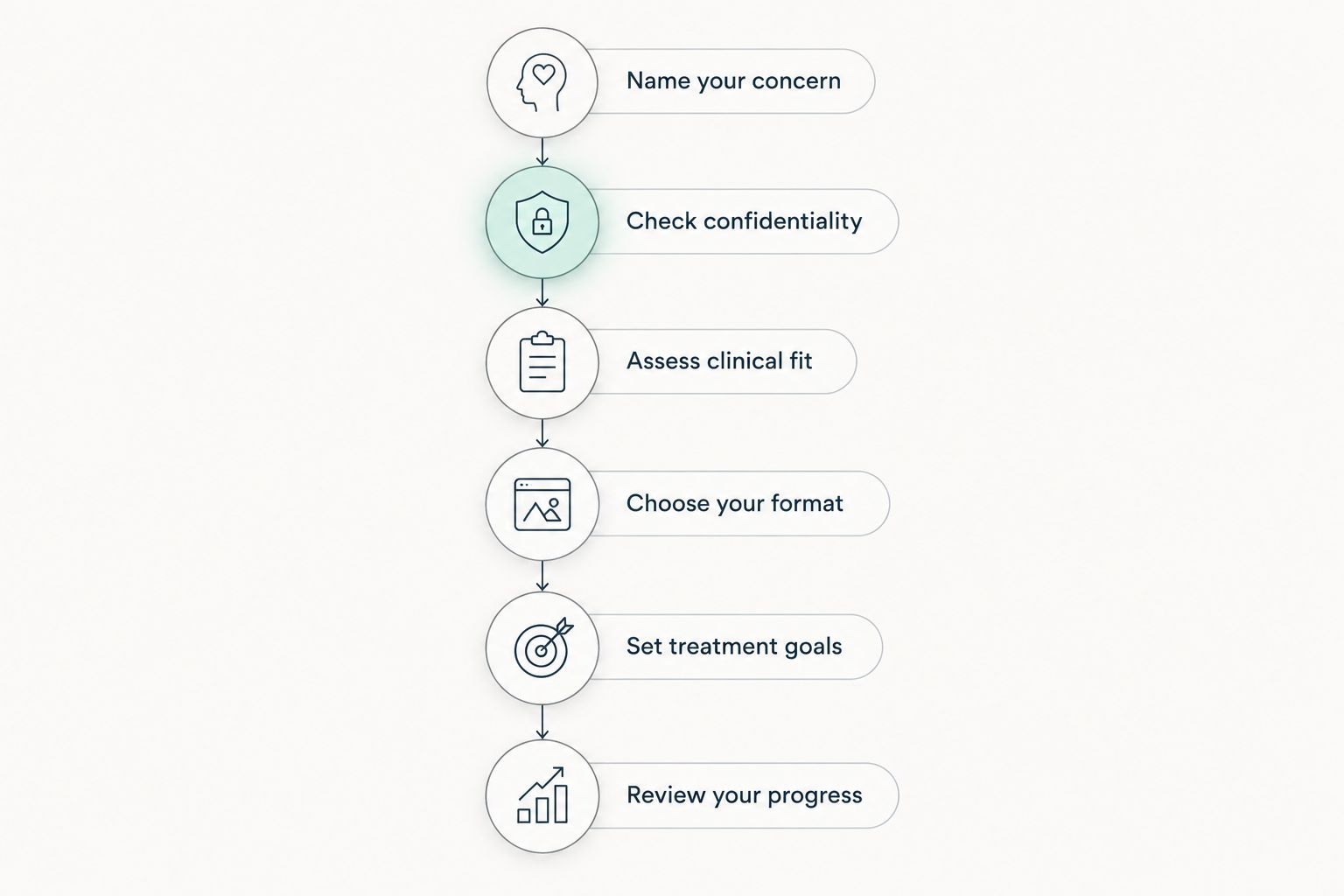
Start with a written description of what is happening, then check privacy, clinical fit, and practical access. You do not need an app or an employer referral to organize these questions.
Name your concern
Use a private note to describe what you want help with before searching for a therapist. Spend 5 minutes recording what happens before, during, and after a difficult workday; this is a preparation exercise, not a screening test.
Separate observations from labels. For example, difficulty sleeping after a distressing shift describes an experience; deciding that it must be PTSD skips the assessment. Burnout, depression, anxiety, trauma-related symptoms, and physical health problems can require different responses.
Include life outside work. A therapist needs to understand whether distress follows particular assignments or continues across days off, relationships, and activities you normally enjoy.
- Record changes in sleep, mood, concentration, and relationships.
- Note whether symptoms appear mainly at work or across settings.
- Describe alcohol or other substance use without minimizing it.
- Identify what you want to discuss first, without patient identifiers.
Check confidentiality
Read the practice’s privacy information and prepare questions before disclosing sensitive workplace details. Therapy is confidential, but confidentiality has legal exceptions; it is not a promise that no information can ever be disclosed.
Ask how clinical records differ from billing information, whether insurance claims include a diagnosis, and who receives communications. Employer-sponsored services require their own questions about eligibility verification, reporting, and record access. Do not assume an employee benefit follows the same information flow as independently arranged care.
Licensing, credentialing, and employment forms are separate matters. Read the exact wording of any form rather than assuming that receiving therapy automatically determines how you must answer it. Obtain qualified guidance when a reporting obligation is unclear.
- Ask the clinician to explain confidentiality and its exceptions.
- Confirm where appointment reminders and billing notices will arrive.
- Ask what information goes to an insurer or benefits administrator.
- Discuss documentation concerns before sharing identifiable workplace details.
Assess clinical fit
Prepare 3 questions: What experience do you have with healthcare workers? How would you assess my concerns? How will we decide whether treatment is helping? A clinician’s answers should explain a process, not promise a result.
Counselingcharlotte provides counseling for several concerns relevant to this search, including anxiety, depression, and trauma. That service range is a starting point—not proof that every clinician treats every condition or understands every clinical workplace.
If trauma symptoms are your main concern, review trauma and PTSD therapists in Charlotte and ask about assessment and treatment approaches. Discuss whether trauma-focused care is appropriate before committing to a method.
Notice the interaction, too. You should be able to discuss anger, grief, uncertainty, or mistakes without being reduced to your professional role. You do not need a therapist who has held your exact job; you need someone who understands the relevant pressures and works within their competence.
- Ask about experience with your occupation and presenting concern.
- Request a plain-language explanation of the proposed approach.
- Ask how the clinician handles grief, guilt, or moral distress.
- Confirm referral options when your needs exceed the clinician’s scope.
Choose your format
Map your actual work pattern before choosing in-person or virtual appointments. Include rotating shifts, commute time, caregiving responsibilities, and the need to sleep after overnight work. A convenient appointment is not useful if you cannot participate attentively or privately.
Virtual counseling removes travel, but it still requires an appropriate setting. A break room, shared workstation, or parked car within earshot of colleagues does not reliably provide privacy. Do not attend while driving or while responsible for patient care.
Counselingcharlotte offers both in-person and virtual counseling in the Charlotte area. Confirm scheduling arrangements directly; offering virtual care does not establish evening hours, cross-state eligibility, or compatibility with every rotation.
For your 2026 schedule, ask what happens when mandatory overtime disrupts an appointment. Understanding cancellation and rescheduling policies is part of assessing fit, not an administrative detail to leave until later.
- Compare appointment times with your current rotation.
- Identify a private location for virtual sessions.
- Confirm telehealth eligibility where you will physically attend.
- Read cancellation, rescheduling, and communication policies.
Set treatment goals
Write 2 goals in your own words before asking a therapist to help refine them. Choose changes you can recognize, such as being more present with family after work or responding differently when an upsetting memory interrupts your evening.
A useful goal does not demand that you stop having normal emotional responses to difficult work. It describes how you want to function and what support you need. Your therapist can help distinguish symptom treatment from decisions about workload, boundaries, relationships, or medical evaluation.
Keep the plan workable during demanding weeks. If between-session exercises are part of treatment, explain what your schedule permits rather than agreeing to a plan you cannot follow. For 2026, prioritize a repeatable practice over an ambitious routine that depends on an ideal shift pattern.
- Define a change in daily functioning that matters to you.
- Identify a work-related trigger you want to understand.
- Agree on appropriate between-session practice.
- Clarify when additional assessment or another service is needed.
Review your progress
Keep brief notes about meaningful changes and unresolved concerns, then bring them into sessions. You do not need to score every emotion. Look for whether treatment is addressing the problem you named and whether the approach makes sense to you.
Improvement is not simply feeling calm immediately after an appointment. Discuss functioning, symptom patterns, relationships, and your ability to use what you are learning. Also tell your therapist when sessions leave you confused, overwhelmed, or unsure about the plan.
Ask when to review progress rather than imposing a universal treatment deadline. If care is not meeting your needs, discuss adjustments, a different approach, or referral. Changing clinicians is an option, not evidence that you have failed at therapy.
- Bring examples of improvement and continuing difficulty.
- Ask how your current sessions connect to your goals.
- Discuss exercises that are unhelpful or impractical.
- Revisit clinical fit when your needs change.
The sequence keeps practical questions from getting lost: define the concern, understand privacy, assess the clinician, choose the setting, agree on goals, and review the work.
Compare support options for healthcare workers
Choose the option that matches your need, not the one that requires the least explanation. A colleague can understand a difficult shift without being equipped to assess persistent depression or trauma symptoms.
These options serve different purposes. Ask about the actual service, clinician, and terms before deciding; an employer benefit or virtual format does not establish a particular level of care.
| Option | Best for | Main benefit | Key limitation |
|---|---|---|---|
| In-person individual therapy | Workers wanting a separate, private setting | Provides direct clinical assessment and treatment without relying on home privacy | Requires travel and a compatible appointment time |
| Virtual individual therapy | Workers who can attend privately but want to avoid travel | Makes location more flexible within applicable practice rules | Requires privacy, a suitable connection, and location eligibility |
| Employer-sponsored assistance | Workers exploring support through employment benefits | Provides an established route for asking about counseling or referrals | Scope, confidentiality arrangements, and session terms require verification |
| Peer support | Workers seeking understanding from colleagues with related experience | Offers shared occupational context and connection | Does not replace clinical assessment or treatment |
| Couples or family therapy | Workers whose distress is affecting relationships | Addresses interaction patterns and shared concerns | Does not automatically address an individual’s separate treatment needs |
Counselingcharlotte offers individual mental health services alongside couples/family therapy, with in-person and virtual formats. Confirm which service and clinician fit your needs; the practice’s stated services do not establish medication management, occupational evaluations, or emergency response.
Explore counseling for your needs
Review in-person and virtual counseling services for Charlotte-area adults.
Common mistakes nurses and healthcare workers make
Treating every symptom as burnout
Calling everything burnout can hide concerns that deserve assessment. Describe what you experience—including symptoms outside work—rather than asking a therapist only for help tolerating your job. Seek medical evaluation when physical symptoms or sleep concerns require it.
Choosing only by occupational familiarity
A clinician’s experience with healthcare workers matters, but it does not replace competence in your presenting concern. Ask about both. Shared professional language is useful only if the clinician can also explain an appropriate treatment plan.
Waiting until work performance changes
You do not need a disciplinary event or an inability to complete a shift to justify counseling. Changes in relationships, sleep, enjoyment, or emotional recovery are valid concerns to bring to an assessment. Your personal well-being matters independently of your productivity.
Sharing patient details to prove the story
You can discuss your emotional response without naming patients or supplying identifying combinations of details. Ask your therapist how to describe an event while respecting your professional obligations. The focus is your experience, not reconstructing a patient’s record.
Asking therapy to solve an organizational problem
Therapy can address your response to workplace stress; it cannot make unsafe conditions acceptable. Keep treatment goals separate from staffing, accommodation, grievance, or safety-reporting processes. Use the appropriate professional channels for those issues.
FAQ
What’s the best therapy for nurses and healthcare workers?
The best therapy matches your assessed concern, treatment goals, and practical needs—not your job title alone. Ask the clinician about relevant experience, the proposed approach, and how progress will be reviewed.
How do I know whether I need therapy or just time off?
A clinical assessment can help clarify distress that persists, affects daily life, or concerns you. Rest and workplace changes can matter alongside treatment; you do not have to choose between them before asking for help.
Will my employer find out that I’m seeing a therapist?
Do not assume your employer receives therapy records automatically, but verify how your particular service handles information. Ask about confidentiality exceptions, employer-sponsored benefit reporting, billing, and any authorization you are asked to sign.
Is virtual therapy better for nurses who work night shifts?
Virtual therapy avoids travel, but the better format depends on appointment timing, privacy, and your ability to participate. Confirm actual scheduling options rather than assuming virtual care includes overnight or evening appointments.
Can a therapist help with guilt after a patient dies?
A therapist can help you discuss grief, guilt, and distress after a patient’s death and assess what support is appropriate. Therapy does not determine professional liability or replace a workplace review process.
Does getting therapy affect my nursing license?
Receiving therapy does not by itself answer a licensing or credentialing question. Review the current form and applicable requirements, and seek qualified guidance about your circumstances rather than relying on a general assurance.
Can I discuss patient-care experiences in therapy?
You can discuss your reactions to patient-care experiences while avoiding patient identifiers. Ask your therapist how to keep the conversation focused on your experience and consistent with your professional confidentiality obligations.
What should I do if I feel unsafe or might hurt myself?
In the United States, call or text 988 for crisis support; call 911 or go to an emergency department for immediate danger. Routine therapy appointments and scheduling messages are not substitutes for emergency care.
One last thing
You do not have to make therapy sound like a clinical handoff. Bring the sentence you would normally leave out: that you feel numb at home, resent another shift, or cannot stop revisiting an encounter. Start there.
For your first appointment in 2026, write down what you want help with and what would make the conversation feel safe. You are attending as a person receiving care—not as the professional responsible for everyone else.


