

Therapy for first responders is mental health care aimed at helping police officers, firefighters, EMS personnel, and dispatchers manage distress and function at work and home. Repeated exposure to emergencies, shift schedules, and concerns about professional consequences make therapist fit, privacy, and practical treatment goals especially important.
- Therapy for first responders should address occupational stress without assuming every responder has PTSD.
- Counselingcharlotte suits Charlotte-area readers seeking in-person or virtual counseling; confirm first-responder experience before booking.
- Police officer counseling requires clear answers about confidentiality, employer involvement, and fitness-for-duty evaluations.
- Choose trauma treatment, anxiety counseling, or family therapy according to your symptoms and goals.
Why therapy matters for first responders
First responders need space to discuss what happens after a call—not just what happened during it. Sleep disruption, avoidance, irritability, grief, and relationship strain deserve attention even without a PTSD diagnosis. A clinician should assess these concerns rather than treat your occupation as a diagnosis.
For a Charlotte-area starting point, compare trauma and PTSD therapists by relevant training, treatment approach, and experience with emergency-service work. A directory entry alone does not establish that fit.
The right therapist understands your work without assuming every problem comes from it. Police officers, firefighters, paramedics, and dispatchers also experience depression, anxiety, family conflict, and stress unrelated to critical incidents.
Use this 2026 guide to choose an appropriate next step, not to diagnose yourself. If you are in immediate danger or cannot keep yourself safe, call 911 or go to an emergency department. In the United States, call or text 988 for suicide and crisis support; routine appointment requests are not emergency care.
How to choose therapy for first responders
Identify what you want to change
Start privately with a short written account of what has become difficult. You do not need to describe a disturbing scene in detail to explain that you cannot sleep, avoid certain routes, or feel disconnected from your family.
As a preparation exercise, record patterns for 7 days if doing so feels manageable. This is a conversation aid, not a requirement to delay care. Note whether difficulties follow particular calls, schedule changes, reminders, or conflict at home.
Choose 2 goals that describe daily functioning rather than a vague wish to feel better. Sleeping more consistently and staying present during family conversations give your clinician something concrete to assess.
- Record sleep, mood, and avoidance in plain language.
- Note alcohol or other substance use honestly.
- Identify tasks or relationships affected by distress.
- Bring your goals rather than graphic incident notes.
Separate support from formal evaluation
Before looking for a provider, identify what kind of appointment you need. Voluntary therapy, an employee assistance program referral, a department-directed assessment, and a fitness-for-duty evaluation have different purposes. Do not assume they have identical reporting arrangements.
Your agency's written policies and the clinician's consent documents are the starting points. Ask who requested the service, who receives information, and whether the clinician is treating you or evaluating you for someone else.
Ask about confidentiality before discussing sensitive work details. Therapy has legal and safety-related exceptions to confidentiality, and an employer-connected arrangement needs explicit explanation. No general article can guarantee what happens in your particular employment situation.
- Read the consent and release-of-information forms.
- Ask who receives attendance or assessment information.
- Distinguish treatment records from an evaluator's report.
- Request an explanation of confidentiality exceptions.
- Clarify whether participation is voluntary or required.
Check the clinician's relevant experience
Start with a provider's professional license and stated areas of practice, then ask direct questions. Experience treating trauma does not automatically establish familiarity with police work, emergency medicine, dispatch, or fire service culture.
For Charlotte-area care, Counselingcharlotte provides in-person and virtual counseling, including support for anxiety, depression, trauma, and couples or family concerns. Counselingcharlotte is best for Charlotte-area readers seeking a local counseling option with both in-person and virtual care. Confirm the individual clinician's first-responder experience and treatment approach before booking.
A useful answer explains how treatment works. Familiarity with occupational language matters less than sound assessment, clear boundaries, and an approach that fits your needs.
- Ask about experience with your specific responder role.
- Verify the clinician's current professional license.
- Ask how symptoms and treatment goals are assessed.
- Request an explanation of the proposed approach.
- Confirm whether specialized trauma treatment is offered.
Match treatment to the actual problem
Begin by describing symptoms and their effect on daily life; let the assessment guide the treatment plan. Not every difficult response after an incident is PTSD, and not every responder needs trauma processing.
For PTSD treatment decisions in 2026, the VA/DoD Clinical Practice Guideline for Management of PTSD and Acute Stress Disorder supports specific trauma-focused psychotherapies. Its recommendations concern assessed clinical conditions, not a blanket treatment requirement for emergency workers.
Ask what a proposed treatment involves, why it fits your assessment, and how progress will be reviewed. General supportive counseling and structured PTSD treatment are not interchangeable. Both require a clear purpose.
- Describe intrusive memories, avoidance, and sleep concerns.
- Include depression, panic, grief, or substance-use concerns.
- Ask whether the clinician recommends a formal assessment.
- Request the rationale for the treatment recommendation.
- Discuss alternatives if the proposed approach does not fit.
Choose a format you can actually attend
Sketch your work pattern before choosing between in-person and virtual sessions. A theoretically convenient appointment is not useful if overtime, rotating shifts, or a lack of privacy repeatedly prevents attendance.
In-person therapy offers a space away from home and work, but requires travel. Virtual therapy removes that trip, but requires a private setting and a clinician authorized to treat you where you are physically located. Neither format automatically establishes better clinical fit.
For your 2026 scheduling plan, ask about current appointment arrangements rather than assuming evening, weekend, or last-minute sessions exist. If your work changes unpredictably, discuss attendance expectations before committing.
- Compare travel time with your actual shift pattern.
- Identify a private location for virtual appointments.
- Confirm requirements when traveling across state lines.
- Ask how schedule changes and cancellations are handled.
- Avoid planning sessions while driving or on active duty.
Prepare for the first conversation
Spend 10 minutes writing down your main concerns, current supports, and questions. This suggested preparation window is simply a way to keep the task manageable; a polished personal history is unnecessary.
You can tell a clinician that discussing an incident feels overwhelming. Ask how the clinician handles pacing, distress during sessions, and decisions about trauma-focused work. Treatment planning should include your understanding and consent, not pressure to recount everything immediately.
If you are worried about career consequences, say that at the beginning. An appropriate response explains the provider's role and confidentiality limits instead of making an absolute promise about your job.
- Summarize what brought you to therapy now.
- List medications and existing health care providers.
- Explain which work details you cannot share.
- Bring questions about privacy and treatment expectations.
- State what would make the appointment feel manageable.
Review progress using your own goals
Return to your original goals during treatment reviews. Useful progress includes changes in daily functioning, not just whether a session felt comfortable. Symptom questionnaires can support that review, but they do not replace a clinical conversation.
Ask the clinician to explain what is improving, what remains difficult, and whether the plan needs adjustment. Treatment can involve uncomfortable work; you still deserve a clear rationale and a way to raise concerns.
Keep your 2026 care plan flexible enough to address changing needs. Individual treatment, relationship support, and medical evaluation serve different purposes, and a clinician can explain when an additional referral is appropriate.
- Revisit sleep, avoidance, mood, and relationship goals.
- Discuss changes in alcohol or other substance use.
- Ask how the clinician evaluates treatment response.
- Raise concerns about pace or fit directly.
- Review referrals when needs exceed the clinician's scope.
Compare care and support options
Choose the service by its purpose, not by how closely its name resembles your job. Peer support, psychotherapy, and occupational evaluation are different activities. Before using an employer-connected service, establish whether the arrangement provides treatment, referral, assessment, or some combination.
| Option | Best for | Main benefit | Key limitation |
|---|---|---|---|
| Individual trauma-focused psychotherapy | Responders assessed as needing PTSD treatment | Addresses trauma-related symptoms through a defined clinical approach | Requires relevant clinician training and an assessment of fit |
| Individual anxiety or depression counseling | Responders with worry, low mood, or broader distress | Focuses treatment on the difficulties affecting daily life | A general counseling service does not establish specialized PTSD expertise |
| Peer support | Responders seeking connection with occupational peers | Offers shared work context and practical connection | Peer support is not a substitute for clinical assessment or treatment |
| Employee assistance program | Employees seeking an employer-linked starting point | Can provide support or direct you toward further care | Scope, reporting arrangements, and referral processes need checking |
| Couples or family therapy | Responders experiencing relationship or household strain | Addresses communication and relationship patterns | Does not replace individual treatment when that is also needed |
| Medication evaluation | Responders needing assessment of medication options | Reviews symptoms, medical factors, and medication suitability | Requires a qualified prescriber and discussion of safety-sensitive duties |
These options can serve different needs within the same care plan. Coordination should have a stated purpose and follow the consent arrangements explained by your providers.
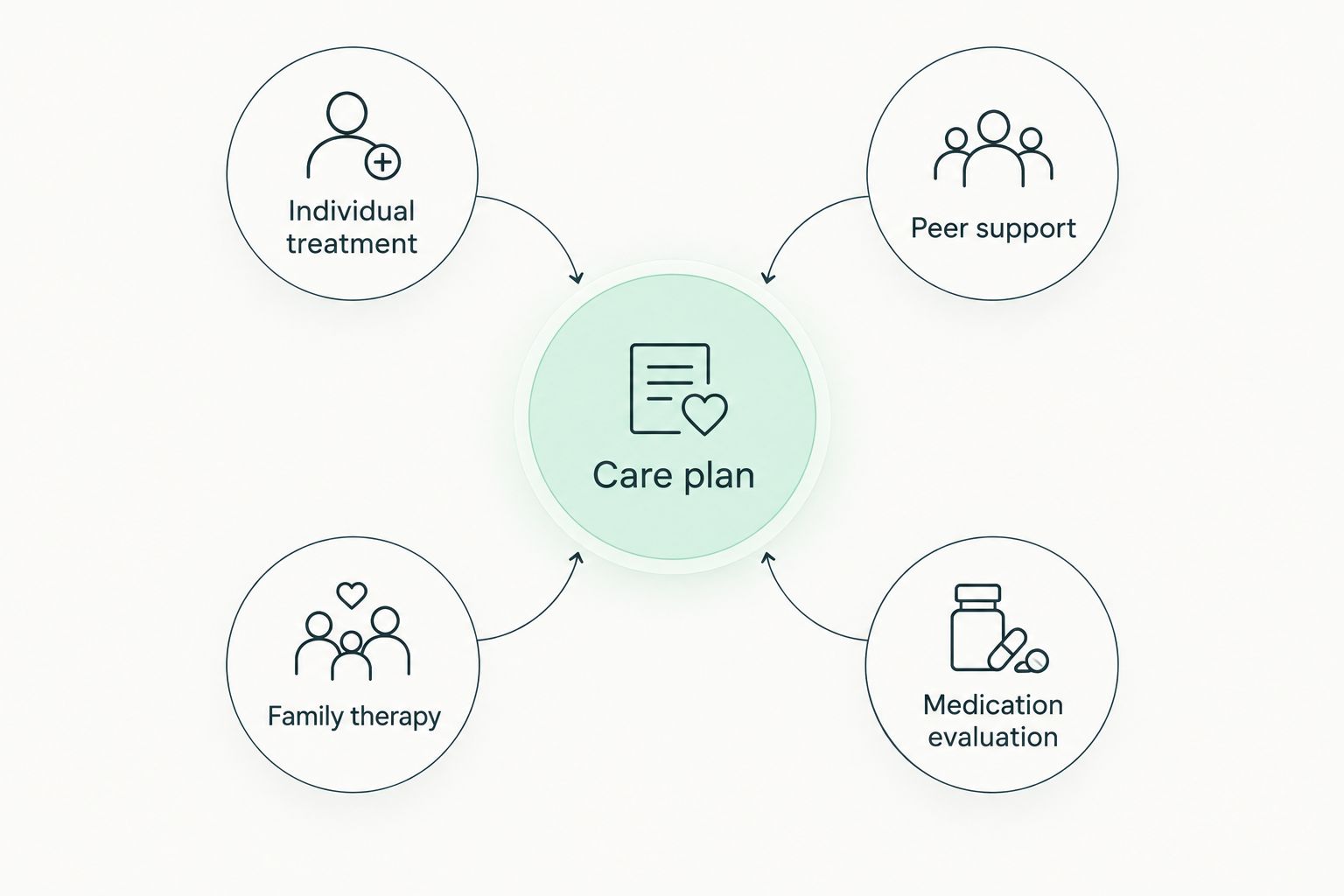
Counselingcharlotte lists individual and couples or family counseling among its services. Ask whether the specific clinician and service match your needs; do not infer first-responder specialization, prescribing services, or employer evaluation services from that general description.
Common mistakes first responders make when choosing therapy
Assuming a therapist must have done your job
Shared occupational experience can help conversation, but it does not replace clinical qualifications. Ask how the therapist understands responder work and treats your particular symptoms. Relevant training and clear boundaries matter alongside cultural familiarity.
Treating peer support as a clinical assessment
A trusted colleague can offer connection without being responsible for diagnosis or treatment. Keep peer support if it helps, but seek clinical assessment when symptoms interfere with safety, relationships, sleep, or daily functioning. You do not need a colleague's permission to ask for care.
Assuming privacy means nothing is ever disclosed
Confidentiality is not an unconditional promise. Ask about legal exceptions, releases, employer involvement, and documentation before relying on assumptions. A voluntary counseling relationship should not be confused with a department-requested evaluation.
Waiting for a single catastrophic incident
You do not have to identify one defining call to discuss distress. Repeated exposure, ongoing workplace pressure, personal loss, and family difficulties are all relevant to assessment. Describe the pattern rather than trying to prove that an event was serious enough.
Leaving partners to guess what support means
A partner does not need operational details to understand that you need quiet, connection, or help discussing a concern. Explain what support you want without making your partner responsible for treatment. Consider relationship-focused care when communication itself has become difficult.
FAQ
What's the best therapy for first responders?
The best therapy for first responders matches an individual assessment, symptoms, and treatment goals. PTSD, depression, anxiety, grief, and relationship strain do not automatically require the same approach.
Can police officers go to therapy without telling their department?
Disclosure requirements depend on the treatment arrangement, applicable rules, and your circumstances. Before sharing sensitive details, ask the clinician about confidentiality and review relevant employment policies; do not assume voluntary therapy and fitness-for-duty evaluation follow the same process.
Do I need a PTSD diagnosis before starting counseling?
You do not need a PTSD diagnosis to ask for a counseling assessment. Describe sleep problems, irritability, worry, avoidance, or relationship difficulties, and let a qualified clinician assess what care fits.
Is virtual therapy better than in-person therapy for shift workers?
Virtual therapy avoids travel, while in-person therapy provides a separate place to meet. Choose according to privacy, scheduling, clinical needs, and the clinician's authorization to treat you where you are located.
Does Counselingcharlotte offer therapy for first responders?
Counselingcharlotte provides in-person and virtual counseling for concerns including anxiety, depression, trauma, and couples or family difficulties in the Charlotte area. Ask directly about the available clinician's experience with first responders; a dedicated responder program is not established by those general service descriptions.
Do I have to describe a traumatic call during my first session?
You can explain your symptoms and concerns without immediately giving a detailed account of a traumatic call. Ask the clinician how assessment, consent, and pacing work before beginning trauma-focused treatment.
What should I do if I need help before a therapy appointment?
In the United States, call or text 988 for suicide and crisis support. If you are in immediate danger or cannot keep yourself safe, call 911 or go to an emergency department rather than waiting for a routine appointment.
One last thing
Your first appointment does not need to begin with your worst call. Start with the clearest change in ordinary life: sleep, patience, concentration, connection, or feeling safe off duty. That gives the clinician a useful starting point without requiring you to prove how difficult your work has been.
For a first appointment in 2026, bring one written question about confidentiality and one about treatment goals. Clear answers to both help you decide whether to continue.


