

Yes—therapist-guided online therapy can be as effective as in-person therapy for many adults, particularly when both formats deliver the same evidence-based treatment for anxiety or depression. That finding does not make every therapy app, messaging service, or treatment interchangeable. For your 2026 decision, match the treatment, privacy, and level of support to your needs—not just the appointment format.
- Is online therapy as effective as in-person therapy? Often, yes, when treatment and therapist involvement are comparable.
- Research on therapist-guided remote CBT does not establish that every therapy app matches office-based treatment.
- Choose video therapy when privacy, technology, and clinical suitability support meaningful participation.
- Counselingcharlotte offers Charlotte-area mental health counseling in both virtual and in-person formats.
Why this matters
Choose the treatment first and the delivery format second. A convenient appointment is useful only if you can speak openly, participate fully, and receive care suited to your concerns. An office visit is not automatically better, and a video appointment is not automatically equivalent.
For a local starting point, Counselingcharlotte provides in-person and virtual counseling for children, teens, and adults in the Charlotte area. When comparing providers in 2026, ask how each therapist decides whether remote treatment fits your situation.
Is online therapy as effective as in-person therapy?
Research supports comparable outcomes for therapist-guided remote cognitive behavioral therapy and in-person CBT across several adult conditions. A systematic review and meta-analysis published in CMAJ, titled Therapist-guided remote versus in-person cognitive behavioural therapy, included 54 randomized trials involving 5,463 adults. The review found moderate-certainty evidence of little to no difference in effectiveness between the delivery formats.
That evidence concerns structured treatment with therapist involvement. It does not establish that an unguided app, occasional text exchange, and a full psychotherapy appointment deliver the same care. It also does not prove equivalence for every diagnosis, age group, or level of clinical complexity.
| Format | Best for | Main advantage | Main limitation |
|---|---|---|---|
| Live video therapy | People who can participate privately from a suitable location | Removes travel while retaining real-time conversation | Depends on a usable connection and a confidential setting |
| In-person therapy | People who need or prefer a shared clinical space | Separates therapy from home and allows fuller observation | Requires travel and attendance at a physical location |
| Messaging-based support | People seeking written communication within an appropriate care plan | Lets you express thoughts in writing | Does not provide the same interaction or immediate response as a live session |
| Self-guided mental health apps | People seeking exercises or reminders alongside appropriate support | Makes practice materials accessible between appointments | Does not replace individualized assessment or therapist-led treatment |
The practical question is whether your therapist can deliver the intended treatment well in the chosen setting. Ask what happens during sessions, what you will practice between appointments, and how you will know whether treatment is helping. A format comparison without those details leaves out the care itself.
When live video therapy is a good fit
Live video therapy fits people who can speak freely, stay engaged, and use the treatment tools remotely. It removes the commute and lets you attend from an appropriate private location. Those advantages matter when transportation, mobility, or scheduling makes office attendance difficult.
The limitation is that your surroundings become part of the appointment. A shared bedroom, an interrupting household member, or an unreliable connection can prevent the conversation you need to have. Headphones help with listening privacy, but they do not stop someone nearby from hearing your voice.
Before choosing video therapy, check whether you can discuss the hardest topic—not just routine updates—from your planned location. If the answer is no, resolve the privacy problem before treating remote appointments as a workable substitute. Convenience should not require you to censor clinically important information.
When in-person therapy is a better fit
In-person therapy fits people who need a separate, private treatment setting or participate better face to face. The office creates a boundary between daily life and the appointment. It also gives the therapist a broader view of your movement and nonverbal communication than a typical camera frame allows.
The trade-off is travel. You must reach the office and build the appointment into your day, which can complicate attendance. That burden deserves consideration, but it does not outweigh a genuine need for privacy or a clinician's recommendation about the setting.
In-person care is especially relevant when a therapist needs materials, activities, or observation that are difficult to reproduce remotely. Ask what the office setting adds to your specific treatment rather than assuming that being in the same room guarantees better results.
Why therapy effectiveness varies
The research comparison does not erase individual differences. These factors help explain why one person progresses with video sessions while another needs a different setting or treatment plan:
- Treatment match: The approach must address the problem you want to change. A delivery format cannot compensate for an unsuitable treatment.
- Therapist involvement: Guided treatment includes assessment, feedback, and adjustments. Access to content alone is a different service.
- Privacy: You need enough confidentiality to describe symptoms, relationships, and safety concerns honestly.
- Participation: Interruptions, multitasking, and technical problems can interfere with the work you do during sessions.
- Therapeutic relationship: You need to understand the plan and feel able to question, disagree with, or give feedback to your therapist.
- Clinical needs: Symptoms, communication needs, developmental stage, and safety concerns affect whether remote care is appropriate.
For a 2026 provider comparison, turn these factors into questions. Ask how the therapist adapts treatment remotely and what would trigger a recommendation to change formats. A clear answer should address your situation rather than promise that either setting works for everyone.
How do you choose between online and in-person therapy?
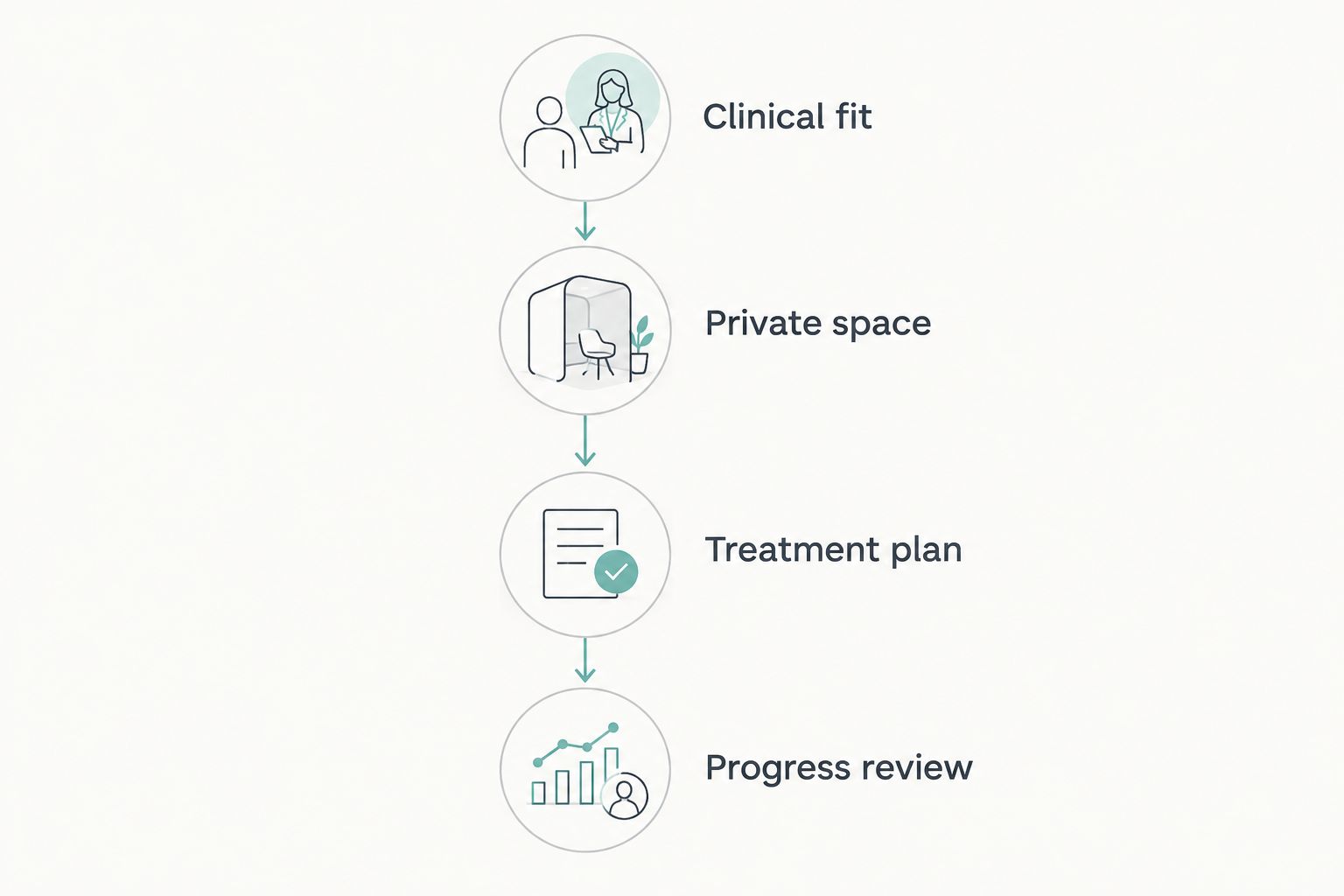
Use a short decision process before booking. Start with whether the care is appropriate, then consider whether you can participate consistently.
- Clinical fit: Describe your concerns and ask whether remote treatment is appropriate. Include symptoms or circumstances that could affect safety or participation.
- Private space: Identify where you would attend and who could overhear you. Check whether you can use that space consistently.
- Treatment plan: Ask which approach the therapist recommends and what sessions involve. Clarify whether the service is live video, telephone, messaging, or a combination.
- Progress review: Agree on what improvement would look like and when you will discuss it. Include what happens if the format interferes with treatment.
Do not make the decision around camera comfort alone. Feeling awkward on video is different from being unable to disclose a safety concern because someone is listening. Tell the therapist which obstacle you face so the response addresses the actual problem.
Does online therapy work for anxiety and depression?
Therapist-guided online treatment can help with anxiety and depression, and remote CBT has comparative evidence supporting its use. The important distinction is between receiving an appropriate psychological treatment remotely and simply using a mental health website or app.
Ask the therapist to explain how the proposed approach addresses your symptoms. For example, a CBT plan can involve identifying unhelpful patterns, practicing skills, and changing behaviors between appointments. The delivery method should support that work rather than reduce sessions to general conversation without agreed goals.
Do not interpret the research as a promise about your individual outcome. If symptoms worsen or progress stalls, discuss the treatment plan, the relationship, and the appointment setting. Changing only the screen-to-office arrangement does not necessarily resolve a treatment mismatch.
Is online therapy suitable for children, teens, and couples?
Online therapy requires an age-appropriate and situation-specific assessment for children, teens, and couples. The adult CBT evidence described above does not answer every question about these groups. Ask about the therapist's experience with your child's developmental stage or your relationship concerns.
For children, consider attention, caregiver participation, and whether the therapist uses activities that need adaptation. For teens, confidentiality at home deserves explicit discussion. A teenager who fears being overheard needs more than reassurance that the video connection is secure.
For couples, both partners need a setting where they can participate freely. Fear, coercion, or violence requires a separate safety assessment; a shared video appointment is not an automatic solution. Tell the clinician about these concerns before arranging a joint session.
When should you seek more support than routine online therapy?
Routine outpatient therapy—online or in person—is not an emergency service. Immediate danger, an inability to stay safe, or rapidly worsening symptoms requires urgent assessment rather than waiting for the next appointment. A scheduled video session should not be your only safety plan.
In the United States, call or text 988 for suicide and crisis support. Call 911 for immediate danger or a medical emergency. These services serve different purposes from ongoing counseling.
Before remote treatment begins, ask how the therapist handles urgent concerns, a dropped connection, and emergencies at your physical location. Also ask what contact outside appointments includes. Do not assume that access to a messaging feature means continuous monitoring or immediate replies.
How can you tell whether your therapy format is working?
Judge the format by whether it supports treatment—not by whether appointments feel convenient. You should be able to speak honestly, understand the plan, and give feedback about what is or is not helping. Your therapist should review progress with you rather than leave success undefined.
Choose goals tied to daily life: attending an activity you have been avoiding, responding differently during conflict, or completing an agreed treatment exercise. The goals should reflect your concerns, not a generic promise to feel better. Ask whether symptom questionnaires would help track change alongside those goals.
For your 2026 treatment plan, agree on a review point with the clinician rather than adopting an arbitrary session deadline. If video interruptions repeatedly disrupt difficult conversations, discuss a setting change. If the setting works but symptoms do not improve, review the treatment itself.
Choosing local counseling in Charlotte
Counselingcharlotte suits Charlotte-area readers seeking a practice that offers both in-person and virtual mental health counseling. Its stated services include anxiety, depression, trauma, OCD, and couples or family therapy for children, teens, and adults. That makes appointment format a relevant question to raise alongside the concern bringing you to counseling.
The availability of both formats does not establish which one is appropriate for you or whether a particular clinician uses the treatment you need. Ask directly about clinical fit, the proposed approach, and whether changing formats would require changing therapists. Confirm those details before committing to a plan.
FAQ
Is online therapy as effective as in-person therapy in 2026?
Therapist-guided online therapy can be as effective as in-person therapy for many adults, particularly when the treatment approaches are comparable. Research on remote CBT does not establish that every app, messaging service, or therapy format produces equivalent results.
Is video therapy the same as texting a therapist?
Video therapy is not the same as texting a therapist. Live appointments allow real-time interaction, while messaging has different response expectations and does not provide the same observation or immediate exchange.
Should I choose in-person therapy if I have no privacy at home?
In-person therapy is a practical choice when you cannot speak confidentially at home. You can also discuss another appropriate private location with the therapist before deciding whether video appointments are workable.
Can children and teenagers benefit from online counseling?
Children and teenagers can benefit from online counseling when the treatment and format fit their developmental and clinical needs. Ask how the therapist handles attention, caregiver involvement, and confidentiality.
Can I switch from online therapy to office visits?
Ask your provider whether switching between video and office visits is possible. Confirm whether the same therapist can continue your care and whether the treatment plan needs adjustment.
Does Counselingcharlotte offer online and in-person counseling?
Counselingcharlotte provides both in-person and virtual mental health counseling in the Charlotte area. Ask which format and clinician fit your concerns, age group, and treatment needs.
What should I do if I need immediate mental health help?
Call or text 988 in the United States for suicide and crisis support, or call 911 for immediate danger or a medical emergency. Do not wait for a routine online or office therapy appointment if you cannot stay safe.
One last thing
Use this question in your 2026 consultation: “What would make you recommend changing my treatment format?” It asks the therapist to explain the limits of the proposed arrangement before those limits become obstacles. A useful answer connects privacy, participation, symptoms, and safety to a clear next step—not a blanket preference for online or office care.


