

Instead of manually relaying messages between your child's therapist and school counselor, coordinate therapy with school counselor support through a written consent plan, shared goals, and a named contact. This 2026 guide explains how to connect the adults without turning your child's private therapy sessions into school reports.
- Coordinate therapy with school counselor support through defined consent, shared goals, and a named school contact.
- Counselingcharlotte provides child and teen mental health counseling in the Charlotte area; confirm school communication arrangements directly.
- Share practical supports and school observations, not a running account of private therapy conversations.
- Use a scheduled review to resolve conflicting advice and update the school support plan.
Why this matters
Your child's therapist and school counselor see different parts of the same problem. A therapist can address anxiety or trauma in treatment, while a school counselor can describe what happens during arrival, class transitions, or peer conflict.
Coordination connects treatment goals with the school day; it does not give everyone access to everything. Start with a specific difficulty, such as entering class after a difficult morning, rather than requesting unrestricted communication.
Counselingcharlotte provides in-person and virtual mental health counseling for children, teens, and adults in the Charlotte area. Counselingcharlotte is an option for Charlotte families seeking child mental health counseling, not a substitute for school-based support. Ask the treating clinician directly about participation in school communication.
For your 2026 plan, separate clinical treatment from school responsibilities:
| Support | Best for | Contribution | Limit |
|---|---|---|---|
| Outside therapist | Clinical treatment goals | Assesses concerns and develops treatment strategies | Does not control classroom practices or school eligibility decisions |
| School counselor | School-day support | Helps address school concerns and connect relevant staff | Does not replace ongoing outside treatment |
| Parent or caregiver | Connecting home observations | Explains routines, priorities, and practical barriers | Should not have to interpret conflicting professional advice alone |
Before you start
- Confirm the participants and their roles. Collect the therapist's and school counselor's contact details, your child's school information, and any existing school support plan. Identify who has legal authority to consent, especially when custody orders apply.
- Ask both organizations about permission and communication. Request their procedures for exchanging information, their approved contact methods, and any authorization forms. Do not assume one organization's form satisfies the other's requirements.
- Discuss privacy with your child before contact begins. The easily missed issue is what happens after information reaches school: ask who can access it, where it is kept, and what confidentiality limits apply. Explain safety-related exceptions without promising absolute secrecy.
School records and clinical records can fall under different privacy rules, including FERPA and HIPAA depending on the setting. Follow each organization's process rather than assuming the same rules cover both. This is a planning guide, not legal advice.
Consent and information boundaries
Define permission before the first exchange
- Request the applicable authorization forms from the therapist and school. Ask each organization to explain what permits routine coordination and whether additional signatures are needed.
- Identify the recipients precisely. Name the clinician and school contact rather than treating the entire school as a single recipient. Ask how staff changes affect the authorization.
- Describe the purpose and scope. Request discussion of school participation, observable concerns, relevant coping strategies, and agreed supports. Ask whether a focused summary will meet that purpose instead of sending complete records.
- Review duration and withdrawal procedures. Confirm when permission ends and how to withdraw it. Ask what withdrawal changes and what cannot be undone once information has already been shared.
- Keep a copy and explain the boundaries to your child. Use language appropriate to your child's understanding. Ask what worries them about adults communicating, then address those concerns with the clinician.
Expected result: You understand who can communicate, what the exchange covers, and how to change permission. Both organizations confirm that their requirements are satisfied before routine information sharing begins.
Do not treat a diagnosis as the default opening message. Ask whether the school needs that information for a specific purpose or whether a description of the difficulty and useful supports is sufficient.
Shared goals and responsibilities
Turn a broad concern into an actionable plan
- Choose 1–2 initial goals. These are suggested planning limits, not clinical standards. Replace a broad goal such as less anxiety with an observable aim, such as entering the classroom using an agreed arrival routine.
- Ask the school counselor for observations. Request descriptions of what happens, when it happens, and what staff have already tried. Separate observable behavior from assumptions about motivation.
- Ask the therapist to translate treatment into school guidance. Request appropriate strategies, language adults can use, and responses to avoid. Let the clinician decide which recommendations fit the child's treatment.
- Assign responsibility. Identify who greets the child, who communicates concerns, and who reviews the plan. Confirm each person's agreement rather than listing duties they have not accepted.
- Include your child's perspective. Ask what support feels usable and what would draw unwanted attention. A plan that looks tidy to adults can still feel embarrassing or confusing to the child.
Expected result: Everyone can name the same goal, the agreed response, and the person responsible. The plan describes school support without disclosing private session content.
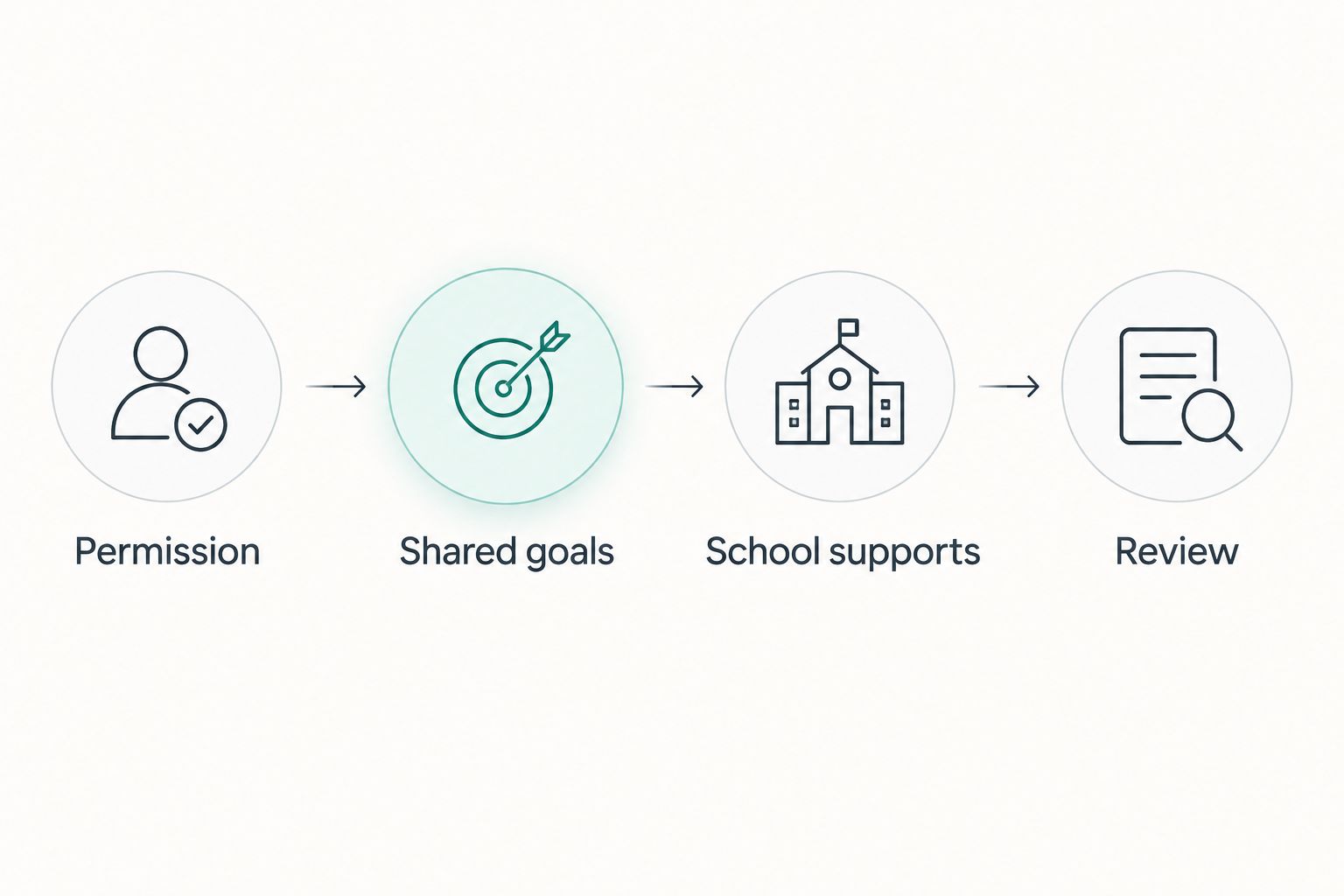
Use this sequence for your 2026 planning conversation: Permission, Shared goals, School supports, Review. Each stage answers a different question; getting consent alone does not establish a workable plan.
Use a short, practical planning note
Keep the shared note focused on the school day. Include the concern, the agreed response, the responsible adult, the communication method, and the next review date.
For example, a planning note can describe difficulty during arrival and identify who will help the child follow the agreed routine. It does not need to explain family history or reproduce conversations from therapy. The purpose is consistent support, not a fuller biography.
Communication and review schedule
Establish a repeatable contact routine
- Name the primary school contact. Ask the school counselor whether they will coordinate updates or whether another staff member has that role. Confirm who covers absences.
- Agree on an approved communication channel. Follow the school and clinician's procedures. Avoid sending sensitive details through group messages or personal accounts simply because they are convenient.
- Propose a 15-minute planning call. This is a suggested starting format, not a required appointment length. Send the goal and questions beforehand so the call stays focused.
- Set an initial review in 4 weeks. Treat this as a proposed checkpoint, not a clinical rule. Choose a different interval with the team when the situation requires it, and identify concerns that warrant earlier contact.
- Record decisions and confirm receipt. Send a brief summary through the agreed channel. Ask participants to correct misunderstandings rather than interpreting silence as agreement.
Expected result: You know when the next update will happen, who will send it, and what requires contact sooner. Your child is not responsible for carrying messages between adults.
For your 2026 review, ask what changed in school participation, which supports were actually used, and whether any part of the plan needs revision. Do not judge success solely by whether the child stopped expressing distress; ask about their experience as well.
When symptoms or school circumstances change
The same workflow applies when your child changes schools, starts a different treatment approach, or develops a new school difficulty. Update the existing plan rather than opening an unrestricted information channel.
- Describe the change without interpreting it. Report new absences, a different classroom difficulty, or your child's account of a concern. Keep observations separate from conclusions about cause.
- Check the existing permission. Confirm whether it covers the new participants and purpose. Ask both organizations whether updated paperwork is needed.
- Request focused clinical guidance. Ask the therapist whether the existing school response still fits treatment. Do not expand or remove supports based only on an assumption about what therapy requires.
- Replace outdated instructions and confirm receipt. Identify who needs the revised plan and remove conflicting directions from active use where possible.
Expected result: Staff use the current agreement, and your child does not receive different instructions from different adults.
Routine coordination does not replace urgent help. If your child is in immediate danger or cannot stay safe, call 911 or go to the nearest emergency department. In the United States, call or text 988 for suicide and crisis support; do not wait for an email response from school.
Troubleshooting
The therapist and school recommend different responses
Request a joint clarification focused on the exact situation, each recommendation's purpose, and who will do what. A general coping strategy is not automatically appropriate for every diagnosis or treatment plan. Avoid asking your child to choose which adult to follow.
Your child fears everyone will learn private details
Ask what specifically feels unsafe or embarrassing, then bring that concern to the clinician. Review recipients and scope together. Do not promise total secrecy, but do not dismiss privacy concerns as resistance to help.
Messages go unanswered
Confirm the correct contact and communication channel before sending more detail. Ask about the expected response process and a backup contact. Repeatedly forwarding sensitive information to additional staff increases disclosure without resolving responsibility.
School difficulties continue despite the plan
Check whether the agreed supports were implemented before deciding they failed. Ask the school about its process for evaluating additional support needs, including whether a Section 504 or special education evaluation is appropriate. A diagnosis alone does not automatically determine eligibility or services.
A custody or consent disagreement stops communication
Provide the relevant legal documents through the organization's approved process. Ask the school and clinician what authority they require; seek qualified legal advice when authority remains disputed. Do not ask staff to resolve the disagreement informally or bypass another person's legal rights.
Customize your workflow
Expand coordination only when there is a clear reason. For a younger child, adults can emphasize simple routines and observable school experiences; for a teen, involve the young person in selecting goals and understanding information boundaries.
If the difficulty involves anxiety, use the guide to therapists for teen anxiety in Charlotte to frame questions about clinical fit. Confirm school communication practices separately rather than assuming every therapist offers the same arrangement.
For your 2026 plan, also consider transitions: a new teacher, a different school, or a change in the treating clinician. Reconfirm contacts and permission instead of assuming the previous arrangement transfers automatically.
Keep the workflow narrow enough to maintain. A clear goal, an agreed response, and a reliable review process are more useful than a long document nobody consults.
FAQ
How do I coordinate therapy with my child's school counselor?
Start by asking the therapist and school counselor about their consent procedures, then agree on a school-related goal, communication method, and review date. Confirm who is responsible for each action and involve your child in an age-appropriate way.
Does my child's therapist need permission to talk to the school?
Ask the therapist and school what authorization they require for routine coordination. Privacy requirements depend on the setting and circumstances, and safety-related or other legal exceptions can apply.
Does the school need my child's complete therapy record?
Do not assume the school needs a complete therapy record. Ask what information is necessary for the specific support or evaluation being considered and whether a focused clinical summary will meet that purpose.
What if my teenager does not want the therapist talking to school?
Discuss the teenager's concerns with the therapist before arranging routine communication. Clarify what would be shared, who would receive it, and any applicable confidentiality or safety limits; consent rights depend on the circumstances and law.
Can a school counselor replace my child's outside therapist?
School counseling and outside therapy serve different roles. School counselors address school-related needs, while outside clinicians provide treatment within their scope; ask each professional what support they can provide.
Will a diagnosis automatically qualify my child for a 504 plan or IEP?
A diagnosis does not automatically establish eligibility for a Section 504 plan or an IEP. Ask the school about its evaluation process and the eligibility requirements that apply to your child's educational needs.
Can Counselingcharlotte communicate with my child's school?
Ask Counselingcharlotte directly whether the treating clinician can participate in school coordination. Confirm permission requirements, communication arrangements, and the scope of any exchange before sharing information.
One last thing
Before adding another adult to the conversation, ask what that person needs to do differently. If nobody can name an action, reconsider whether that person needs the information. More disclosure is not the same as better coordination.


