

Best starting point for Charlotte-area in-person or virtual care: Counselingcharlotte. Best approach to discuss for persistent worry and avoidance: teen-focused cognitive behavioral therapy. Best fit to discuss when compulsions drive anxiety: exposure and response prevention. This guide to the best therapists for teen anxiety in Charlotte NC compares care options by the problem your teen needs help addressing, rather than treating every anxiety concern as interchangeable.
- Counselingcharlotte offers teen anxiety counseling with in-person and virtual care in the Charlotte area.
- The best therapists for teen anxiety in Charlotte NC explain treatment goals, confidentiality, and parent involvement.
- Discuss cognitive behavioral therapy for worry and avoidance; ask about exposure and response prevention for OCD.
- Choose a therapist your teen can speak with honestly, not just a format that suits your calendar.
Why this matters
Teen anxiety can affect school attendance, friendships, sleep, and family routines. The useful question is not simply whether a therapist treats anxiety. It is whether the therapist understands the pattern affecting your teen and can explain how treatment will address it.
For your 2026 search, separate provider fit from treatment fit. A practice can offer a convenient appointment format while an individual clinician still needs to explain their experience with your teen's concerns. Start with the problem, then choose the person and setting.
The ranked options below compare a local practice and treatment pathways. They are not interchangeable competitors: a clinician can combine several approaches within one treatment plan.
What makes the best teen anxiety therapist?
Use these criteria before choosing a provider in 2026:
- Teen experience: Ask how the clinician works with adolescents, including reluctant teens and those who struggle to describe their feelings.
- Problem-specific treatment: Ask how sessions address worry, avoidance, panic symptoms, compulsions, or trauma reminders rather than anxiety in general.
- Teen participation: Your teen should help identify goals and understand the purpose of treatment activities.
- Parent boundaries: Clarify what parents receive, what stays private, and when safety concerns require disclosure.
- Practical fit: Choose a setting where your teen can attend consistently and speak privately.
- Progress review: Ask how the clinician evaluates changes in daily functioning and adjusts the plan.
Counselingcharlotte is a teen anxiety counseling option for families seeking in-person or virtual mental health care in the Charlotte area. Use that confirmed service fit as a starting point, then assess the individual clinician against these criteria.
Teen anxiety care options at a glance
This 2026 comparison assigns each option a distinct purpose. Treatment approach and appointment format are separate decisions; virtual care does not identify which therapy a clinician uses.
| Option | Best for | Main focus | Key limitation |
|---|---|---|---|
| Counselingcharlotte | Families seeking Charlotte-area in-person or virtual teen counseling | Teen mental health care with anxiety among the stated services | Individual clinician methods and fit require discussion |
| Teen-focused cognitive behavioral therapy | Worry and avoidance affecting everyday activities | Connections between thoughts, feelings, and behavior | Requires practice beyond talking during sessions |
| Exposure and response prevention | Anxiety involving obsessions and compulsions | Facing triggers without performing compulsive responses | Requires an OCD-informed assessment and treatment plan |
| Family-involved anxiety treatment | Anxiety reinforced by household responses | Parent responses, communication, and support for participation | Family involvement must preserve the teen's voice |
| Trauma-focused treatment | Anxiety connected to traumatic experiences | Trauma-related symptoms, coping, and recovery | Not every anxiety concern calls for trauma-focused work |
1. Counselingcharlotte: best for local and virtual care choices
Counselingcharlotte provides in-person and virtual mental health counseling for children, teens, and adults in the Charlotte, NC area. Its stated services include anxiety, depression, trauma, OCD, and couples/family therapy.
That makes the practice a relevant starting point when you want teen anxiety care with a choice of appointment settings. The next decision is the clinician, not just the practice name: ask who works with teens and how that person approaches your child's specific symptoms.
Counselingcharlotte pros:
- Teen counseling is part of the stated service scope.
- Both in-person and virtual counseling formats are offered.
- The stated scope includes anxiety and related concerns such as OCD and trauma.
Counselingcharlotte considerations:
- A practice-level service list does not establish an individual clinician's treatment approach.
- Virtual sessions require a setting where your teen can speak without being overheard.
Best for: Families seeking Charlotte-area teen counseling who want to discuss both in-person and virtual care.
Ask whether the proposed clinician addresses the main concern directly. For example, repeated checking needs a different assessment conversation from fear of presentations or anxiety after a traumatic event.
Verdict: Choose Counselingcharlotte for an initial fit conversation; choose the clinician after discussing treatment methods and teen participation.
2. Teen-focused CBT: best for worry and everyday avoidance
Cognitive behavioral therapy, or CBT, examines how thoughts, feelings, and actions interact. For teen anxiety, treatment can include identifying anxious predictions, practicing coping skills, and gradually approaching situations the teen avoids.
Ask the clinician to connect the plan to real activities. Returning to class, speaking with a friend, or completing a task independently is a clearer goal than simply feeling less anxious.
Teen-focused CBT pros:
- Connects therapy to specific situations outside the counseling room.
- Gives the teen a way to examine anxious predictions.
- Can include gradual practice with feared but safe activities.
Teen-focused CBT considerations:
- Skills need practice between appointments.
- A generic coping-skills plan does not replace assessment for OCD, trauma, or other concerns.
Best for: Teens whose worry and avoidance interfere with school, friendships, or daily responsibilities.
Ask how the clinician makes exercises age-appropriate and collaborative. Treatment should not become a contest in which an adult insists a fear is irrational and the teen feels dismissed.
Verdict: Choose teen-focused CBT when the clinician can explain how practice will address the activities anxiety is restricting.
3. Exposure and response prevention: best for OCD-related anxiety
Exposure and response prevention, or ERP, is a treatment approach used for obsessive-compulsive disorder. It involves approaching triggers while resisting compulsive responses, including rituals or repeated reassurance-seeking when those behaviors are part of OCD.
OCD is not simply intense worry or a preference for neatness. Tell the clinician about intrusive thoughts, checking, mental rituals, and repeated requests for certainty so the assessment addresses the full pattern.
ERP pros:
- Targets the relationship between obsessions and compulsive responses.
- Addresses rituals that ordinary reassurance does not resolve.
- Can include guidance for family members involved in reassurance routines.
ERP considerations:
- Practice involves tolerating discomfort rather than immediately removing it.
- Treatment needs a clinician who understands OCD and can plan appropriate exercises.
Best for: Teens whose anxiety includes intrusive thoughts and compulsive behaviors or mental rituals.
Ask how the clinician distinguishes an obsession from a genuine safety issue and how parents participate without taking over. Exposure exercises should be explained and planned collaboratively, not imposed as a surprise.
Verdict: Choose an OCD-informed clinician when compulsions are central; do not treat repeated rituals as ordinary stress alone.
4. Family-involved treatment: best for changing household responses
Family-involved anxiety treatment examines how caregivers can support a teen without reinforcing avoidance. The work can include communication, responses to reassurance requests, and agreements about approaching difficult activities.
Family involvement does not mean that parents caused the anxiety. It means that support at home should match the treatment plan rather than unintentionally working against it.
Family-involved treatment pros:
- Gives caregivers specific ways to respond outside sessions.
- Helps align expectations between the teen and adults.
- Creates space to discuss conflict around anxiety-related routines.
Family-involved treatment considerations:
- Parent participation must not replace the teen's opportunity to speak privately.
- Joint sessions alone do not establish that the underlying anxiety receives targeted treatment.
Best for: Families repeatedly struggling over reassurance, avoidance, attendance, or how much help to provide.
Ask whether treatment includes separate teen conversations, caregiver guidance, or joint sessions. The right arrangement depends on the teen's needs and the clinician's assessment, not on a blanket rule that parents must always attend.
Verdict: Choose family involvement when household responses are part of the problem, while protecting the teen's role in treatment.
5. Trauma-focused treatment: best for anxiety tied to trauma
Trauma-focused treatment addresses symptoms connected to traumatic experiences. Depending on the assessment and approach, therapy can involve coping skills, work with trauma-related beliefs, and planned discussion of distressing memories.
Tell the clinician about reminders, nightmares, avoidance, or feeling constantly on guard. You do not need to make your teen recount every detail during a provider-search conversation.
Trauma-focused treatment pros:
- Makes trauma-related symptoms part of the assessment.
- Connects coping work to reminders and reactions.
- Provides a framework for discussing difficult experiences at an appropriate pace.
Trauma-focused treatment considerations:
- Trauma-focused work is not the default for every anxious teen.
- The clinician needs to explain pacing, consent, and safety before difficult exercises.
Best for: Teens whose anxiety is connected to traumatic experiences or persistent reactions to reminders.
Ask what trauma-focused approach the clinician uses and how the teen participates in decisions. A broad trauma service label does not tell you what an individual therapist does in sessions.
Verdict: Choose trauma-focused assessment when the history and symptoms point to trauma, rather than assuming all anxiety needs the same plan.
How to choose a therapist your teen will engage with
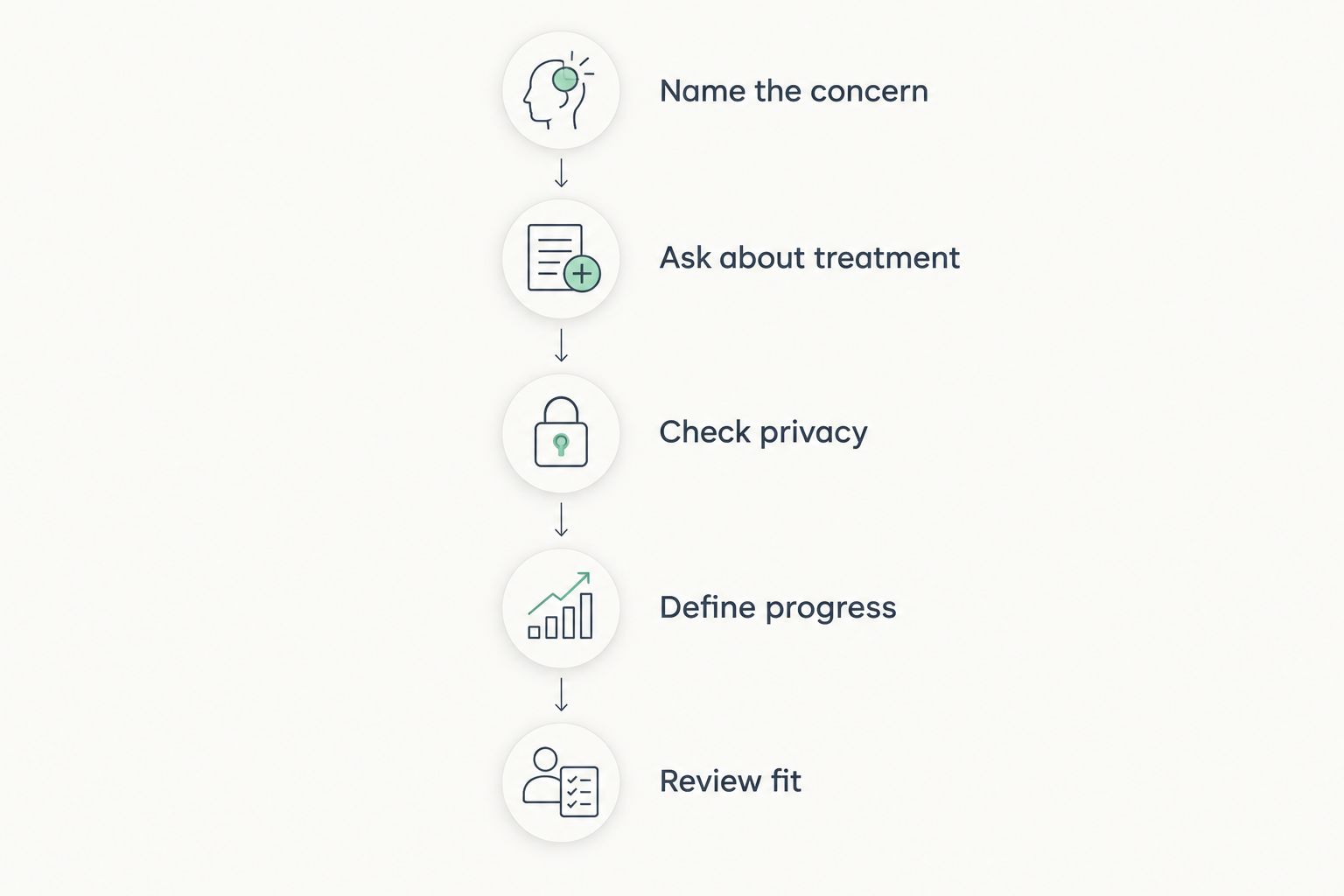
Use this sequence to turn a 2026 shortlist into a practical decision. Keep the conversation specific without asking your teen to diagnose themselves.
Name the concern
Write down 1 main concern in your teen's own words. Add the situations where it appears and what becomes difficult: attending school, sleeping alone, meeting friends, or stopping a checking routine.
Ask about treatment
Ask how the clinician would assess that concern and what treatment could involve. Request an explanation of parent involvement, confidentiality, and how the teen helps set goals.
Check privacy
For virtual sessions, confirm that your teen has a private place to talk. For in-person care, discuss transportation and whether a caregiver waits nearby or participates; ask the clinician how these arrangements affect the session.
Define progress
Choose 3 practical goals with the clinician and your teen. Use actions your teen cares about, such as attending a class, joining an activity, or completing a routine with less reassurance.
Review fit
Bring observations from 2 weeks of ordinary routines to a treatment conversation if that is useful to your clinician. This is a way to describe patterns, not a deadline for improvement; ask the therapist when and how progress should be reviewed.
A difficult session does not automatically mean the therapist is a poor fit. Ask whether discomfort comes from planned therapeutic practice or from feeling unheard; the clinician should help you make that distinction.
How these options are ranked
The order prioritizes a relevant local starting point, followed by treatment pathways matched to different symptom patterns. The criteria are teen experience, problem-specific care, participation, parent boundaries, practical fit, and progress review.
This 2026 guide does not rank individual clinicians by outcomes. A service description helps you build a shortlist; a treatment conversation determines fit.
Which teen anxiety care should you choose?
Start with Counselingcharlotte if you want to explore Charlotte-area in-person or virtual counseling. Describe the main concern before asking for a particular treatment approach.
For your 2026 decision, discuss CBT for worry and avoidance, ERP when compulsions are central, family involvement when household responses need attention, and trauma-focused care when symptoms connect to trauma. Your teen can need more than one element; ask the clinician how those pieces fit together.
FAQ
What's the best therapist for teen anxiety in Charlotte NC?
The best fit is a clinician who works with teens and explains treatment for your teen's specific anxiety pattern. Counselingcharlotte is a local option offering teen counseling through in-person and virtual care; assess the individual clinician before choosing.
Is online therapy or in-person therapy better for an anxious teen?
Choose the format that allows your teen to participate privately and consistently. Discuss clinical suitability with the therapist rather than assuming one format is better for every teen.
What should I ask before booking teen anxiety counseling?
Ask about adolescent experience, treatment methods, confidentiality, parent involvement, and progress review. Describe the activities anxiety disrupts so the conversation goes beyond a general anxiety service label.
Does my teen need CBT or ERP?
The choice depends on assessment of the symptoms and behaviors involved. CBT can address worry and avoidance, while ERP specifically addresses obsessions and compulsive responses in OCD.
Should parents attend a teenager's counseling sessions?
Parent participation should follow the teen's needs, treatment plan, and confidentiality arrangements. Ask how caregiver guidance and private teen conversations will be balanced.
How do I know whether teen anxiety therapy is helping?
Review agreed goals and changes in daily functioning with the clinician. Discuss participation in school, friendships, sleep routines, or other activities relevant to your teen rather than expecting every session to feel comfortable.
What should I do if my teen is in immediate danger?
Call 911 or go to an emergency department if your teen is in immediate danger. In the United States, call or text 988 for suicide and crisis support; a routine counseling appointment is not emergency care.
One last thing
Ask your teen what would make a therapist easier to talk to. The answer can reveal a practical barrier that a provider directory misses: fear of being judged, uncertainty about what parents will hear, or difficulty speaking privately.
Let your teen help define the first goal. A plan built only around adult priorities leaves out the person who needs to participate in treatment.


