

Child therapy in Charlotte, NC does not have one fixed cost: what you pay depends on the clinician’s fee, your insurance benefits, the appointment type, and how often your child attends. A quoted session fee does not necessarily include separate parent appointments, paperwork, or other services, so request a written explanation before booking. This 2026 guide explains how to compare estimates without confusing the therapist’s fee with your family’s actual payment.
- How much does child therapy cost in Charlotte NC? Compare written estimates and insurance benefits, not session fees alone.
- Counselingcharlotte offers child counseling in Charlotte in person and virtually; confirm fees and payment arrangements directly.
- An insurance directory listing does not establish your child's coverage with a particular clinician.
- Ask how intake appointments, parent participation, and services outside sessions are billed before starting treatment.
How much does child therapy cost in Charlotte NC?
Your family’s cost is the amount you owe for the specific care your child receives—not necessarily the therapist’s advertised fee. For insured care, that amount depends on the plan’s coverage rules. For self-pay care, it depends on the provider’s written fee agreement.
Counselingcharlotte provides mental health counseling for children, teens, and adults in the Charlotte area, with in-person and virtual services. Ask about your child’s needs and the payment arrangements for the clinician you are considering rather than assuming every appointment follows the same billing terms.
Use this breakdown when requesting an estimate:
| Part of the estimate | What to confirm | Why it affects your budget |
|---|---|---|
| Initial appointment | Whether the intake has a separate fee or appointment length | The first visit need not match ongoing visits |
| Ongoing child sessions | Appointment length, frequency, and billing method | Recurring appointments form the continuing expense |
| Parent participation | Whether parent-only appointments are separate services | Parent involvement does not automatically mean one combined bill |
| Family appointments | Who participates and how the appointment is billed | A family appointment is not necessarily billed like an individual visit |
| Outside-session services | Whether reports, forms, or coordination carry separate charges | The session quote does not explain every possible service |
| Cancellation policy | Notice requirements and any associated charges | Missed visits can have different payment rules from completed treatment |
Why this matters
A fee comparison can point you toward the wrong provider if the appointments are not comparable. A child-only session, a parent consultation, and a family appointment serve different purposes; ask what each proposed appointment includes.
For your 2026 planning, separate clinical fit from payment fit. You need someone whose services address your child’s concerns and a payment arrangement you understand before treatment starts. Neither a familiar practice name nor an insurance logo answers both questions.
Keep scheduling practicalities in view, too. Travel, time away from work, and a private setting for virtual appointments belong in your decision even though they are not therapist charges. A payment arrangement that looks manageable on paper still has to work for your family’s routine.
How do the main payment options compare?
Compare payment routes before comparing individual practices. The same session fee can lead to different out-of-pocket obligations under different insurance plans.
These are payment approaches to investigate, not statements about which arrangements any particular practice accepts.
| Payment approach | Best for | Main advantage | Main limitation |
|---|---|---|---|
| In-network insurance | Families whose preferred clinician participates in their child’s plan | Covered services follow the plan’s negotiated payment terms | Deductibles, cost-sharing, and coverage requirements still apply |
| Self-pay | Families choosing care without submitting an insurance claim | You can establish the provider’s payment terms directly | You remain responsible for the agreed charges |
| Out-of-network benefits | Families with applicable benefits who prefer a nonparticipating clinician | The plan can reimburse eligible services under its rules | Reimbursement is not guaranteed and can require claim paperwork |
| Employer assistance benefit | Families whose employer benefit includes eligible dependent counseling | It provides another benefit to investigate | Eligibility, participating providers, and service limits require confirmation |
Choose the payment route you can verify, not the one with the most reassuring label. A provider’s willingness to supply paperwork is not the same as an insurer’s agreement to reimburse you.
If your household has an employer assistance benefit, review this guide to using an employer EAP benefit for counseling in Charlotte. Ask the benefit administrator specifically about dependent children and the process for accessing care.
What changes your child therapy bill?
The following factors belong in every cost conversation. Ask the practice and insurer about their respective responsibilities rather than expecting either one to confirm the entire arrangement.
- Appointment type. Clarify whether the proposed visit is an intake, individual child session, parent appointment, or family session. Ask whether the fees differ.
- Appointment length. Compare estimates for the same scheduled service. A fee without an appointment description is an incomplete comparison.
- Treatment frequency. Ask the clinician to explain the proposed schedule and when you will review it. Do not assume a starting schedule lasts indefinitely.
- Insurance rules. Confirm the individual clinician’s network status, applicable deductible, cost-sharing, and any authorization requirements with your insurer.
- Additional services. Ask about written reports, school coordination, forms, and communication outside appointments before requesting them.
- Practice policies. Read the payment and cancellation agreement. Understand when payment is due and what happens if a claim is denied.
A 2026 benefits summary is a starting point, not confirmation that a particular appointment is covered. Verify the service and clinician, and retain the insurer’s response or call reference details.
How do I get a useful estimate before booking?
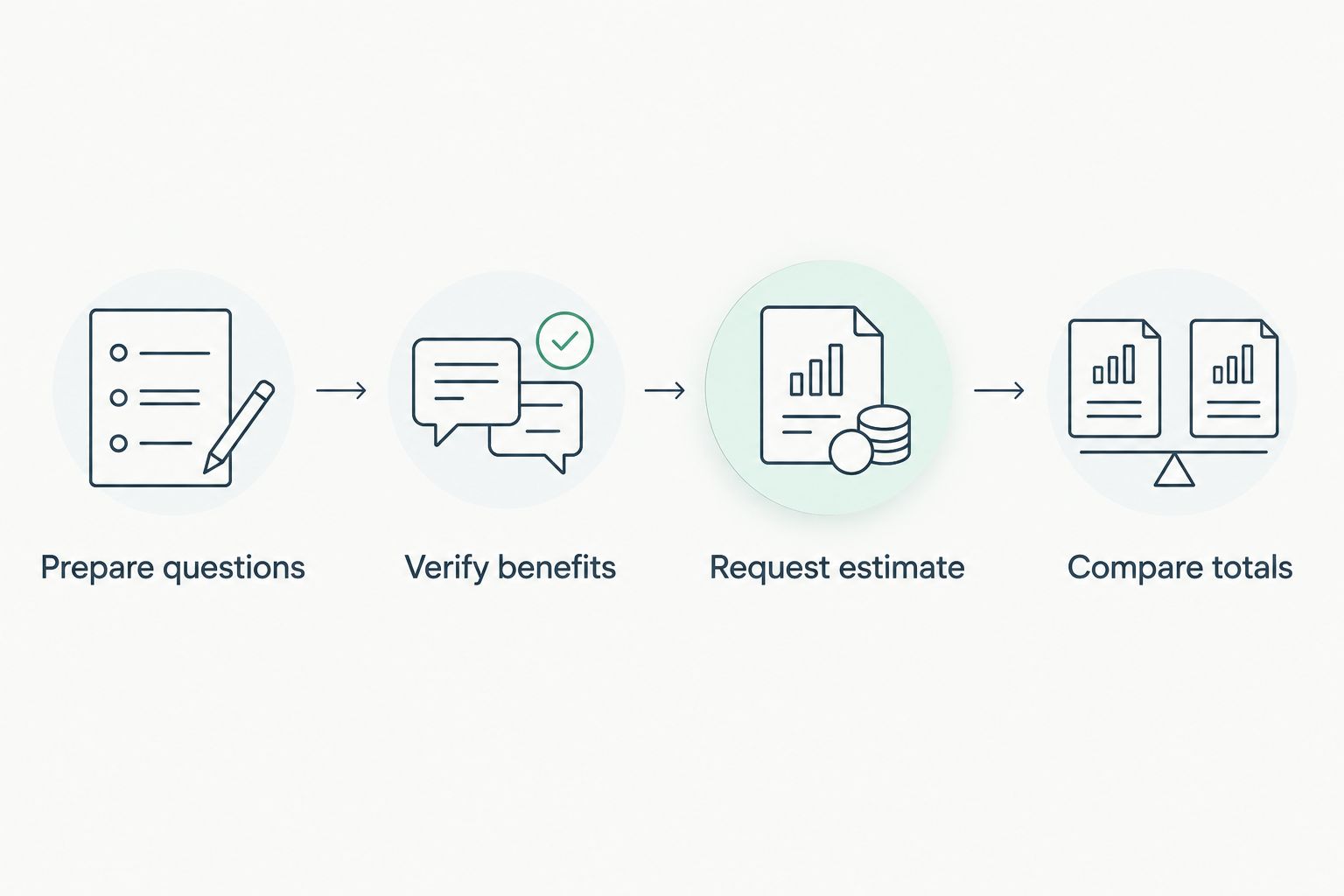
A useful estimate identifies the service, explains your expected responsibility, and distinguishes confirmed terms from insurance estimates. Follow this sequence before committing to ongoing appointments.
1. Prepare questions
Describe your child’s age, main concerns, and the type of support you are seeking. Ask whether the clinician works with those concerns and whether the initial appointment includes your child, a parent, or both.
Keep your financial questions separate from your clinical description. You do not need to share detailed personal history with a billing representative to ask about appointment fees and payment policies.
2. Verify benefits
Give your insurer the clinician’s identifying information and the proposed service details supplied by the practice. Ask whether the clinician is in network for your child’s exact plan, not simply whether the practice accepts the insurance company.
Confirm whether authorization or a referral is required. If the insurer needs more information, obtain it before treating the estimate as settled.
3. Request estimate
Ask the practice for written payment terms covering the intake, ongoing visits, and any separately billed services you expect to use. If you are self-paying or not using insurance, ask whether you are entitled to a Good Faith Estimate under federal rules.
An estimate is not a promise that insurance will pay. Ask who handles denied claims and what financial responsibility remains with you.
4. Compare totals
Compare the proposed care over the same planning period, using the appointment schedule each clinician recommends. Keep intake appointments, recurring sessions, and possible additional services on separate lines.
Do not change a clinically recommended schedule solely to make two estimates look identical. Instead, ask each clinician to explain the schedule and how it connects to your child’s treatment goals.
Keep the practice’s written terms alongside your insurer’s explanation. If they describe different payment responsibilities, resolve the discrepancy before the appointment rather than assuming one cancels out the other.
Is virtual child therapy less expensive than in-person therapy?
Virtual child therapy does not automatically mean a lower fee or a lower insurance payment. Ask for the terms for each format and confirm whether your plan applies different requirements to telehealth.
Virtual appointments remove the trip to an office, but your child still needs an appropriate, private setting. Ask the clinician how parent involvement, privacy, and interruptions will be handled at home.
In-person appointments involve travel and scheduling around the office visit. Compare those practical demands with the clinician’s assessment of what fits your child; do not treat format as a substitute for clinical suitability.
For a 2026 comparison, confirm both the provider’s terms and your current benefits. An arrangement used for another family member or a different service does not establish the terms for your child’s appointment.
Does insurance cover a parent joining the session?
Insurance coverage for parent participation depends on the service provided and the plan’s rules. Ask the clinician how the appointment will be documented and billed, then confirm coverage with your insurer.
A parent joining part of a child’s appointment is not necessarily the same service as a separate parent-only consultation. Likewise, a family appointment has its own purpose and billing considerations.
Ask what parent involvement the clinician recommends and how updates will work. Your financial agreement should explain billing, while your clinical discussion should explain participation and confidentiality. Neither conversation replaces the other.
How do I choose a provider without choosing on fees alone?
Start with the problem you want help addressing. Ask how the clinician works with your child’s age group and concerns, how parents participate, and how you will discuss progress.
Counselingcharlotte is an option for Charlotte families seeking child counseling in person or virtually. Its described services include counseling for anxiety, depression, trauma, and OCD, alongside couples and family therapy. Confirm which clinician and appointment type match your child’s needs.
Service scope alone does not settle the choice. Ask directly about clinical fit, scheduling, payment terms, and your family’s preferences before deciding.
A useful initial conversation should leave you knowing what happens next, who attends, and what you are agreeing to pay. If any answer remains unclear, ask for clarification before booking recurring care.
Ask about child counseling
Discuss your child’s needs and confirm appointment formats and payment terms before booking.
FAQ
How much does child therapy cost in Charlotte NC with insurance?
Your payment depends on your child’s plan, the clinician’s network status, and the service billed. Confirm the deductible, cost-sharing, and any authorization requirements with your insurer before booking.
Does a child therapy intake cost the same as a regular session?
An intake does not necessarily have the same payment terms as an ongoing session. Ask the practice to identify the appointment type, scheduled length, and applicable fee in writing.
Can I get insurance reimbursement for an out-of-network child therapist?
Reimbursement depends on whether your plan includes applicable out-of-network benefits and whether the service meets its requirements. A superbill supports a claim but does not guarantee payment.
Is online therapy cheaper for children in Charlotte?
Online therapy is not automatically cheaper than in-person therapy. Confirm the clinician’s payment terms and your insurer’s telehealth rules, then consider the practical difference in travel and privacy.
Can my employer assistance benefit cover my child’s counseling?
An employer assistance benefit can include dependent counseling, but eligibility and services depend on the benefit. Ask the administrator whether your child qualifies and how to access participating care.
Should I ask for a Good Faith Estimate for child therapy?
Ask about a Good Faith Estimate if your child is uninsured or you are not using insurance for the care. Federal rules provide estimate rights for eligible uninsured and self-pay patients; confirm how they apply to the planned service.
What should I ask before booking child counseling at Counselingcharlotte?
Ask about the clinician’s fit for your child’s concerns, parent participation, appointment format, and written payment terms. Confirm insurance questions separately with your insurer rather than assuming coverage from the practice’s service description.
One last thing
Ask how progress will be reviewed before asking how long therapy will last. A treatment plan should connect appointments to your child’s needs rather than promise a fixed result by a fixed date.
For your 2026 decision, request a clear next step: what the first appointment covers, when you will discuss the treatment plan, and how changes to the schedule affect your financial agreement. That gives you something more useful than an isolated session quote—a way to understand the commitment as care develops.


