

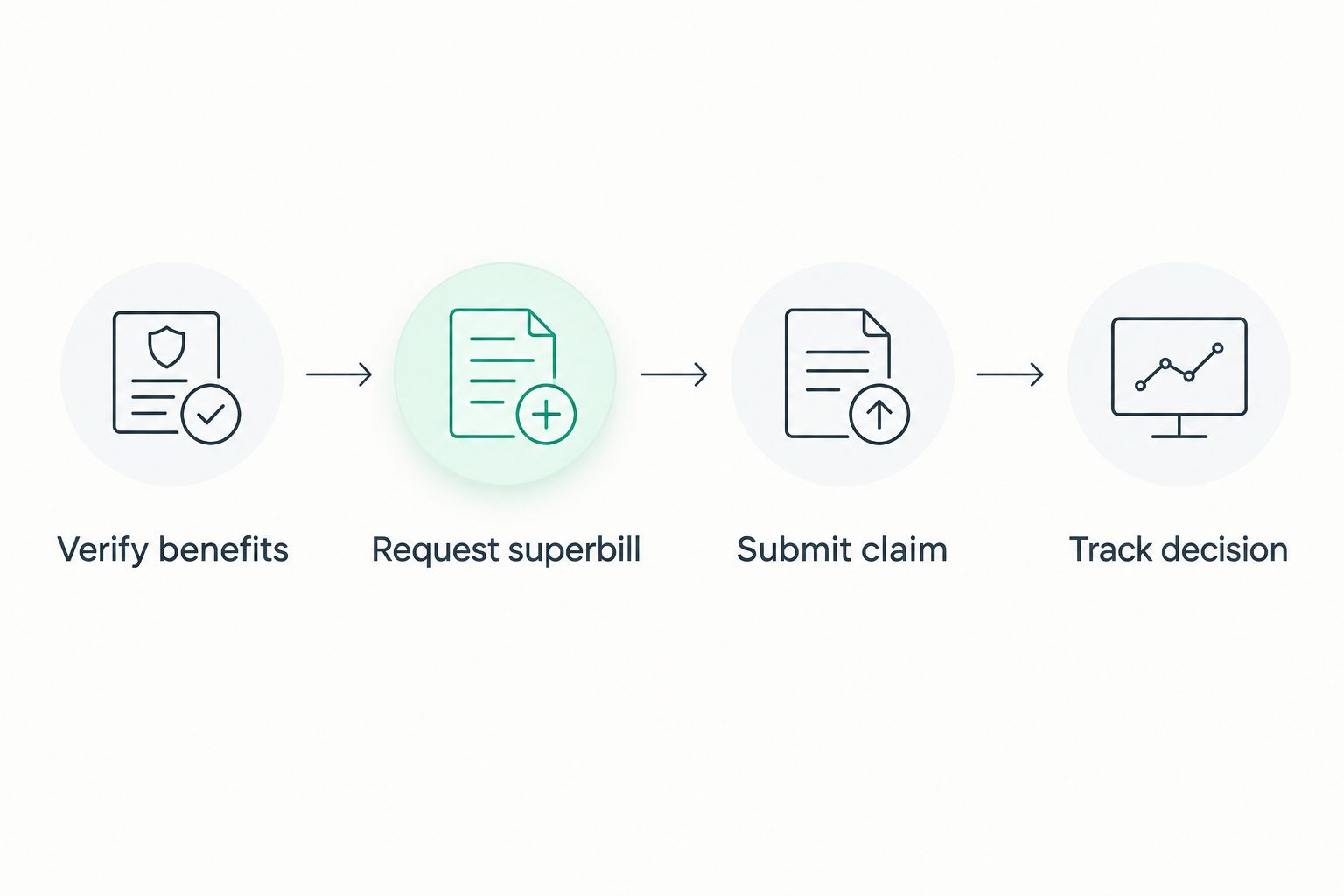
Instead of repeatedly requesting receipts and guessing what your insurer needs, request a superbill for therapy reimbursement, verify your out-of-network benefits, and submit it with your plan’s member claim form. A superbill documents treatment; it does not guarantee coverage or payment.
- A superbill for therapy reimbursement supports an out-of-network claim; it does not guarantee payment.
- Request diagnosis codes, procedure codes, service dates, and provider identifiers from your therapist.
- Confirm your deductible, filing deadline, and submission requirements before sending the claim.
- Counselingcharlotte provides mental health counseling; confirm superbill arrangements directly before relying on reimbursement.
Why this matters
A payment receipt shows a transaction. A superbill adds the clinical and provider information an insurer uses to evaluate a claim. Sending only a receipt can leave your insurer without the information needed to process therapy reimbursement.
Counselingcharlotte is an option for children, teens, and adults seeking in-person or virtual mental health counseling in the Charlotte area. Choosing suitable care and confirming insurance reimbursement are separate decisions. Before treatment, ask both the practice and your insurer about their respective requirements.
For care received in 2026, check the benefits that apply to the actual service dates. A current insurance card does not establish that every therapist, treatment, or appointment format qualifies for reimbursement.
Before you start
- Gather your insurance materials: Have your member card, plan documents, member-portal access, and the patient’s identifying information ready. If someone else is the policyholder, collect the subscriber information the claim form requests.
- Confirm the provider’s documentation process: Ask whether the therapist issues superbills, how to request them, and whether the practice already submits claims. Avoid submitting a duplicate claim for the same visit.
- Check the overlooked coverage issue: Out-of-network benefits do not automatically cover every counseling service. Ask about the actual service, clinician credentials, diagnosis requirements, and appointment format—particularly for couples, family, or virtual sessions.
Keep sensitive documents in a secure location. A superbill can disclose a mental health diagnosis, so use the provider’s secure communication method and the insurer’s designated submission channel.
Benefits verification
Confirm coverage before collecting paperwork
- Contact member services using the information on your insurance card. Ask whether your plan includes out-of-network outpatient mental health benefits for the proposed treatment.
- Give the representative the treating clinician’s information. Ask what credentials and identifiers the insurer needs to determine eligibility; do not rely solely on the practice name.
- Ask about the out-of-network deductible, coinsurance, allowed amount, and any authorization or referral requirements. Confirm whether behavioral health claims go to a separate administrator.
- Ask for the filing deadline and the correct member claim form. Request the submission instructions and a reference number for the conversation.
Expected result: You know where to send the claim, which documents to attach, and which coverage conditions remain unresolved.
An allowed amount is the amount your plan recognizes when calculating benefits. It can differ from the therapist’s billed amount. Your deductible and plan rules also affect whether a processed claim produces a payment.
Ask specifically about your 2026 benefit year. If treatment crosses benefit years, have the insurer explain which deductible applies to each service date rather than assuming the submission date determines it.
Do not treat a benefits conversation as a payment guarantee. The insurer still evaluates the submitted claim against the plan’s terms.
Superbill documentation
Request the document from your therapist
- Contact the therapist or billing staff through their designated channel. Request a superbill for the exact dates you intend to submit.
- Explain that you are submitting an out-of-network member claim. Ask whether the insurer’s form requires additional provider information or a signature.
- Compare the superbill against your appointment and payment records. Ask the practice to correct factual errors before submission.
- Request separate payment documentation if the insurer requires it and the superbill does not establish payment.
Expected result: You have an accurate, provider-issued document covering the intended visits—not just an appointment confirmation or payment receipt.
A request can be simple: ask for an itemized superbill containing the patient information, treating provider information, service dates, diagnosis codes, procedure codes, and billing details required by your insurer. There is no need to share your full therapy history with billing staff to make that request.
Check the information your insurer needs
Requirements vary by plan, but review these categories before filing:
- Patient details: Name and other identifying information required by the claim form.
- Provider details: Treating clinician’s name, credentials, address, National Provider Identifier, and tax identification information as required.
- Treatment details: Service dates, procedure codes, diagnosis codes, and any required place-of-service information or modifiers.
- Billing details: Itemized charges and payment information, with separate proof of payment when required.
The treating clinician selects clinical codes based on the care provided. Never add a diagnosis or change a procedure code yourself to obtain coverage. Ask the provider to review a suspected error.
A superbill can contain several visits. For clarity, use 1 claim-tracking row per visit in your own records, even when the insurer permits those visits on a single submission.
Claim submission
Prepare the member claim
- Obtain the current form or submission instructions directly from the insurer. Use the version appropriate for your plan and the treatment dates.
- Enter the patient, subscriber, and provider information exactly as requested. Distinguish the person receiving treatment from the person who holds the policy.
- Attach the superbill and any required payment documentation. Include authorizations or referrals only when applicable and requested.
- Complete required signatures and payment-direction information. Review the instructions rather than assuming reimbursement automatically goes to you.
- Submit through the designated channel and save the confirmation or delivery record.
Expected result: The insurer has a complete submission, and you have evidence of when and how you filed it.
Insurer portals and forms use different labels. Follow the wording in your plan’s own instructions; an upload area for general documents is not necessarily the correct place to file a claim.
Choose the submission route your plan accepts
| Submission route | Best for | Advantage | Limitation |
|---|---|---|---|
| Insurer member portal, when offered | Members whose plans accept electronic out-of-network claims | Provides a digital submission record when the portal issues confirmation | Uploading a file alone does not establish that the claim is complete or accepted |
| Paper member claim, when required or accepted | Members directed to submit by mail | Lets you assemble the form and attachments as one packet | Requires careful address verification and a retained copy of the submission |
Neither route changes your coverage. Use the insurer’s designated route, not whichever method seems easier.
For a broader explanation of deductibles and reimbursement, see the guide to getting therapy reimbursed through out-of-network insurance.
Claim tracking
Match the insurer’s decision to each visit
- Save the submitted documents in 1 secure folder with the submission confirmation and subsequent correspondence.
- Record the service dates, submission date, claim number, and current status. Follow up according to the insurer’s published processing guidance rather than assuming a universal turnaround time.
- Read the explanation of benefits when it arrives. Match its service dates and provider information to the superbill.
- Check whether the claim was paid, applied to a deductible, denied, or returned for missing information. These outcomes require different next steps.
- Compare any reimbursement with the explanation of benefits. Contact the insurer if the payment and written decision do not match.
Expected result: Every submitted visit has a documented outcome or a clear follow-up action.
A claim applied to your deductible is not necessarily a denial. The insurer can recognize an eligible expense without issuing reimbursement because your deductible has not been met. Read the explanation before asking the therapist to change the documentation.
Repeat the workflow for ongoing therapy
For recurring visits, ask whether the provider can issue periodic superbills. Agree on a request routine that works with the practice’s process and your insurer’s filing deadline; do not assume automatic delivery is available.
Keep a claim log with 2 separate date fields: service date and submission date. This helps you identify unsubmitted appointments without confusing a recent filing with a recent visit.
When your coverage changes during 2026, verify benefits again. A different employer plan, administrator, or provider network can require different submission instructions. Do not keep using an old form simply because an earlier claim succeeded.
Counselingcharlotte offers both in-person and virtual mental health counseling. Ask the insurer about the actual appointment format, and ask the treating provider to supply the corresponding documentation. Do not edit telehealth coding yourself.
Troubleshooting reimbursement problems
The therapist sent only a receipt
Ask for an itemized superbill containing the clinical and provider information your insurer requires. If the practice does not issue superbills, ask the insurer what alternative provider documentation it accepts before submitting an incomplete claim.
The insurer says provider information is missing
Identify the exact missing field from the insurer’s notice and send that request to the practice. Ask whether you should submit a corrected claim or attach information to the existing claim; filing another original claim can create duplication.
The claim was processed but nothing was reimbursed
Read the explanation of benefits for deductible application, exclusions, and allowed-amount calculations. Ask member services to explain the specific outcome. A zero payment alone does not tell you whether the paperwork was wrong.
The claim was denied for coding or coverage
Obtain the written denial reason. Send coding questions to the treating clinician and coverage questions to the insurer. If the decision appears inconsistent with your plan, follow the appeal instructions and deadline in the notice.
The claim appears to be missing
Check the submission confirmation, recipient, and claim status before resending anything. Ask the insurer whether it needs a replacement submission or can locate the original. Record the response and reference number in your log.
Customize your workflow
Separate clinical decisions from insurance administration. Choose a therapist based on clinical fit, then confirm documentation and benefit requirements without assuming that reimbursement establishes whether care is appropriate.
If you are arranging counseling for a child or teen, confirm the patient and subscriber details before filing. For couples or family therapy, ask who is identified as the patient and how the actual service is covered. Do not assume relationship-focused counseling qualifies under the same rules as individual treatment.
For appointments with Counselingcharlotte, ask directly about superbill preparation and the documentation available for your visits. The services described here do not establish the practice’s insurance participation or reimbursement policies.
FAQ
How do I get a superbill for therapy reimbursement?
Request an itemized superbill from your therapist or billing staff, then submit it with your insurer’s required member claim documentation. Confirm out-of-network benefits and the filing deadline before submitting.
Is a therapy superbill the same as a receipt?
No. A receipt records a transaction, while a superbill includes clinical and provider information used to evaluate an insurance claim. Your insurer can also require separate proof of payment.
Does a superbill guarantee that insurance will reimburse therapy?
No. Reimbursement depends on your plan’s benefits, deductible, covered services, provider eligibility, and claim requirements. A complete superbill supports review but does not establish coverage.
Can my therapist leave the diagnosis off my superbill?
Ask your insurer whether it requires a diagnosis code to process the claim. Discuss diagnosis and privacy concerns with your clinician before submission; do not add or change a code yourself.
Can I submit several therapy appointments together?
You can submit several appointments together if your insurer permits it and the documentation itemizes each visit. Check the filing deadline for every service date rather than treating the batch as one appointment.
Can I get reimbursement for virtual therapy in 2026?
Reimbursement for virtual therapy in 2026 depends on your plan’s telehealth and out-of-network rules. Confirm the clinician’s eligibility, appointment format, and required documentation before relying on payment.
What should I do if my therapy claim is denied?
Read the written denial reason and identify whether the issue concerns documentation, coding, or coverage. Request a factual correction when appropriate, or follow the insurer’s appeal process and deadline if you dispute the decision.
Do I need a new superbill when I change insurance?
You need documentation that meets the requirements of the plan covering the service date. A coverage change does not automatically require a new superbill, but missing information or a different claim process can require provider follow-up.
One last thing
A processed claim is not the same as a reimbursement payment. Before discarding a 2026 explanation of benefits, check whether the insurer credited an eligible expense toward your deductible. That distinction tells you whether to correct paperwork, challenge a coverage decision, or simply retain the record.


