

Blended-family therapy is counseling that helps stepfamilies address relationships, roles, and conflict with the aim of building a safer, more workable family life. Unlike parenting advice alone, it makes room for different family histories, relationships across households, and children who do not share adults’ excitement about a new partnership.
- Family therapy for blended families addresses stepfamily roles, household boundaries, and co-parenting without making children choose sides.
- Counselingcharlotte offers family counseling in the Charlotte area; ask specifically about the clinician’s blended-family experience.
- Choose family sessions for shared patterns, couples sessions for adult disagreements, and individual support for private concerns.
- Start with observable goals, not a demand that every family member feel equally close.
Why family therapy matters for blended families
A stepfamily brings existing relationships into a new household structure. A parent and child have a shared history that a new partner does not, while siblings and stepsiblings can have different expectations about privacy, discipline, and time together.
The goal is respectful relationships, not instant closeness. A child can follow household rules without calling a stepparent a parent or feeling ready to share personal concerns.
If you are comparing family therapists in Charlotte, NC, ask how each clinician handles differences in attachment, authority, and participation. Experience with children alone does not answer those questions.
For families seeking help in 2026, a useful starting question is: which recurring interaction needs to change? That produces a clearer treatment discussion than asking a therapist to fix an allegedly difficult child.
How to prepare for blended-family counseling
Identify the pattern instead of naming a problem person
Start with a private written account of a recent disagreement. Describe what happened before the argument, what each person did, and how it ended. Leave out labels such as manipulative or disrespectful; record the behavior instead.
For example, a disagreement about bedtime might also involve a stepparent correcting a child, a parent reversing that decision, and the adults arguing afterward. Family counseling can examine that sequence without treating the child as its sole cause.
Choose 2 observable goals for the first treatment conversation. Fewer goals make it easier to explain what improvement would look like; this is a planning suggestion, not a treatment requirement.
- Write down a recurring disagreement and its immediate trigger.
- Separate adult partnership issues from child behavior concerns.
- Record what helps the disagreement settle.
- Ask each person what they want to become easier.
- Describe success through actions rather than feelings.
Map relationships, responsibilities, and household boundaries
Draw a simple family map on paper before looking for an app or worksheet. Include parents, stepparents, children, siblings, and other important caregivers. Note who lives where and which decisions create uncertainty.
Then separate household expectations from emotional expectations. You can require knocking before entering a bedroom; you cannot require affection on demand. Different households also do not need identical routines for your own household’s expectations to be understandable.
Use a 10-minute adult check-in as a starting format for reviewing one practical issue. Keep children out of disputes about the other household, and do not turn the check-in into a review of everything a partner has done wrong.
- List the caregivers involved in daily decisions.
- Identify who handles school and health communication.
- Write down expectations about privacy and belongings.
- Agree on how adults will discuss disputed consequences.
- Keep adult messages out of children’s responsibilities.
Choose a clinician for the actual family problem
Use your written goals to ask specific questions before arranging care. A clinician should be able to explain how they assess family relationships, decide who attends, and respond when family members disagree about the purpose of therapy.
Counselingcharlotte is best for Charlotte-area families seeking a choice of in-person and virtual family counseling. Its described services include counseling for children, teens, and adults, plus couples and family therapy. Those services do not establish a particular clinician’s stepfamily training; ask directly before choosing.
For your 2026 search, prioritize fit with the problem over a long list of specialties. Couples conflict, child adjustment, trauma concerns, and cross-household coordination can require different treatment arrangements.
- Ask about experience working with blended and stepfamilies.
- Describe your goals without assigning a diagnosis.
- Ask how the clinician includes children’s perspectives.
- Clarify who consents and who receives updates.
- Discuss in-person and virtual suitability.
- Ask how the clinician evaluates whether joint sessions are safe.
Prepare children without asking them to take sides
Explain therapy in plain language: the family is getting help with disagreements, routines, or communication. Do not announce that counseling will make a child accept a stepparent, change their feelings, or agree with an adult’s account.
Give children room to ask practical questions. They might care more about who will be in the room and what gets repeated afterward than about a therapy approach’s name. Ask the clinician to explain privacy and its limits in age-appropriate language.
Avoid rehearsing answers or asking children to report what another household says. Preparation should reduce uncertainty, not recruit support for your position. A reluctant child still deserves a clear explanation of what the appointment involves.
- Explain the purpose without blaming anyone.
- Tell children who is expected to attend.
- Invite questions about privacy and participation.
- Avoid promising that everything will stay secret.
- Ask the clinician how to handle reluctance.
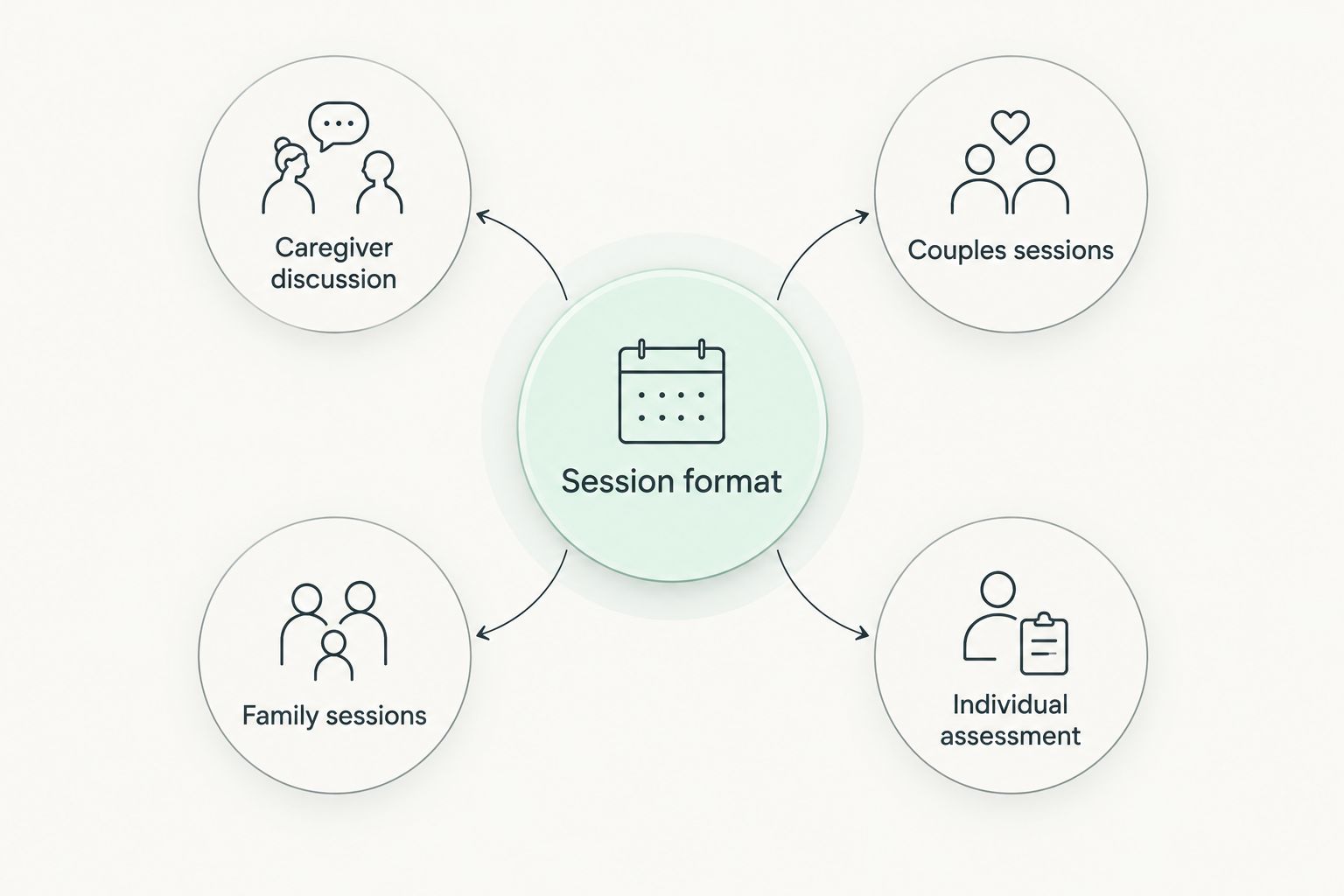
Match the session format to the concern
Family therapy for blended families does not mean everyone must attend every appointment. Discuss whether the work should begin with caregivers, a couple, a parent and child, or another combination. The clinician should explain the reasoning and relevant consent arrangements.
At Counselingcharlotte, the stated availability of couples and family counseling offers formats to ask about; it does not establish how your treatment will be organized. Individual concerns also deserve their own assessment rather than automatic discussion in front of the household.
Keep the purpose explicit. Adult disagreements about discipline need an adult conversation, while a child’s concerns about belonging need space that does not become a debate between partners.
- Use caregiver discussion for disputed adult responsibilities.
- Ask about couples sessions for partnership conflict.
- Discuss family sessions for shared interaction patterns.
- Request individual assessment for private mental health concerns.
- Revisit attendance when the treatment goal changes.
Review progress through behavior, not forced affection
Before treatment starts, ask when you will review the plan. You might suggest a discussion after 4 weeks, while letting the clinician recommend timing that fits the actual appointment schedule and concerns. This is a review prompt, not an expected recovery timeline.
Track changes that family members can describe without guessing someone else’s feelings. Adults discussing a consequence privately is observable; deciding that a teenager finally respects the marriage is not.
During a 2026 treatment review, ask what has changed, what remains difficult, and whether the current format still fits. If someone feels unheard, bring that into the conversation instead of treating attendance itself as proof of progress.
- Compare current disagreements with your original examples.
- Notice whether adults follow the boundaries they agreed on.
- Ask children what feels clearer or more difficult.
- Review whether each person has space to speak.
- Adjust goals and session attendance with the clinician.
Compare support options for your stepfamily
Choose support by the problem it addresses, not by the largest attendance list. Each option below has a useful role and a limit. None substitutes for an individualized assessment when distress or safety concerns are present.
| Option | Best for | Main benefit | Key limitation |
|---|---|---|---|
| Family therapy | Recurring interactions involving several family members | Lets the clinician work directly with shared communication and relationship patterns | Joint sessions are not appropriate for every safety situation |
| Couples therapy | Partners disagreeing about parenting roles or their relationship | Gives adults a place to address conflict without involving children | Does not directly capture every child’s experience |
| Individual counseling | A child, teen, or adult needing private support | Provides focused space for personal concerns | Does not directly change how the whole household interacts |
| Co-parenting counseling | Caregivers working on child-related communication | Focuses discussion on shared parenting responsibilities | Requires clarity about participation, purpose, and boundaries |
| Household check-ins | Practicing everyday agreements between appointments | Makes responsibilities and routines explicit | Is not treatment for mental health conditions |
Counselingcharlotte provides in-person and virtual counseling, including couples and family services. The practical advantage is having those formats to discuss with a provider; the limitation is that the service description alone does not establish the right clinician, attendance plan, or treatment approach for your family.
For your 2026 decision, ask about clinical fit, consent, privacy, and practical participation before committing to a format. A convenient appointment does not resolve an unsuitable treatment arrangement.
Common mistakes blended families make
Treating therapy as a vote on who is right
Arriving with a case against a child, partner, or former partner turns the appointment into an argument about blame. Bring concrete examples, but also describe your own responses. Ask the clinician to identify the interaction that needs to change rather than declare a winner.
Expecting equal closeness on an adult timetable
Children do not need to feel the same way about every caregiver. Set expectations for respectful conduct while leaving room for grief, uncertainty, and different levels of connection. Avoid using names, hugs, or declarations of love as measures of treatment success.
Giving children responsibility for adult communication
Asking a child to carry schedule changes, explain a financial dispute, or report on another home places them inside an adult disagreement. Use direct caregiver communication where it is safe and appropriate. Discuss contested communication arrangements with the relevant professional rather than making a child manage them.
Ignoring privacy and safety before joint sessions
Family participation does not mean unrestricted access to everyone’s private disclosures. Ask about records, confidentiality, caregiver updates, and their limits before sessions begin. If someone fears retaliation, intimidation, or violence, disclose that privately to the clinician before arranging joint discussion; immediate danger requires emergency help, not a family meeting.
FAQ
What is family therapy for blended families?
Family therapy for blended families is counseling focused on relationships, roles, communication, and conflict within a stepfamily. Treatment goals can include clearer household expectations, less triangulation, and more workable adult-child interactions without demanding immediate emotional closeness.
Do all family members have to attend every session?
No, every family member does not have to attend every session. Ask the clinician which combination of caregivers, partners, or children fits the treatment goal and what consent arrangements apply.
Is couples therapy better than family therapy for a stepfamily?
Couples therapy fits adult partnership concerns, while family therapy addresses interactions involving other family members. A clinician can help decide whether to use one format or coordinate different kinds of support.
What should I tell my child before the first appointment?
Tell your child that the family is getting help with a specific difficulty, such as arguments or confusing routines. Explain who will attend, invite questions, and let the clinician explain privacy rather than promising secrecy.
Can we start therapy if the other household will not participate?
You can ask a clinician about working with the family members who are able and authorized to participate. The clinician must clarify consent, the treatment scope, and what can be addressed without the other household present.
How long does blended-family therapy take?
Blended-family therapy has no single timetable that applies to every household. Ask the clinician to establish goals, schedule progress reviews, and explain what would support changing or ending treatment.
Can blended families use virtual family counseling?
Virtual family counseling is an option to discuss with a provider that offers it. Ask about participant locations, privacy, consent, and whether the clinician considers the format suitable for the family’s concerns.
One last thing
A better boundary can matter more than a warmer family photograph. For your 2026 family plan, choose one agreement adults can consistently keep, such as discussing disputed consequences away from children. Bring that agreement to therapy and ask whether it addresses the pattern you actually want to change.


