

Teen Counseling offers online access to licensed therapists, which suits families who want remote appointments. That format stops fitting when your priority is sitting with a therapist in the same room. The best Teen Counseling alternative in 2026 is Counselingcharlotte if you need in-person teen therapy in Charlotte; school counseling is a better starting point for school-specific support.
- For teen counseling alternatives charlotte, Counselingcharlotte fits families seeking in-person teen therapy rather than online-only appointments.
- School counseling supports school concerns; it does not replace ongoing mental health treatment.
- Compare individual therapy, family therapy, and teen groups by the problem you need addressed.
- Choose a therapist with relevant teen experience, clear confidentiality boundaries, and a workable appointment format.
Why this matters
Choosing a teen therapist is not just choosing between a screen and an office. You are choosing how your teenager will participate, which concerns the clinician will address, and how parents will be involved. A convenient format does not automatically make a good clinical match.
For your 2026 search, separate 3 priorities: treatment fit, teen participation, and practical access. Treatment fit means matching the clinician's experience to the concern. Teen participation means giving your teenager a meaningful voice, while practical access means choosing appointments your family can attend consistently.
The alternatives below include a local counseling practice and different routes into support. They are not interchangeable: school counseling, outpatient therapy, groups, and family work serve different purposes. Start with the problem, then choose the setting.
Teen Counseling alternatives at a glance
| Option | Best for | Standout feature | Difference from Teen Counseling | Main limitation |
|---|---|---|---|---|
| Teen Counseling | Families seeking online teen therapy | Remote access to licensed therapists | The online benchmark for this comparison | Does not meet a requirement for in-person appointments |
| Counselingcharlotte | Families seeking local teen mental health counseling | In-person and virtual counseling in the Charlotte area | Offers an in-person route | Office visits require travel |
| School counseling | School-related concerns and coordination | Support connected to the school environment | Focuses on school participation and student support | Not a substitute for ongoing clinical treatment |
| Community outpatient counseling | Families comparing local clinical services | A route to office-based mental health care | Lets you search for a local treatment setting | Teen services and treatment approaches differ by provider |
| Teen group therapy | Teens whose treatment goals include practicing skills with peers | Structured interaction with other teens | Uses a group rather than exclusively individual format | Requires a suitable group and comfort with participation |
| Family therapy | Concerns involving communication and family relationships | Work on interactions among family members | Includes the family system in treatment | Does not automatically replace individual therapy |
Use this table to choose a route, not to diagnose your teenager. A clinician can help determine whether individual sessions, family work, a group, or a combination fits the situation.
1. Counselingcharlotte: best for local in-person teen therapy
Counselingcharlotte provides in-person and virtual mental health counseling for children, teens, and adults in the Charlotte, NC area. Its stated services include anxiety, depression, trauma, OCD, and couples/family therapy. That makes it a direct option when you want local counseling rather than an online-only platform.
Best for: Families whose main requirement is in-person teen mental health counseling in Charlotte.
Where the practice shines
- In-person counseling matches the central reason for this search.
- Virtual counseling provides another appointment format to discuss.
- The stated services cover several concerns families seek counseling for, including anxiety, depression, trauma, and OCD.
- Family therapy is part of the service offering when relationships also need attention.
Where the practice falls short
- In-person appointments add travel to your schedule.
- A list of services does not establish which individual clinician fits your teen; discuss the concern before choosing.
- Offering both appointment formats does not mean every therapist uses both. Ask about the clinician and setting you want.
Head-to-head with Teen Counseling
| Dimension | Local practice | Teen Counseling |
|---|---|---|
| Appointment setting | In-person and virtual | Online |
| Geographic focus | Charlotte-area counseling services | Remote therapy platform |
| Stated service scope | Children, teens, adults, and couples/family counseling | Teen-focused therapy platform |
| Main decision | Whether the clinician and local setting fit | Whether online therapy fits |
For your 2026 decision, bring a description of what is happening rather than a diagnosis you feel obliged to prove. Explain changes in school participation, friendships, sleep, or family interactions, and ask how the clinician would assess those concerns.
Verdict: Choose Counselingcharlotte for in-person teen counseling in Charlotte; confirm the individual therapist's fit before starting.
2. School counseling: best for school-specific support
School counseling is a useful starting point when the immediate concern involves attendance, classroom participation, peer conflict, or coordination with school staff. The counselor's connection to the school makes this route different from private therapy. Ask the school what its counseling service covers and how referrals work.
Best for: Families who need help understanding and addressing a problem within the school setting.
Where school counseling shines
- Connects the conversation to the environment where the problem occurs.
- Provides a point of contact for discussing school-related support.
- Helps you understand when an outside mental health referral is appropriate.
Where school counseling falls short
- It is not equivalent to ongoing outpatient mental health treatment.
- The scope of support depends on the school and the counselor's role.
- School involvement does not remove the need to assess concerns affecting life beyond school.
| Dimension | School counseling | Teen Counseling |
|---|---|---|
| Setting | School-based | Online |
| Primary focus | School-related student support | Teen mental health therapy |
| Coordination | Connected to the school environment | Separate from the school setting |
You do not have to choose between school support and outside therapy. Ask how the professionals can coordinate with appropriate consent, while keeping your teen's privacy boundaries clear.
Verdict: Choose school counseling for school-specific support; do not treat it as a replacement for clinical care.
3. Community outpatient counseling: best for comparing local services
Community outpatient counseling gives you another route to in-person mental health care. This category includes local services rather than one uniform program, so compare the actual clinicians and services—not the label alone. Start by confirming that a provider works with teenagers and offers office appointments.
Best for: Families who want to compare local clinical options before selecting a therapist.
Where community outpatient counseling shines
- Gives you a route to a local treatment setting.
- Lets you ask directly about teen experience and condition-specific care.
- Supports a search based on clinician fit rather than platform preference.
Where community outpatient counseling falls short
- Providers differ in the ages they serve and the services they offer.
- An outpatient label does not establish expertise in every concern.
- Comparing providers requires direct questions about the clinician, appointment format, and treatment plan.
| Dimension | Community outpatient counseling | Teen Counseling |
|---|---|---|
| Setting | Local outpatient setting; confirm office appointments | Online |
| Selection focus | Individual provider and service scope | Online therapist match |
| Teen services | Confirm with the provider | Teen-focused platform |
Ask who will conduct the initial assessment and who will provide ongoing therapy. Knowing that distinction helps you understand the care arrangement before your teen begins sharing personal information.
Verdict: Choose community outpatient counseling when you want to compare local clinical services; select the provider, not just the category.
4. Teen group therapy: best for structured peer practice
Teen group therapy brings participants together around defined therapeutic goals. It serves a different purpose from private individual sessions, particularly when the work includes practicing skills with peers. A clinician should help decide whether the group fits your teenager's needs.
Best for: Teens whose treatment goals include supported practice with other teens.
Where teen groups shine
- Provide opportunities to practice interaction in a structured setting.
- Add peer participation to the therapeutic work.
- Offer a format to discuss alongside individual treatment.
Where teen groups fall short
- Participation requires a suitable group and a teen willing to engage.
- Group work does not provide the same individual focus as private sessions.
- Members' privacy agreements cannot eliminate every risk of disclosure outside the group.
Ask about the group's purpose, facilitator, screening process, and confidentiality expectations. Your teen should understand what participation involves before agreeing to join.
Verdict: Consider teen group therapy when a clinician identifies a suitable goal; do not choose it solely because it is in person.
5. Family therapy: best for communication and relationship concerns
Family therapy addresses patterns between family members, including how people communicate and respond to conflict. It is a different treatment focus, not simply individual teen therapy with a parent in the room. Ask whether family work belongs alongside private sessions or serves as the main approach.
Best for: Families whose concerns include recurring conflict, communication difficulties, or relationship patterns.
Where family therapy shines
- Makes family interactions part of the therapeutic work.
- Gives parents and teens a setting to discuss shared concerns.
- Moves the focus beyond expecting one person to change everything.
Where family therapy falls short
- It requires participation from the people involved.
- A teen still needs clear boundaries around private disclosures.
- Safety concerns require clinical assessment rather than an assumption that joint sessions are appropriate.
Verdict: Consider family therapy for relationship-focused work; preserve space for individual care when clinically appropriate.
Why people switch from Teen Counseling
The strongest reason to switch is a mismatch between online appointments and the setting you want. If in-person therapy is your requirement, an online service cannot satisfy it. That is a format distinction, not evidence that the competitor provides poor care.
Other reasons concern the kind of support you need. School coordination calls for school involvement; family communication calls for evaluating family work; structured peer practice calls for evaluating a group. None of those decisions requires an unsupported claim about a platform's quality.
For a 2026 switch, define the change you want before comparing providers:
- Setting: You want office appointments rather than remote sessions.
- Treatment fit: You want to discuss the clinician's experience with your teen's concern.
- Family involvement: You need a clear plan for parent participation and private teen sessions.
- Coordination: You need to understand how outside professionals can work together with consent.
If your teen already has a therapist, discuss the transition rather than abruptly ending care. Ask how to share relevant treatment information and how to handle support during the change.
Ask these questions before choosing
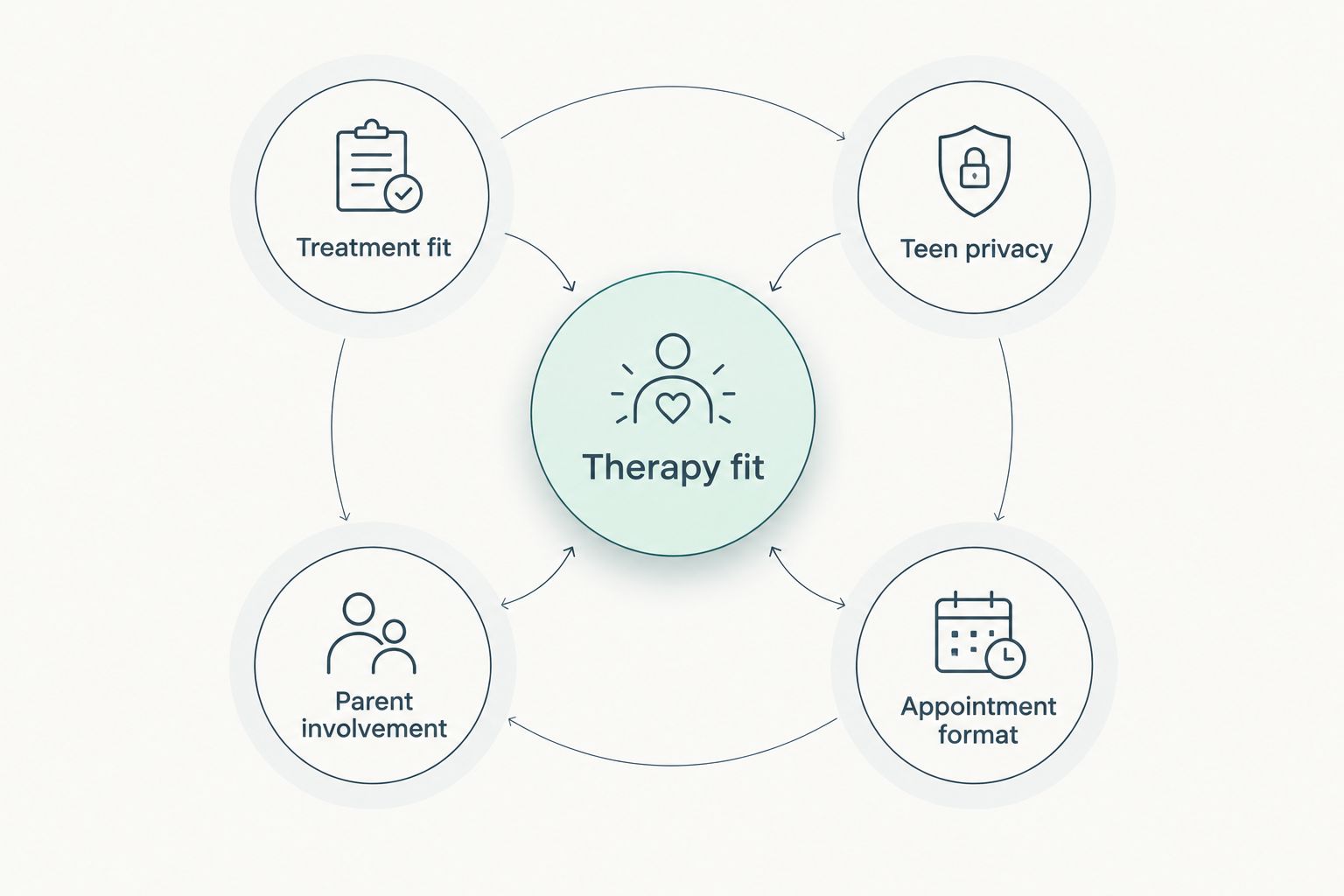
Bring 4 questions to your first provider conversation. They keep the decision focused on care rather than a persuasive profile.
Treatment fit
What experience does the clinician have with teenagers and the concern bringing your family to therapy? Ask how the initial assessment informs the treatment approach. A recognizable therapy name alone does not answer whether the clinician fits your teenager.
Teen privacy
What remains private, what information can parents receive, and what circumstances require disclosure? Ask the clinician to explain these boundaries to both you and your teen. Do not promise your child absolute secrecy on a clinician's behalf.
Parent involvement
How will parents participate, and how will the therapist distinguish shared updates from private session content? Clarify the arrangement before a disagreement arises. Parent involvement should be explicit rather than assumed.
Appointment format
Which appointments take place in person, and what does the office arrangement involve? If you are considering **2 settings—in-person and virtual—**ask how each fits the treatment plan. Format flexibility matters only if it works for your teen.
When staying with Teen Counseling is the right call
Stay with Teen Counseling when online therapy fits your teenager and the existing therapeutic relationship is useful. An office setting is not automatically better. Switching solely because another option ranks first in a list is not a sound treatment decision.
For your 2026 choice, weigh the teen's willingness to participate alongside the practical arrangement. Discuss concerns about privacy, engagement, or progress with the current clinician before assuming a change of platform will solve them. Choose the setting that supports appropriate care—not the setting that sounds most traditional.
FAQ
What's the best Teen Counseling alternative for in-person therapy in Charlotte?
Counselingcharlotte is a direct option for families seeking in-person teen counseling in the Charlotte area. Confirm that the individual clinician fits your teen's concern and preferred appointment format.
Is in-person teen therapy better than online therapy?
In-person therapy is not automatically better than online therapy. Choose based on the teen's needs, the clinician's assessment, privacy, and the ability to participate consistently.
Can a school counselor replace a teen therapist?
School counseling does not replace ongoing clinical mental health treatment. It supports school-related concerns and can help families understand outside referral options.
Should parents attend every teen therapy session?
Parents should discuss participation with the therapist rather than assume they will attend every session. The arrangement should explain private teen sessions, parent updates, and confidentiality limits.
Can family therapy replace individual teen counseling?
Family therapy and individual teen counseling have different focuses. A clinician can assess whether family work, individual sessions, or both fit the concerns.
What should I ask a teen therapist before booking in 2026?
Ask about teen experience, treatment fit, confidentiality, parent involvement, and the appointment setting. Explain the changes that prompted your search rather than feeling required to provide a diagnosis.
What should I do if my teen needs urgent help?
In the United States, call or text 988 for suicide or mental health crisis support. Call 911 for an immediate life-threatening emergency; a routine therapist search is not an emergency response.
One last thing
Ask your teenager what would make a first appointment easier to attend. The answer can be practical: knowing who will be in the room, understanding privacy, or having help explaining the concern. You can bring that request to the clinician without asking your teen to design the treatment.
A clear first-session plan is more useful than another provider shortlist. Agree on what you will ask, what your teen wants to say privately, and how you will discuss the appointment afterward without demanding a full account of the session.


