

Best overall approach: a clinician-led group matched to your teen’s needs. Best for anxiety: a cognitive behavioral therapy group. Best for emotion-regulation skills: a dialectical behavior therapy skills group. To choose among the best group therapy programs for teens in Charlotte NC in 2026, compare treatment formats first—not provider names or promises.
- The best group therapy programs for teens in Charlotte NC match clinical needs, age, and readiness to participate.
- CBT groups fit anxiety-focused goals; DBT skills groups focus on managing emotions, distress, and relationships.
- Counselingcharlotte offers teen counseling in Charlotte through in-person and virtual services.
- For OCD, ask about exposure and response prevention rather than choosing a general support group.
- Confirm screening, confidentiality, caregiver involvement, and crisis procedures before choosing a teen group.
Why this matters
A teen who avoids school because of anxiety needs a different treatment plan from a teen struggling with intense emotions or compulsive rituals. The word group describes the setting. It does not tell you what treatment happens there.
Counselingcharlotte provides mental health counseling for children, teens, and adults in the Charlotte area, including in-person and virtual services. Counselingcharlotte is a counseling option for Charlotte families seeking in-person or virtual support for teens. Treat that as a counseling option, not confirmation of a particular group program.
This guide ranks group formats by their purpose. Use it to ask better questions about a specific Charlotte program, then let an assessment determine whether group therapy, individual therapy, family therapy, or a combination fits your teen.
What makes the best teen group therapy program?
For your 2026 search, assess each program against these criteria before comparing its name or meeting location:
- Clinical fit: The group addresses your teen’s main concern with a clearly explained treatment approach.
- Age and developmental fit: Participants share an appropriate developmental range, and the activities suit that range.
- Qualified leadership: You can identify the facilitator’s credentials, clinical role, and experience working with adolescents.
- Screening and safety: The program assesses suitability, explains crisis procedures, and identifies when another level of care is needed.
- Privacy and caregiver boundaries: Teens and caregivers understand confidentiality, its limits, and what information is shared.
- Practical participation: The meeting format, attendance expectations, transportation, and private space support consistent participation.
Ask 3 questions before committing: What happens during a session? How do you decide whether a teen belongs in this group? How will you evaluate progress? Answers about activities, screening, and goals tell you more than a broad promise to build confidence.
Teen group therapy options at a glance
These are treatment formats to discuss with a clinician, not a directory of confirmed Charlotte group offerings. The order reflects distinct needs rather than a claim that one approach is best for every adolescent.
| Group format | Best for | Standout feature | Key limitation |
|---|---|---|---|
| CBT-based anxiety group | Anxiety-related avoidance | Connects thoughts, behaviors, and supported practice; see the teen anxiety therapist guide | General coping lessons alone do not establish an exposure-based treatment plan |
| DBT skills group | Emotion-regulation and relationship skills | Structured skills teaching; compare the DBT therapist guide | A skills group is not the same as a full DBT treatment program |
| Interpersonal or process group | Practicing connection and communication | Facilitated interaction and feedback | Open discussion does not replace condition-specific treatment |
| Multifamily skills group | Caregiver–teen communication | Teens and caregivers practice together | Shared participation creates different privacy boundaries |
| OCD-focused ERP group | OCD-related rituals and avoidance | Exposure and response prevention; see the OCD therapist guide | Treatment requires individualized assessment and planning |
1. CBT-based anxiety groups: best for anxiety-related avoidance
Cognitive behavioral therapy, or CBT, examines how thoughts, feelings, and behaviors interact. An anxiety-focused group can teach these connections and provide structured opportunities to practice responding differently to feared situations.
For anxiety treatment, ask specifically about exposure: supported practice approaching feared situations rather than continually avoiding them. A group that discusses stress is not automatically an anxiety-treatment group, and exposure work needs an appropriate clinical plan.
CBT anxiety group pros:
- Provides a shared vocabulary for understanding anxiety.
- Offers opportunities to rehearse coping and approach behaviors.
- Connects session work with goals outside the therapy room.
CBT anxiety group cons:
- Group exercises do not address every teen’s specific fears.
- Peer participation can feel demanding for a socially anxious teen.
- Generic relaxation instruction is not a substitute for targeted treatment.
Best for: Teens whose assessed treatment goals involve anxiety-related avoidance and practicing more flexible responses.
Ask the facilitator for 1 example of how a session activity connects to a real-life goal. An explanation about practicing a feared interaction is more informative than a promise that participants will feel less anxious.
Verdict: Choose a CBT anxiety group when its treatment plan directly addresses your teen’s anxiety—not simply because anxiety appears in the description.
2. DBT skills groups: best for learning emotion-regulation skills
Dialectical behavior therapy, or DBT, teaches skills in mindfulness, distress tolerance, emotion regulation, and interpersonal effectiveness. A teen DBT skills group focuses on learning and practicing those skills with clinical guidance.
The distinction between a skills group and a full DBT program matters. Full DBT includes additional treatment components; the group alone does not establish that those components are present.
DBT skills group pros:
- Gives teens concrete language for emotions and responses.
- Organizes skills into clearly defined areas.
- Includes practice related to distress and relationships.
DBT skills group cons:
- Learning a skill does not guarantee using it during distress.
- Group participation alone does not provide individualized crisis care.
- A DBT label does not establish a complete DBT program.
Best for: Teens whose clinician recommends structured work on emotion regulation, distress tolerance, or relationship skills.
During your 2026 search, ask who supports the teen between meetings and whether caregivers receive skills instruction. Clarify how the group coordinates with individual treatment rather than assuming that coordination is included.
Verdict: Choose a DBT skills group for explicit skills practice; do not treat it as a replacement for the rest of a recommended care plan.
3. Interpersonal groups: best for practicing connection
An interpersonal or process-oriented group uses interaction between participants as part of the therapeutic work. The facilitator helps teens notice communication patterns, express feelings, and respond to feedback.
This format differs from a class built around a fixed set of coping lessons. Participation and relationships within the group become part of the material discussed.
Interpersonal group pros:
- Provides a setting to practice expressing needs and feelings.
- Allows discussion of relationship patterns as they occur.
- Includes guided feedback from peers and the facilitator.
Interpersonal group cons:
- Open-ended discussion can feel less predictable than a curriculum.
- Group composition affects the interactions a teen experiences.
- General connection-focused work does not replace targeted OCD or other condition-specific treatment.
Best for: Teens whose assessed goals center on communication, relationships, and participation in a therapeutic peer setting.
Ask how the facilitator manages hurtful comments, unequal participation, and disclosures that overwhelm other members. A rule against bullying matters, but the response when a boundary is crossed matters too.
Verdict: Choose an interpersonal group when relationship practice is the treatment goal, not as a default answer to every mental health concern.
4. Multifamily skills groups: best for caregiver–teen communication
A multifamily group brings adolescents and caregivers into a shared therapeutic setting. Depending on the program, the work includes communication, validation, problem-solving, or skills practice.
The format puts family interactions inside the treatment process rather than leaving caregivers to interpret advice afterward. Ask whether sessions keep families together, separate participants for some activities, or combine both arrangements.
Multifamily group pros:
- Gives caregivers and teens a shared language for skills.
- Creates opportunities to rehearse communication together.
- Places family participation within the treatment plan.
Multifamily group cons:
- Teens do not have the same privacy as in a teen-only setting.
- Attendance requires coordinating caregiver and teen schedules.
- Unsafe family dynamics require individual assessment before shared participation.
Best for: Families whose clinician recommends practicing communication or coping skills together.
Counselingcharlotte provides couples and family therapy as well as counseling for teens. A family-focused service and a multifamily group are different formats; ask directly which format supports the goals identified in your teen’s assessment.
Verdict: Choose a multifamily group when shared practice is appropriate and the privacy boundaries are clear.
5. OCD-focused ERP groups: best for OCD-specific treatment goals
Exposure and response prevention, or ERP, is a form of CBT used to treat OCD. It involves approaching triggers while reducing compulsive responses, with treatment planned around the person’s symptoms and needs.
An OCD-focused group should explain how ERP informs its work. Supportive discussion alone does not establish ERP treatment, and reassurance can become part of an OCD cycle rather than resolve it.
OCD-focused ERP group pros:
- Uses a treatment framework specific to OCD.
- Distinguishes compulsions from helpful coping strategies.
- Provides a setting to discuss exposure practice with clinical guidance.
OCD-focused ERP group cons:
- Participants’ triggers and compulsions differ.
- Exposure exercises require individualized clinical planning.
- Group discussion needs boundaries around reassurance and symptom comparison.
Best for: Teens with assessed OCD treatment needs whose clinician recommends ERP in a group setting.
Ask how the facilitator adapts work for different symptoms and how caregivers learn to respond to reassurance requests. Do not pressure a teen into exposure exercises without an appropriate treatment plan.
Verdict: Choose an OCD-focused ERP group when OCD is the treatment target; skip general support as a substitute for OCD-specific care.
How these group formats are ranked
The ranking prioritizes clinical fit, structured goals, screening, privacy, and practical participation. It does not rank Charlotte providers by outcomes, credentials, or reputation, and it does not establish which programs are accepting participants.
For a 2026 decision, compare the actual group description with your teen’s assessment. A relevant treatment approach with clear boundaries is a stronger basis for choosing than a broad list of conditions on a provider’s website.
Which teen group should you choose?
Start with assessment, then match the group format to the treatment goal. Choose CBT-focused work for anxiety-related goals, DBT skills for the indicated skills needs, interpersonal work for relationship practice, multifamily work for shared family goals, or ERP-focused care for OCD.
Bring 2 goals to the conversation: one your teen identifies and one you observe as a caregiver. Keep them behavioral—for example, participating in a school activity or communicating during conflict—rather than demanding that the teen become happier on a deadline.
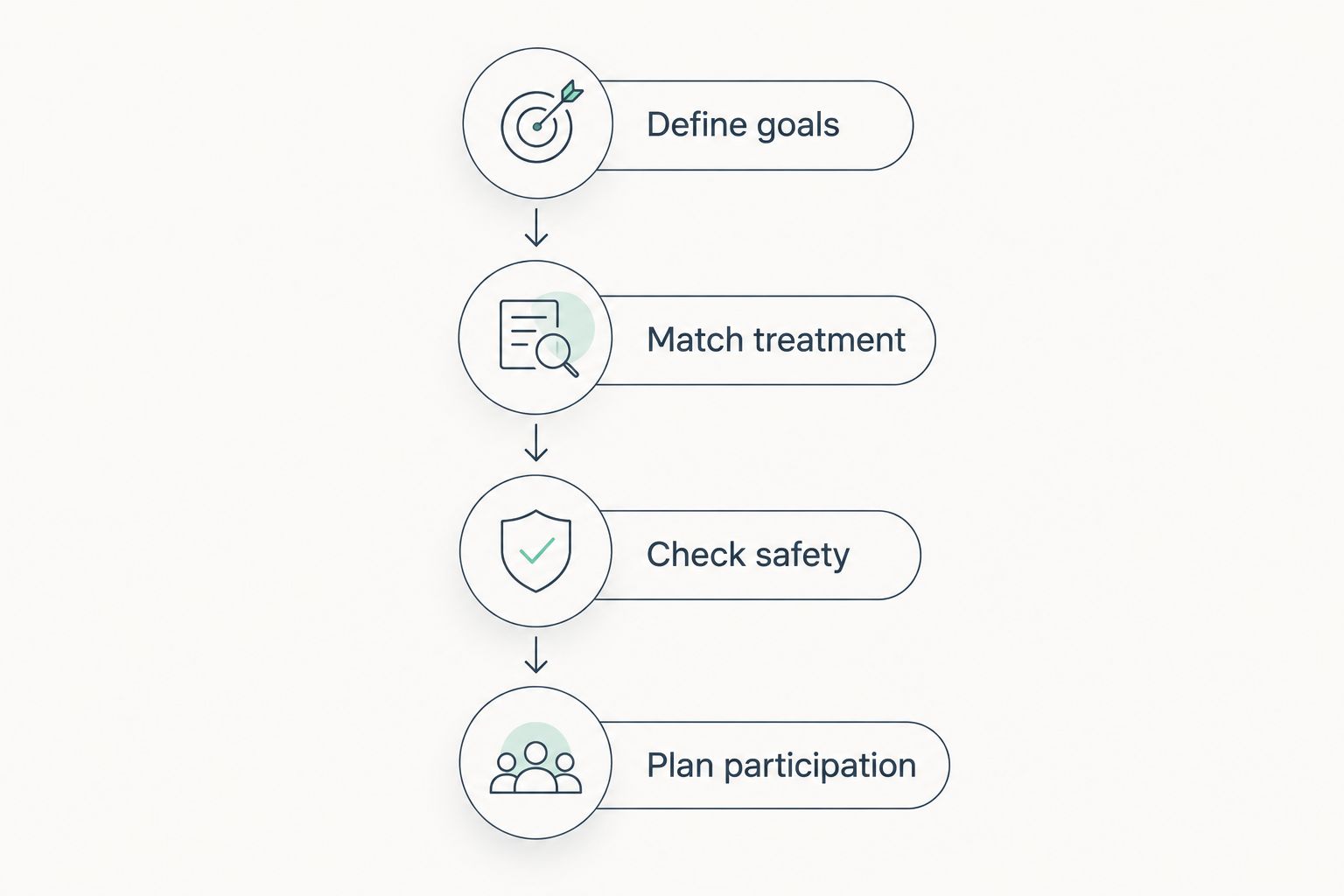
Use this decision sequence:
- Define goals: Identify the changes your teen wants help making.
- Match treatment: Ask which approach addresses those goals.
- Check safety: Review screening, privacy, and crisis procedures.
- Plan participation: Confirm how attendance and practice fit daily life.
The sequence keeps practical questions in view without allowing convenience to decide clinical fit. Include your teen in the discussion before presenting a group as a settled decision.
Counselingcharlotte offers counseling for anxiety, depression, trauma, OCD, and family concerns. Discuss the concern and the desired treatment format separately so a service description does not become an assumption about group care.
Explore teen counseling options
Review in-person and virtual counseling services for teens and families in the Charlotte area.
FAQ
What are the best group therapy programs for teens in Charlotte NC in 2026?
The best fit is a clinician-led program that matches your teen’s assessed needs, developmental stage, and treatment goals. Compare CBT anxiety groups, DBT skills groups, interpersonal groups, multifamily groups, and OCD-focused ERP groups by purpose rather than assuming one format is best for everyone.
Is group therapy better than individual therapy for teens?
Neither format is automatically better for every teen. Group therapy provides peer interaction and shared practice, while individual therapy provides a private setting for personalized work; an assessment determines the appropriate format or combination.
What is the difference between a DBT skills group and a full DBT program?
A DBT skills group teaches skills, while a full DBT program includes additional treatment components. Ask the provider exactly what care, coordination, and support the program includes.
Should a teen with OCD join a general anxiety group?
A general anxiety group is not automatically an appropriate OCD treatment. Ask whether the treatment includes exposure and response prevention and how the clinician addresses compulsions and reassurance-seeking.
Can parents attend teen group therapy?
Caregiver participation depends on the group format and treatment plan. Teen-only groups, caregiver sessions, and multifamily groups have different participation and confidentiality arrangements, which the provider should explain before treatment begins.
Can my teen do group therapy online?
Virtual group therapy requires clinical suitability, privacy, and clear emergency procedures. Ask how the provider handles participation, confidentiality, caregiver involvement, and the teen’s physical location during sessions.
Does Counselingcharlotte offer counseling for teens?
Counselingcharlotte provides mental health counseling for children, teens, and adults in the Charlotte area, with in-person and virtual services. Discuss the treatment concern and format directly rather than assuming a specific group program.
What should I do if my teen needs help before a group begins?
Do not wait for group enrollment when your teen needs urgent support. In the United States, call or text 988 for suicide or mental health crisis support; call 911 for immediate danger or a medical emergency.
One last thing
A willingness to explain when a group is the wrong fit is an important selection signal. Ask the facilitator what needs the group does not address and what happens if your teen needs different care.
For your 2026 choice, keep that answer beside the list of benefits. Clear limits help you make a treatment decision without mistaking a welcoming description for an individualized recommendation.


