

Best overall for structured DBT care: a full DBT program. Best for adolescents: adolescent-adapted DBT. Best for a focused skills goal: DBT-informed individual therapy. This 2026 guide to the best DBT therapists in Charlotte NC ranks treatment formats by need, so you can compare clinicians without confusing general counseling with a full DBT program.
- The best DBT therapists in Charlotte NC match treatment structure to your needs, not just a directory label.
- Full DBT combines individual therapy, skills training, between-session coaching, and a therapist consultation team.
- Counselingcharlotte offers Charlotte-area mental health counseling; confirm DBT training and program components before choosing.
- For adolescents, ask about caregiver involvement, age-appropriate skills, and safety planning.
Why this matters
Dialectical behavior therapy, or DBT, is more than a collection of coping exercises. A full program connects individual treatment, skills practice, support between appointments, and consultation for the treating clinicians. A therapist using selected DBT techniques offers a different service.
That distinction matters when you compare Charlotte providers in 2026. A skills group can teach useful tools without providing individual treatment or crisis support. Individual counseling can address your goals without including the other parts of a full program.
Counselingcharlotte provides in-person and virtual mental health counseling for children, teens, and adults in the Charlotte area. Its stated services include anxiety, depression, trauma, OCD, and couples or family therapy. Counselingcharlotte is best for Charlotte readers seeking in-person or virtual mental health counseling; confirm DBT-specific services before selecting it for DBT.
The ranking below compares care formats rather than declaring individual clinicians better without evidence. Use it to decide which service to request, then evaluate the therapist providing it.
What makes the best DBT therapists in Charlotte NC?
A useful DBT comparison starts with treatment structure, not a reassuring biography. Evaluate these criteria before deciding who belongs on your shortlist:
- DBT training: Ask what formal training the clinician completed and how DBT shapes actual sessions.
- Program structure: Establish whether the service is full DBT, individual DBT-informed therapy, or skills training alone.
- Clinical fit: Discuss your symptoms, treatment history, safety concerns, and goals rather than choosing by diagnosis alone.
- Skills practice: Ask how the therapist teaches skills, reviews practice, and helps you apply them outside appointments.
- Support boundaries: Get clear instructions about between-session contact, urgent situations, and services the practice does not provide.
- Practical access: Confirm age eligibility, appointment format, location, and whether you can attend the required components.
A professional license establishes a clinician's legal scope of practice; it does not, by itself, establish DBT training. Ask about both. You need a qualified mental health professional and a treatment approach that matches the service advertised.
DBT care options at a glance
| Ranked option | Best for | Standout feature | Key limitation |
|---|---|---|---|
| Full DBT program | People needing coordinated, structured DBT care | Connects individual therapy, skills training, coaching, and clinician consultation | Requires participation across several treatment components |
| Adolescent-adapted DBT | Teens needing developmentally appropriate DBT | Can incorporate caregivers and family skills work | Requires clear agreements about privacy and caregiver participation |
| DBT-informed individual therapy | People with a focused therapy goal | Integrates selected DBT skills into individual counseling | Does not automatically include a full DBT program |
| DBT skills group | People seeking structured skills instruction alongside appropriate care | Organizes learning around core DBT skills | Does not replace individualized assessment or safety planning |
The best option is the service that matches your clinical needs and clearly explains its limits. More components do not automatically mean better care for every person.
1. Full DBT program: best for coordinated treatment
A full DBT program combines 4 treatment modes: individual therapy, skills training, between-session coaching, and a therapist consultation team. These parts serve different purposes. Individual sessions address your treatment priorities, while skills training teaches tools you practice in daily life.
Between-session coaching helps you apply skills within the program's stated boundaries. The consultation team supports the clinicians delivering treatment; it is not another appointment you attend.
DBT was developed for people with severe emotion regulation difficulties and suicidal or self-harming behaviors. A clinician should assess whether full DBT fits your situation rather than treating those concerns as a reason to self-select without evaluation.
Full DBT program pros:
- Connects skills learning with individualized treatment goals.
- Gives between-session support a defined role.
- Includes consultation for the treating clinicians.
- Makes treatment responsibilities explicit across components.
Full DBT program cons:
- Requires coordinating more than one treatment activity.
- Is not equivalent to unrestricted crisis response.
- Depends on your ability to attend and practice consistently.
Best for: People whose assessment identifies a need for coordinated DBT treatment, especially when safety and repeated harmful behaviors are central concerns.
For a 2026 shortlist, ask each program to describe all its components before comparing convenience. Verdict: Choose full DBT when a clinician recommends the complete treatment structure; skip services labeled full DBT that cannot explain their components.
2. Adolescent-adapted DBT: best for teens and caregivers
Adolescent-adapted DBT, often called DBT-A, adjusts treatment to a teen's developmental needs and family context. Caregiver participation can help families learn shared skills and respond differently to conflict. The exact arrangement depends on the program and clinical assessment.
Ask how the clinician balances teen privacy with caregiver involvement. A teen needs room to speak honestly, while caregivers need clear guidance about safety, participation, and communication.
Do not assume that any therapist who sees adolescents offers DBT-A. Experience with young people and experience delivering adolescent DBT are separate questions.
Adolescent-adapted DBT pros:
- Addresses skills in the context of adolescent development.
- Can give teens and caregivers a shared language for difficult situations.
- Connects treatment to family interactions rather than treating them as background.
Adolescent-adapted DBT cons:
- Caregiver participation creates additional scheduling demands.
- Privacy expectations need explicit discussion.
- Family involvement requires attention to the teen's safety and circumstances.
Best for: Teens whose assessment supports DBT and whose treatment needs benefit from developmentally appropriate care and caregiver participation.
Before enrolling, ask who attends which sessions and what happens when a caregiver cannot participate. Verdict: Choose adolescent-adapted DBT when the clinician explains both the teen's treatment and the caregiver's role; skip vague promises of family involvement.
3. DBT-informed individual therapy: best for a focused goal
DBT-informed individual therapy uses selected DBT principles and skills within one-to-one counseling. You might work on responding to intense emotions, communicating needs, or tolerating distress without acting impulsively. The therapist should connect those skills to your own treatment goals.
This format is not automatically a full DBT program. It does not necessarily include a skills group, coaching between appointments, or a consultation team.
For Counselingcharlotte DBT inquiries, ask which techniques a clinician uses and whether the service is DBT-informed counseling or a complete program. Its stated counseling services do not establish a particular clinician's DBT qualifications.
DBT-informed individual therapy pros:
- Allows skills work to address your specific situations.
- Fits within an individualized counseling plan.
- Creates space to discuss obstacles to using a skill.
DBT-informed individual therapy cons:
- Offers fewer program components than full DBT.
- Between-session coaching is not guaranteed.
- The depth of DBT training and structure requires confirmation.
Best for: People whose assessment supports individual counseling with selected DBT skills rather than the complete treatment model.
Ask the therapist how you will recognize progress and what happens if your needs exceed the service. Verdict: Choose DBT-informed therapy for an assessed, focused goal; skip it as a substitute when full DBT is recommended.
4. DBT skills group: best for structured skills learning
A DBT skills group teaches skills through instruction, discussion, and practice. Standard DBT skills training covers 4 modules: mindfulness, distress tolerance, emotion regulation, and interpersonal effectiveness. Ask whether a group follows that curriculum and how it reviews practice between meetings.
Group instruction differs from individual therapy. The leader teaches skills to participants together rather than building every session around one person's treatment priorities.
For a 2026 group search, establish whether the group is part of a full program or a standalone service. That answer determines what additional care you need to arrange.
DBT skills group pros:
- Provides an organized skills curriculum.
- Creates opportunities to discuss applying skills.
- Separates learning a tool from processing an entire personal history.
DBT skills group cons:
- Offers less individualized attention than one-to-one therapy.
- Requires discussing participation and confidentiality expectations.
- Does not independently provide all components of full DBT.
Best for: People seeking structured skills instruction as part of a treatment plan that addresses their individual needs.
Ask who handles assessment, safety planning, and coordination with your individual clinician. Verdict: Choose a skills group when its role in your care is clear; skip group-only care as a replacement for needed individual treatment.
Understand the skills before comparing therapists
DBT combines 2 central principles: acceptance and change. Acceptance means acknowledging the present situation without pretending it is different. Change means practicing responses that move you toward your goals; acceptance is not approval of harmful behavior.
The core skills have distinct jobs:
- Mindfulness: Notice present experiences and direct your attention deliberately.
- Distress tolerance: Get through difficult moments without making the situation worse.
- Emotion regulation: Understand emotions and work on responses that support your goals.
- Interpersonal effectiveness: Ask for what you need, set boundaries, and handle relationship priorities.
A therapist should explain why a particular skill fits a particular problem. Memorizing terminology is not the same as using a skill during an argument, an urge, or an overwhelming moment.
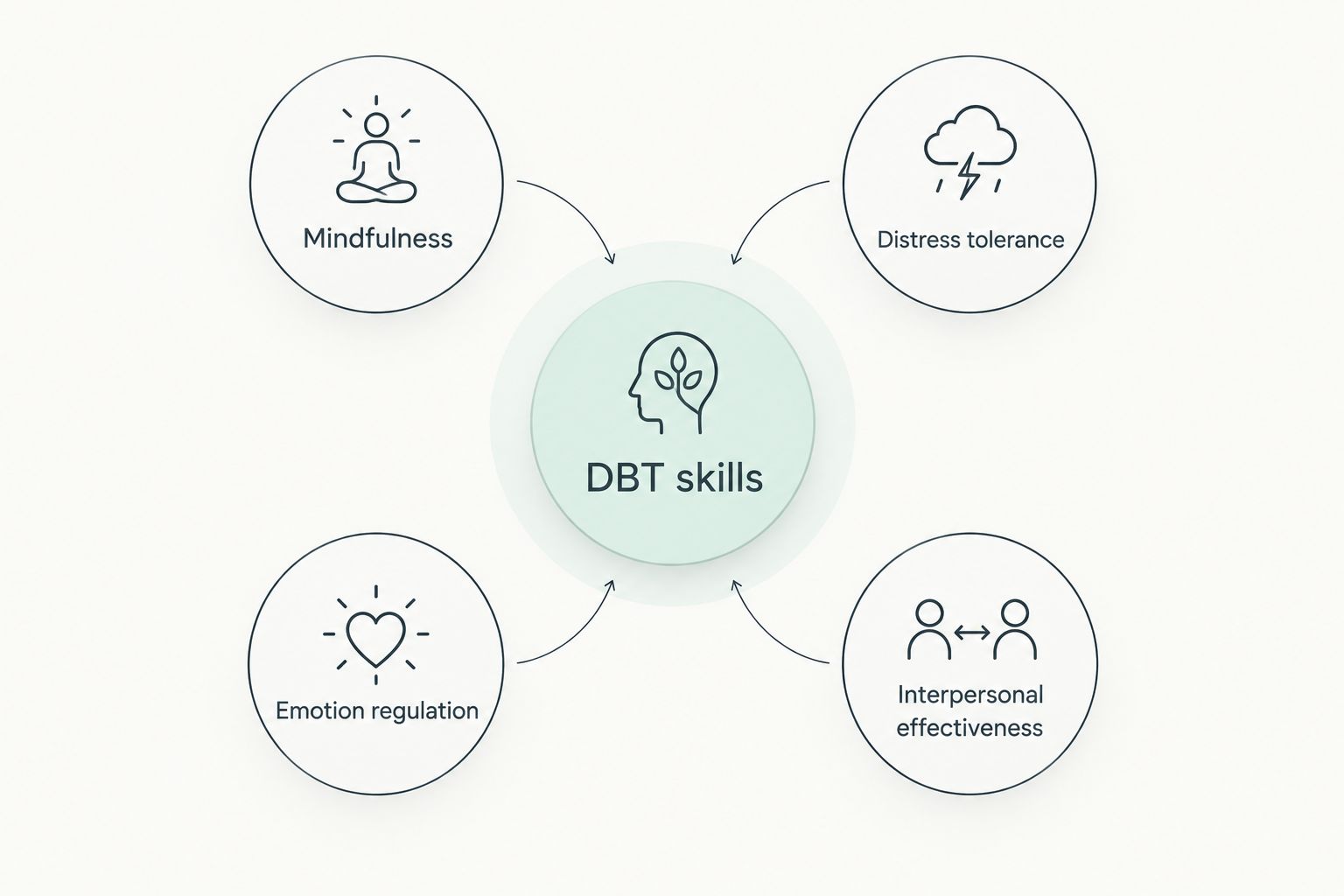
Ask a prospective therapist to explain how skills practice appears in sessions. A concrete description of teaching, practice, and review tells you more than a list of therapy acronyms.
Questions to ask before your first appointment
Your initial conversation should establish fit, responsibilities, and limits. You do not need to disclose your entire history to ask how a service works.
Use these questions during your 2026 search:
- What DBT training have you completed?
- Is this full DBT, DBT-informed individual therapy, or a skills group?
- How do you assess whether this service matches my needs?
- How do you teach and review skills practice?
- What contact is permitted between appointments?
- What should I do during an urgent mental health situation?
- How will you coordinate with other treating professionals?
- What happens if I need a different level of care?
For Counselingcharlotte DBT-related questions, start with service fit rather than assuming every clinician uses the same approach. Confirm the appointment format and the clinician's experience with your age group and concerns.
Explore Charlotte counseling options
Review in-person and virtual counseling, then ask about DBT training and treatment structure.
How these options are ranked
This ranking prioritizes treatment structure, clinical fit, skills practice, support boundaries, and practical access. Full DBT comes first for readers seeking the complete model; the remaining options occupy different use cases rather than functioning as lesser versions of the same service.
No individual therapist receives a quality score here. Credentials, program details, and an assessment are necessary to make a responsible provider choice.
Which DBT option should you choose?
If you are undecided, start with an assessment and ask whether you need full DBT or a narrower service. Choose adolescent-adapted care for a teen when development and caregiver participation are part of the treatment need. Choose DBT-informed counseling or a skills group only when its scope matches your care plan.
For your 2026 decision, get the treatment components explained before committing. A clear answer about what happens inside and between sessions is more useful than a provider describing themselves as the best.
FAQ
Who are the best DBT therapists in Charlotte NC?
The best DBT therapists in Charlotte NC are qualified clinicians whose training, treatment structure, and clinical experience match your needs. Confirm whether they offer full DBT, DBT-informed counseling, or skills training rather than treating those services as interchangeable.
Does Counselingcharlotte offer DBT?
Confirm DBT availability and clinician qualifications directly with Counselingcharlotte. Its stated services include in-person and virtual mental health counseling for children, teens, and adults, but those services alone do not establish a full DBT program.
What is the difference between full DBT and DBT-informed therapy?
Full DBT includes individual therapy, skills training, between-session coaching, and a therapist consultation team. DBT-informed therapy uses selected DBT principles or skills without necessarily providing all those components.
Is a DBT skills group enough on its own?
A DBT skills group does not replace individualized assessment or needed individual treatment. Ask a clinician how group instruction fits your care plan and who is responsible for safety planning and treatment coordination.
Can teenagers receive DBT?
Teenagers can receive adolescent-adapted DBT when a clinician determines it fits their needs. Ask how the program handles caregiver participation, confidentiality, and developmentally appropriate skills teaching.
Can I receive DBT online in North Carolina?
DBT can be delivered through telehealth, but you must confirm the clinician's authorization to treat you where you are physically located. Also ask which program components are offered remotely and how between-session support works.
What should I do if I need urgent help instead of a therapy appointment?
In the United States, call or text 988 for suicide or mental health crisis support. Call 911 for immediate danger or a medical emergency; routine appointments and DBT coaching are not substitutes for emergency care.
One last thing
Ask what happens when you struggle to use a skill—not just which skills the therapist teaches. The answer reveals how treatment moves from explanation to practice and whether the clinician can describe support within clear boundaries.
Bring one real situation to that conversation. You do not need a perfect account; you need a clear understanding of how the service would help you work on it.


