

Therapy for entrepreneurs and business owners is mental health counseling aimed at improving emotional well-being while addressing the pressures of running a business. This 2026 guide explains how to separate business problems from mental health concerns, choose appropriate support, and protect time for care without turning therapy into another performance target.
- Therapy for entrepreneurs and business owners addresses mental health, not business strategy or guaranteed productivity gains.
- Counselingcharlotte offers Charlotte-area adults in-person and virtual counseling; verify the therapist’s fit for your concerns.
- Choose support around anxiety, depression, relationship strain, or other symptoms—not the founder label alone.
- Business coaching and peer support serve different purposes from licensed mental health treatment.
Why therapy matters for entrepreneurs and business owners
When you own a business, financial decisions, workplace relationships, and personal identity can become difficult to separate. A client dispute might require a business response while also bringing up anxiety that continues after the dispute ends.
Therapy addresses your mental health; it does not replace legal, financial, or operational advice. You do not need to wait for the business to fail—or succeed—to seek support. Persistent worry, low mood, disrupted sleep, or relationship conflict are reasons to discuss your experience with a clinician, not diagnoses by themselves.
If worry is your main concern, the guide to anxiety therapists in Charlotte offers a relevant starting point for your search.
Your 2026 care plan should account for practical constraints: confidentiality, a private appointment location, travel, and a schedule that changes. The aim is treatment you can attend and use, not an ideal routine that collapses during a demanding week.
How to choose and use therapy as a business owner
Identify what you want help with
Start with a private note before searching for a provider. Describe what happens, when it happens, and what it interrupts. For example, distinguish worry about an unresolved invoice from worry that continues across work, home, and rest.
Try recording patterns for 7 days if that feels manageable. This is preparation, not a screening test or a reason to delay help. Avoid confidential customer or employee details; your own reactions provide enough material to begin.
Write down these areas:
- Sleep: Trouble settling down, waking during the night, or feeling unrested.
- Worry: Repeated concerns, checking, avoidance, or difficulty disengaging.
- Mood: Irritability, sadness, loss of interest, or emotional numbness.
- Relationships: Withdrawal, repeated arguments, or difficulty being present.
- Functioning: Changes in concentration, daily responsibilities, or self-care.
Separate clinical needs from business decisions
Sort your concerns into business decisions and personal experiences. Deciding how to handle overdue accounts is different from feeling unable to stop checking them. Both deserve attention, but they do not necessarily need the same professional.
A coach or adviser can help with business goals within that professional’s scope. A licensed mental health clinician assesses and treats mental health concerns. Neither role automatically substitutes for the other, and one person holding multiple credentials still needs to explain the role being provided.
Use these questions to clarify the next move:
- Is this primarily a decision requiring business expertise?
- Does the distress continue when the immediate problem is resolved?
- Are sleep, relationships, or daily functioning affected?
- Am I seeking treatment, practical advice, or shared experience?
- Would separate professionals address different parts of the problem?
Check the therapist’s clinical fit
You can begin by reviewing credentials and writing questions yourself. Then ask prospective clinicians directly about their experience treating your main concern. Familiarity with entrepreneurship is useful context, but it is not a substitute for appropriate clinical skills.
Counselingcharlotte is best for Charlotte-area adults seeking a choice of in-person and virtual mental health counseling. Its stated services include anxiety, depression, trauma, OCD, and couples/family therapy. Those service categories do not establish entrepreneur-specific expertise or guarantee a particular therapist match.
You can use Counselingcharlotte as a starting point, then verify the details that matter to your situation. Ask:
- What experience do you have treating my main concern?
- How do you decide which treatment approach fits?
- How will we discuss goals and review progress?
- How do you work with clients whose work affects their identity?
- When would you recommend a referral or another level of care?
Protect privacy and appointment access
Before choosing a format, identify where you can speak without being overheard. An office with employees nearby is not automatically a private therapy space. For virtual care, discuss the clinician’s requirements and whether treatment can take place where you will physically be during appointments.
For your 2026 schedule, plan around actual working conditions rather than assuming every week will be predictable. Ask about appointment arrangements and cancellation policies directly. Do not assume evening appointments, messaging access, or permission to attend while traveling.
Build the practical plan around:
- Private space: A location where colleagues and family cannot overhear.
- Calendar protection: A neutral appointment label on shared calendars.
- Travel checks: Confirmation before attending from another state.
- Technology: A connection and device suitable for a confidential conversation.
- Session transition: A short buffer before returning to demanding work.
Set goals that belong to your health
Write a rough goal before the first appointment, then refine it with the therapist. Choose something observable in your life rather than a revenue target. Wanting less distress during uncertainty gives treatment a different focus from wanting to close more sales.
Begin with 2 personal goals, such as being more present at home and responding differently to work-related worry. These are starting points for discussion, not promises about what treatment will deliver. The clinician can help connect goals to an assessment and appropriate treatment.
Useful goals can focus on:
- Recognizing distress before it drives an impulsive response.
- Reducing avoidance that interferes with daily responsibilities.
- Communicating needs without withdrawing or escalating conflict.
- Building a workable transition between work and home.
- Discussing symptoms honestly instead of reporting only achievements.
Review progress without grading yourself
Bring specific examples to follow-up conversations. Explain what changed, what remained difficult, and whether a suggested exercise was practical. If an assignment becomes another source of self-criticism, say so rather than quietly abandoning treatment.
You might reserve 10 minutes before an appointment to collect examples. That is an organizational suggestion, not a treatment dose. In 2026, track changes that matter to your health—not a productivity score dressed up as recovery.
Use a short review list:
- What felt different since the previous appointment?
- Which situation brought back a familiar pattern?
- What did I try, and what happened afterward?
- What felt unclear, uncomfortable, or unhelpful in treatment?
- Do the current goals still reflect what I need?
Compare support options before choosing
Choose by the problem being addressed, not by which option sounds most ambitious. Mental health treatment, business advice, and peer connection have different purposes. Combining them requires clear boundaries, especially when the same concern has both personal and commercial consequences.
| Option | Best for | Main advantage | Key limitation |
|---|---|---|---|
| Individual mental health therapy | Personal symptoms and patterns affecting daily life | Provides individualized clinical assessment and treatment | Does not replace business, legal, or financial advice |
| Couples or family therapy | Relationship patterns involving partners or family | Creates space to address interactions together | Requires clarity about who participates and the treatment goals |
| Business coaching | Business goals, leadership practices, and accountability | Keeps attention on professional decisions and actions | Is not automatically licensed mental health treatment |
| Entrepreneur peer support | Shared experience and professional connection | Offers perspectives from other business owners | Is not a substitute for clinical assessment; privacy arrangements vary |
| Self-guided reflection | Organizing concerns and preparing questions | Can begin with a notebook and a private routine | Cannot assess symptoms or determine an appropriate treatment plan |
For local in-person or virtual counseling, Counselingcharlotte offers relevant service categories. Verify clinician fit, appointment arrangements, and the treatment approach before deciding; the service description alone cannot answer those questions.
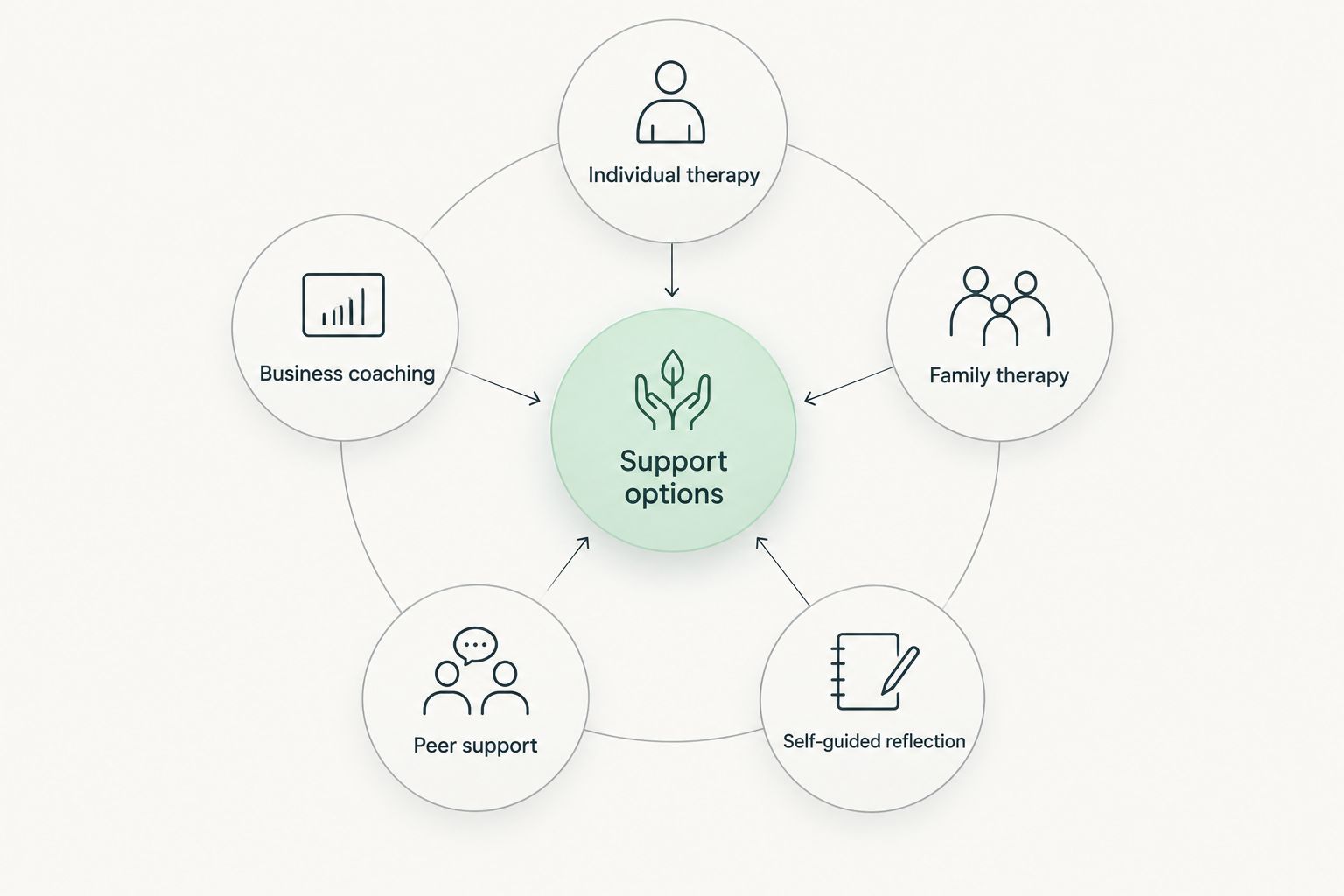
Combining support does not mean everyone needs access to the same information. Ask each professional about their role, records, confidentiality, and any proposed coordination before sharing sensitive material.
Common mistakes business owners make when seeking therapy
These are practical traps to avoid when arranging care in 2026—not assumptions about every entrepreneur.
Treating therapy as executive optimization
If every discussion returns to output, you risk leaving distress unexplored. Tell the therapist when you feel pressure to justify treatment through business results. Your well-being is a valid treatment focus without a commercial return.
Waiting for a quiet quarter
Making care conditional on a fully settled calendar creates a fragile plan. Discuss the schedule you actually have and ask what appointment arrangements are possible. Do not assume treatment requires either unlimited flexibility or perfect attendance without interruption.
Confusing discretion with guaranteed secrecy
Ask about confidentiality and its limits before disclosing sensitive material. Discuss records, insurance billing if relevant, and how the clinician handles requests for information. Avoid bringing employee files, client records, or proprietary documents unless their relevance and handling have been discussed.
Assuming shared business experience proves clinical fit
A therapist does not need to have founded a company to understand your symptoms and circumstances. Ask how the clinician treats your concern and how business pressures will inform the work. Shared vocabulary alone does not answer either question.
Keeping relationship strain outside the conversation
Work stress does not always stay at work. If conflict, withdrawal, or unequal responsibilities are part of the problem, describe them. Ask whether individual treatment, couples work, family therapy, or a referral fits the concerns being assessed.
FAQ
What is therapy for entrepreneurs and business owners?
Therapy for entrepreneurs and business owners is mental health counseling that considers the pressures and circumstances of running a business. It addresses concerns such as anxiety, low mood, relationship strain, or other symptoms rather than providing a business growth plan.
Do I need a therapist who has owned a business?
You do not need a therapist who has owned a business. Prioritize appropriate credentials, experience treating your concerns, and a willingness to understand your working circumstances.
Is business coaching better than therapy for founder stress?
Business coaching and therapy address different needs. Coaching focuses on professional goals within the coach’s scope, while licensed mental health treatment addresses mental health concerns; some people seek both for separate purposes.
Can I attend virtual therapy when I travel for work?
Confirm virtual therapy arrangements with the clinician before attending while traveling. Your physical location can affect whether the clinician is authorized to provide care, so do not assume an existing appointment can proceed from another state.
Will my employees or investors know I am in therapy?
Attending therapy does not automatically notify employees or investors. Ask the clinician about confidentiality, its legal limits, records, and billing, and consider who can see your calendar or hear your appointments.
Does Counselingcharlotte offer counseling relevant to business owners?
Counselingcharlotte provides in-person and virtual mental health counseling for adults in the Charlotte area, including services for anxiety, depression, trauma, OCD, and couples/family concerns. Ask directly about clinician experience with your specific concerns; entrepreneur-specialist expertise is not established by the service description.
How will I know whether therapy is helping?
Review progress against personal treatment goals with your therapist. Bring examples involving distress, daily functioning, relationships, or responses to difficult situations, and discuss what remains unchanged rather than judging treatment by business performance alone.
What should I do if I need immediate mental health help?
In the United States, call or text 988 for suicide or mental health crisis support. If there is immediate physical danger or a medical emergency, call 911; a routine therapy appointment is not emergency care.
One last thing
Put one non-business goal on your therapy agenda. It might concern sleep, a relationship, grief, or the ability to rest without checking work. For your 2026 plan, make room for something that matters even if no customer, employee, or investor ever notices the change.
This guide provides general information, not a diagnosis or an individualized treatment recommendation. A qualified clinician can assess your situation and discuss appropriate care.


