

Yes—virtual therapy is covered by many health insurance plans in North Carolina, but your specific plan must cover the service, the therapist, and the way the session is delivered. In 2026, a covered appointment can still leave you responsible for a deductible, copayment, or coinsurance; coverage does not mean the session is fully paid for.
- Is virtual therapy covered by insurance in North Carolina? Often, yes—but verify your specific plan before booking.
- Confirm the individual therapist’s network status, not just whether the practice accepts your insurance company.
- Counselingcharlotte provides virtual mental health counseling; confirm insurance participation separately before scheduling.
- Ask whether video sessions, your treatment type, and your physical location meet your plan’s requirements.
Is virtual therapy covered by insurance in North Carolina?
Yes, when your health plan’s benefits and the appointment’s billing requirements match. A general statement that a plan covers telehealth is not enough to establish coverage for a particular therapist or session.
Use this sequence to check your benefits before booking:
- Identify your exact plan. Use the member services number on your insurance card and have your member ID ready.
- Confirm the benefit. Ask specifically about outpatient mental health counseling delivered by live video.
- Identify the clinician. Give the insurer the therapist’s name, practice information, and National Provider Identifier, if available.
- Check the requirements. Ask about referrals, prior authorization, covered session types, and location restrictions.
- Confirm your responsibility. Request the applicable deductible, copayment, or coinsurance information and a call reference number.
For Charlotte-area children, teens, and adults seeking virtual mental health counseling, Counselingcharlotte is an option. Its service offering and your insurance benefits are separate questions: confirm both before making an appointment.
Why this matters
A therapist can offer virtual appointments without participating in your insurance network. A plan can cover mental health treatment without covering every service a counseling practice provides.
Those distinctions matter because a booking confirmation is not an insurance coverage decision. Neither is a directory listing, a telehealth appointment link, or a practice’s general statement that it works with insurance.
For a 2026 appointment, check your current plan documents rather than relying on coverage from a previous enrollment period. Changes to your employer plan, selected benefits, network, or deductible can change what applies to your next session.
Compare your routes to covered virtual counseling
Start with the route that matches your insurance arrangement. The table below compares ways to access care, not specific insurers or counseling providers.
| Route | Best for | Main advantage | Main limitation | What to verify |
|---|---|---|---|---|
| In-network therapist | People prioritizing care within their plan’s network | Uses the plan’s contracted provider arrangement | Your preferred clinician must participate in your exact network | Individual therapist, billing entity, and video-session coverage |
| Out-of-network therapist | People seeking a particular clinician when their plan includes out-of-network benefits | Expands the clinicians you can consider | Reimbursement is not automatic, and separate benefit rules apply | Out-of-network benefit, deductible, claim requirements, and allowed amount |
| Plan-designated virtual provider | People whose plan directs telehealth care through a particular service | Offers a defined route for accessing the plan’s virtual benefit | The participating clinicians or services need to fit your needs | Mental health counseling eligibility and how follow-up appointments work |
| Employer assistance program | Employees or eligible household members with an applicable counseling benefit | Provides another route to counseling under the employer’s program | Program limits and ongoing-care arrangements differ from health insurance | Eligibility, authorization, participating clinicians, and transition rules |
Start with in-network care when using your insurance network is your priority. Choose an out-of-network route only after understanding the reimbursement process; do not assume a receipt guarantees payment.
An employer assistance program is a separate benefit to investigate, not proof that your regular health insurance covers the same therapist. Ask which benefit will be used for the appointment and what happens when that arrangement ends.
Why virtual therapy coverage varies
Your state of residence does not answer every coverage question. These factors determine which rules you need to check:
- Your plan’s benefit terms. The mental health and telehealth sections establish what services qualify and which exclusions apply.
- The clinician’s network participation. An insurer’s name alone does not establish participation in your particular network or employer plan.
- The service being provided. Individual psychotherapy, family treatment, and relationship-focused counseling require different coverage questions.
- The session format. Live video, telephone appointments, and messaging are not interchangeable descriptions of care.
- Your physical location. Your therapist must be authorized to treat you where you are, and your plan’s location rules also need checking.
- Administrative requirements. Referrals, authorization, documentation, and claim submission rules affect whether an appointment meets plan requirements.
Ask about the factors that apply to your appointment rather than requesting a general explanation of telehealth. A precise question gives the insurer a specific service to check.
What should you ask your insurer before booking?
Use your insurance card and the therapist’s details during the call. Ask the representative to check your actual member benefits, rather than describe the insurer’s plans in general.
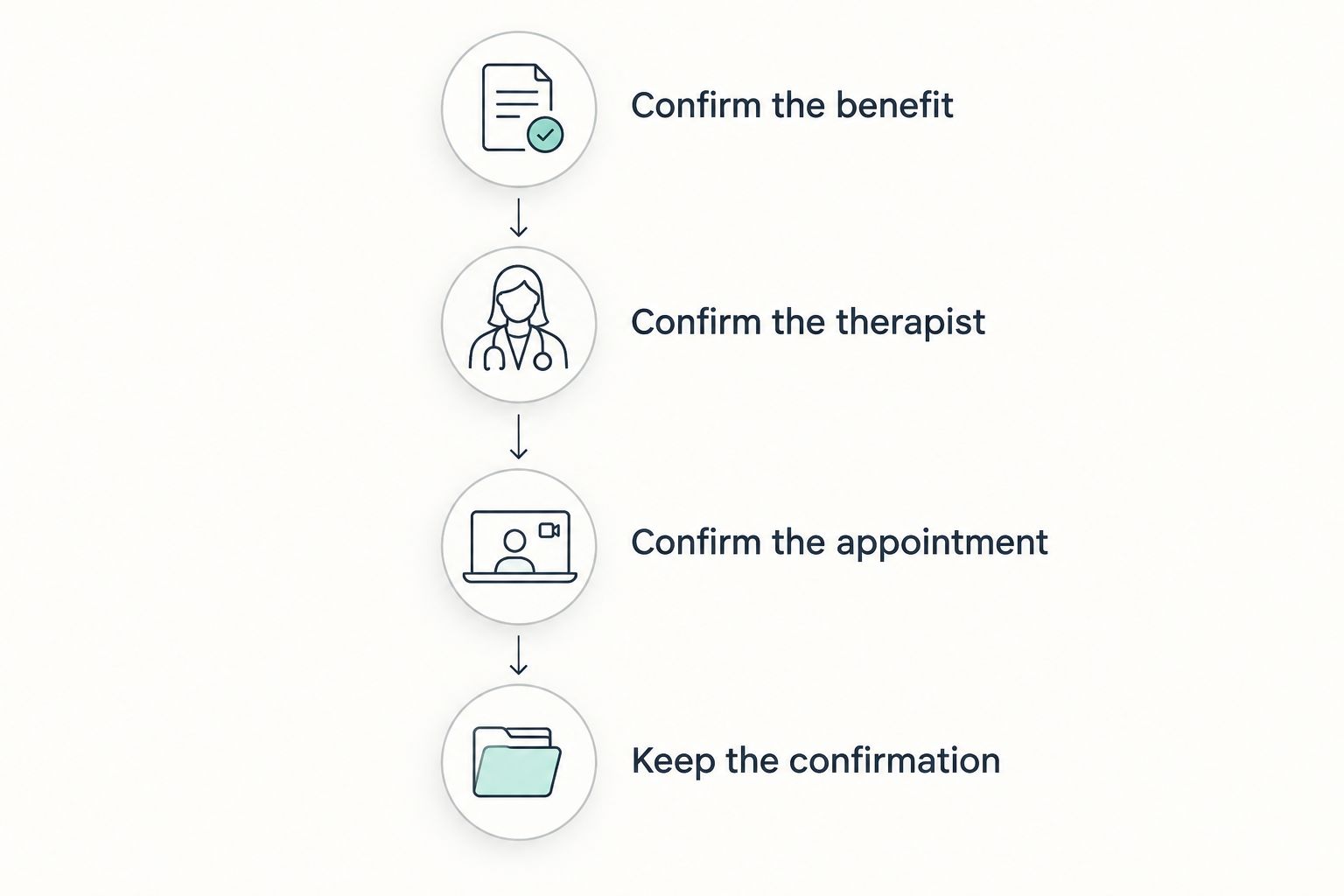
Confirm the benefit
Ask whether outpatient mental health counseling by live video is covered under your current plan. Then ask whether the answer changes for the service you need, such as individual psychotherapy or family treatment.
For 2026 benefits, request the relevant plan document or member-portal explanation. Keep that information with your appointment records so you can refer to the same terms if a claim needs clarification.
Confirm the therapist
Ask the representative to check the individual clinician and the billing practice. A practice can include clinicians with different insurance arrangements, so checking only the business name leaves an important question unanswered.
If the therapist has provided billing codes, ask the insurer to check those codes. Do not select a code yourself or ask a clinician to change a diagnosis simply to obtain coverage.
Confirm the appointment
Describe whether you will attend by video or telephone and where you will physically be during the session. If you are traveling, ask again before attending from a different state.
Ask whether any authorization or referral must be completed before treatment begins. Find out who submits it and how you can confirm it is in place.
Keep the confirmation
Record the date, the representative’s name or identification, the call reference number, and the explanation you receive. Request written confirmation when available.
A benefits check is useful documentation, not a guarantee of claim payment. The insurer still evaluates the submitted claim under the plan’s terms.
Does insurance cover video, telephone, and messaging equally?
No—do not treat approval for video therapy as approval for every remote service. Ask about the exact format your therapist intends to use.
A scheduled video psychotherapy appointment is different from exchanging messages through an app. Telephone-only care also needs its own coverage check rather than an assumption based on video benefits.
Ask what happens if a video connection fails during an appointment. The therapist can explain the clinical backup plan, while the insurer can explain whether a change in format affects coverage.
This distinction also applies when choosing a service: convenient communication features do not establish that those features are reimbursable mental health treatment.
Can you use an out-of-network virtual therapist?
You can seek an out-of-network therapist, but insurance reimbursement depends on whether your plan includes an applicable out-of-network benefit. Confirm that benefit before treating reimbursement as part of your payment plan.
Ask whether the insurer accepts member-submitted claims, what documentation it requires, and whether a separate deductible applies. Also ask how the plan determines its allowed amount; that amount is not necessarily the therapist’s full charge.
A superbill is an itemized document used to support an insurance claim. It is not an approval letter, and providing one does not make a therapist in-network.
The guide to getting a superbill for therapy insurance reimbursement explains that documentation route. Before choosing it, ask the therapist whether they provide the required paperwork and ask your insurer how to submit it.
Are couples and family sessions covered the same way?
Do not assume that coverage for individual therapy extends to every couples or family appointment. The purpose of treatment and the plan’s requirements matter, not just who appears on the video call.
Relationship-focused counseling and treatment involving family members are not automatically the same insurance service. Describe the care you are seeking and ask the clinician how the appointment would be documented and billed.
For a child’s virtual therapy, ask how caregiver participation fits the treatment plan. Also confirm whose insurance will be billed and what consent arrangements the clinician requires.
Counselingcharlotte offers couples and family therapy alongside individual mental health counseling. That service range does not establish coverage for a particular session; verify the proposed treatment with the practice and your insurer.
What should you do if a claim is denied?
Read the explanation of benefits before assuming that virtual therapy itself is excluded. A denial can concern eligibility, network participation, missing information, authorization, or the service submitted.
Ask the insurer for the specific denial reason and the plan provision supporting it. Then ask the therapist’s billing contact whether the claim contains an error that needs correction.
If you disagree with the decision, request the plan’s appeal instructions and submission deadline. Keep the denial, relevant benefits documents, appointment information, and earlier coverage confirmations together.
Do not change or invent treatment details to make a claim payable. An appeal should address the actual service and the actual plan terms. If you need help identifying the appropriate complaint route, ask whether the plan is employer-funded, fully insured, or part of a public program; oversight differs by arrangement.
FAQ
Is virtual therapy covered by insurance in North Carolina in 2026?
Yes, many plans cover virtual therapy in North Carolina in 2026, but coverage depends on your specific benefits, clinician, and appointment. Confirm outpatient mental health video visits with your insurer before booking.
Does a therapist accepting my insurer mean my appointment is in-network?
No, accepting an insurer does not establish participation in your exact plan network. Ask your insurer to verify the individual therapist and billing practice using your member information.
Can I get reimbursed for an out-of-network virtual therapist?
Reimbursement depends on whether your plan includes an applicable out-of-network benefit and whether the claim meets its requirements. A superbill supports a claim but does not guarantee payment.
Does insurance cover couples therapy online?
Coverage depends on the service being provided and your plan’s terms. Do not assume that a benefit for individual psychotherapy includes relationship-focused counseling or every family session.
Can I attend an insured virtual therapy session while traveling?
Confirm both the therapist’s authorization to treat you in your physical location and your plan’s coverage rules before attending while traveling. Living in North Carolina does not settle the requirements for a session you attend elsewhere.
Will my deductible apply to online counseling?
Your deductible applies if your plan assigns covered virtual counseling to that deductible. Ask whether the appointment instead has a copayment or coinsurance and which deductible applies.
Does Counselingcharlotte offer virtual mental health counseling?
Counselingcharlotte offers virtual mental health counseling for children, teens, and adults in the Charlotte area. Confirm the clinician’s insurance participation and your plan’s benefits separately before scheduling.
One last thing
Ask about the next appointment, not just virtual therapy in general. Give the insurer the clinician, treatment format, service information, and your planned location so the answer addresses the session you intend to book.
Save that confirmation with your 2026 benefits documents. If you later change clinicians, insurance plans, or the state where you attend, repeat the relevant checks instead of carrying the old answer forward.


