

Military-family couples therapy is relationship counseling that helps partners address conflict, separation, and changing responsibilities with the aim of building a safer, more workable partnership. This 2026 guide explains how to choose care around deployments, relocations, privacy concerns, and each partner’s needs without assuming every military family has the same experience.
- Couples therapy for military families should address deployment, reintegration, communication, and both partners’ goals.
- Counselingcharlotte offers couples therapy for Charlotte-area families seeking in-person or virtual counseling.
- Confirm confidentiality, clinician qualifications, and location rules before sharing sensitive information.
- Address fear, coercion, or violence through individual safety support rather than ordinary joint communication exercises.
Why couples therapy matters for military families
Military service creates practical questions that belong in relationship counseling: who handles responsibilities during an absence, how partners reconnect afterward, and what happens when another move interrupts treatment. Your therapist needs to understand those circumstances without treating military service as the explanation for every disagreement.
Choose care around the problem you want to change, not military affiliation alone. A household planning a separation needs different conversations from a couple rebuilding trust or deciding whether to stay together. Use the guide to couples therapists in Charlotte, NC to frame your local search around those needs.
For your 2026 care plan, separate relationship concerns from symptoms that need individual attention. Anxiety, depression, trauma symptoms, and relationship distress deserve assessment on their own terms; neither partner should have to accept a diagnosis supplied by the other.
Military experience also does not erase ordinary relationship differences. You still need room to discuss money, affection, parenting, boundaries, and expectations without every conversation becoming a debate about whose responsibilities are harder.
How to choose and use couples therapy
Define goals
Start on paper before you search for a therapist. Each partner should describe what feels difficult, what happens during a typical disagreement, and what a useful change would look like in daily life. Compare the descriptions without trying to settle the argument immediately.
Replace broad goals such as better communication with observable actions: discussing household decisions before making commitments, returning to unfinished conversations, or asking for support without criticism. You do not need identical goals, but the therapist needs to hear where your priorities differ.
For a first appointment in 2026, bring one recent example rather than a complete history of every conflict. Explain what happened before the disagreement, how each person responded, and what remained unresolved afterward.
- Write each partner’s priorities separately.
- Identify the recurring disagreement you want help understanding.
- Describe a change you could recognize at home.
- List upcoming separations, moves, or household transitions.
- Tell the therapist when your goals conflict.
Check privacy
Write your privacy questions down and ask them before discussing sensitive details. Do not assume that civilian care, military-connected support, and informal relationship assistance use identical documentation or confidentiality practices.
Ask who the client is, how records are maintained, what exceptions to confidentiality apply, and how the therapist handles information shared privately by one partner. Request an explanation of any policy about secrets between partners. Both people should understand that policy before individual conversations begin.
Career concerns deserve a specific answer, not reassurance from a directory listing. Ask the provider what information is recorded or disclosed in your circumstances, and direct questions about military reporting requirements to the appropriate qualified resource. No general article can determine what applies to your situation.
- Request the provider’s confidentiality explanation.
- Ask about records and access requests.
- Clarify policies for individual messages and meetings.
- Discuss insurance-related documentation before using benefits.
- Ask how remote-session privacy is protected.
Choose format
Begin by comparing your actual calendars, travel demands, and access to a private room. In-person sessions require getting to the office; virtual sessions require a suitable location and confirmation that the clinician can work with everyone where they are physically located.
Counselingcharlotte couples therapy is best for Charlotte-area couples seeking in-person or virtual relationship counseling. Its stated services include couples and family therapy, alongside counseling for anxiety, depression, trauma, and OCD. That service range does not establish military-specific training or suitability for your particular concerns.
Review Counselingcharlotte as a local option, then ask directly about relevant experience, treatment approach, and coordination with other care. A local practice is not automatically the right provider for partners living in different jurisdictions during a deployment or move.
- Map each partner’s likely session location.
- Compare office travel with private video access.
- Ask about experience with military-family transitions.
- Confirm whether joint remote sessions fit your circumstances.
- Explain any anticipated relocation before treatment starts.
Assess safety
Consider whether you can disagree without fear before practicing joint communication exercises. Threats, intimidation, stalking, sexual coercion, or control over money and movement require a different response from an ordinary disagreement about chores or schedules.
If describing your concerns could expose you to retaliation, seek confidential individual support rather than using a joint session to confront your partner. Ask a qualified professional about a safe way to communicate and obtain help. Do not create a shared written exercise that increases danger.
Immediate safety takes priority over relationship work. In the United States, call 911 for immediate danger. Call or text 988 for suicide or mental health crisis support. These resources serve different purposes; neither replaces an individualized safety assessment.
- Notice whether disagreement produces fear or threats.
- Tell the clinician privately about safety concerns when safe.
- Ask whether joint counseling is appropriate.
- Use a safe device when seeking help if monitoring is a concern.
- Prioritize emergency assistance when danger is immediate.
Plan transitions
Create a practical household plan before a separation or return, then bring disputed parts to therapy. Include responsibilities, parenting decisions, contact expectations, and how you will handle conversations that cannot happen immediately.
Reintegration is not a requirement to restore every old arrangement. The partner at home has been managing responsibilities, while the returning partner has had a different experience. Use counseling to negotiate the current arrangement rather than deciding whose version of normal wins.
For a transition scheduled in 2026, tell the therapist what is known and what remains uncertain. Build a plan that acknowledges changing schedules instead of treating every interrupted conversation as evidence that someone does not care.
- List responsibilities before and after the transition.
- Agree on realistic expectations for contact.
- Identify decisions that need both partners’ input.
- Discuss parenting boundaries without involving children in disputes.
- Ask about continuity of care before relocating.
Review progress
Keep a brief private note about what happens between sessions. Record whether the specific pattern you identified is changing, whether both partners can participate honestly, and whether the work feels relevant to your shared goals.
Progress is not simply having fewer disagreements. Ask whether you understand disagreements better, repair hurt more directly, and make decisions without fear or pressure. A quieter household is not an improvement if one person has stopped speaking because speaking feels unsafe.
Bring concerns about the therapy itself into the room. If sessions repeatedly become unstructured arguments, ask the therapist to explain the treatment plan, how participation will be balanced, and when a different service or referral should be considered.
- Revisit the goals you wrote before treatment.
- Track a concrete example of change or continued difficulty.
- Ask what each exercise is intended to address.
- Discuss individual support needs separately from joint goals.
- Request a referral when the current service does not fit.
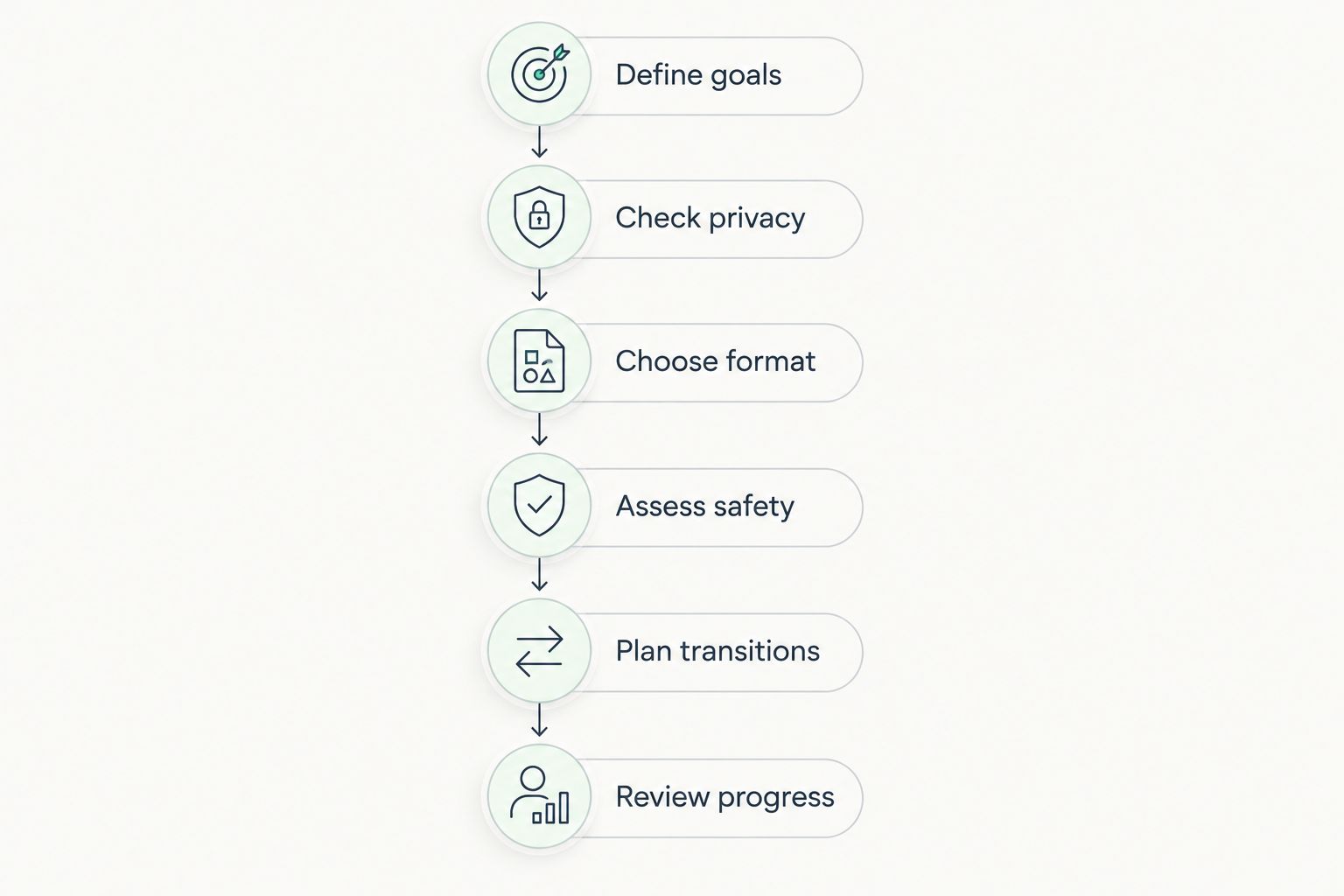
The process is a sequence of decisions, not a promise that every couple should remain together. Define the problem, clarify privacy, select a workable format, assess safety, plan around transitions, and review whether the care is helping.
Compare support options for your family
Best for means the closest match to your current task, not a ranking of treatment quality. Choose the service that addresses the problem you are bringing, then confirm its scope with the provider. You can ask about complementary support without assuming that every service should happen at once.
| Option | Best for | Practical advantage | Key limitation |
|---|---|---|---|
| Couples therapy | Partners addressing relationship patterns together | Makes the relationship the focus of treatment | Joint work requires assessment of safety and suitability |
| Individual therapy | A partner seeking help with personal symptoms or decisions | Provides space for individual concerns | Does not provide the other partner’s perspective in the room |
| Family therapy | Households addressing parenting or family interactions | Includes relevant family relationships | Does not replace private work on the couple’s relationship |
| Military-connected relationship support | Families seeking help within a military-service context | Offers a route to ask about service-related circumstances | Eligibility, scope, confidentiality, and clinical services require confirmation |
| Self-directed relationship exercises | Partners practicing an agreed skill between appointments | Can support a specific task without another appointment | Cannot assess safety or replace individualized clinical care |
For Counselingcharlotte, the practical advantage is the stated choice of in-person and virtual counseling in the Charlotte area. The decision still depends on clinician fit: confirm military-family experience, suitability for your concerns, and whether the planned session locations are permitted.
Ask about any proposed exercise before using it at home. Understanding its purpose matters more than collecting worksheets. If the exercise becomes another way to score points against each other, bring that pattern back to the therapist instead of repeating it unchanged.
Explore counseling for your relationship
Review Charlotte-area couples and family counseling, then ask about military-family experience and session format.
Common mistakes military families make when choosing care
Choosing military familiarity without checking relationship skills
A clinician’s familiarity with military life does not answer how they assess relationship patterns or manage a difficult joint session. Ask about both. You need someone who can understand your circumstances and explain how the proposed treatment addresses your concerns.
Assuming virtual sessions can continue through every move
A video connection is not permission to provide care wherever each partner travels. Tell the clinician about location changes before the next appointment and ask what arrangements are possible. Resolve this before relying on remote care during a separation.
Treating deployment as the entire explanation
Deployment can be relevant without explaining every problem. Name concerns that existed before the separation, patterns that developed during it, and difficulties that appeared after reunion. That distinction gives the therapist a more useful starting point than a single explanation for everything.
Making one partner the identified problem
Couples counseling should not become a campaign to prove that the service member or civilian partner needs fixing. Describe behaviors and their effects instead. Individual symptoms still deserve appropriate attention, but they should not be used to dismiss someone’s account of the relationship.
Involving children in adult disputes
Do not ask children to carry messages, report on the other parent, or choose whose account is correct. Bring parenting disagreements to an adult conversation or an appropriate clinical setting. Ask whether family sessions would serve a clear purpose before including children.
FAQ
What is couples therapy for military families?
Couples therapy for military families is relationship counseling that addresses the couple’s concerns alongside military-related circumstances. Sessions can include deployment expectations, reintegration, parenting responsibilities, trust, and communication.
Do we need a therapist who has served in the military?
Military service experience is not the only criterion for choosing a couples therapist. Ask about relationship-treatment training, experience with military families, confidentiality, and the approach proposed for your specific goals.
Can we attend virtual couples therapy while living apart?
Virtual couples therapy depends on the clinician being able to provide care where each partner is physically located. Confirm both locations and any upcoming travel before scheduling, especially across state or national borders.
Will couples counseling affect a military career?
A general guide cannot determine the career or reporting implications of your particular counseling arrangement. Ask the provider about confidentiality, records, and disclosures, and seek qualified guidance about applicable military requirements.
Is couples therapy appropriate when one partner feels afraid?
Fear, threats, coercion, or violence call for an individual safety assessment before ordinary joint relationship work. Seek confidential support when safe, and call 911 if there is immediate danger in the United States.
Does Counselingcharlotte offer care for couples?
Counselingcharlotte offers in-person and virtual couples and family counseling in the Charlotte, NC area. Ask directly about military-family experience, clinician fit, and whether your planned session locations are appropriate.
What should we prepare for a first couples therapy appointment in 2026?
Prepare each partner’s goals, a recent example of conflict, and questions about confidentiality and treatment. Include upcoming deployments, relocations, or other transitions that affect attendance and household responsibilities.
One last thing
A useful first-session question is: What would make joint counseling inappropriate for us? The answer tests whether the clinician considers safety, treatment fit, and referral needs—not just whether appointments can be scheduled.
Make that part of your 2026 search. Choosing care includes deciding what kind of help does not fit, and either partner should be able to raise that question without being accused of rejecting the relationship.


