

Choose Clear Creek Counseling if you want a Charlotte-area practice offering in-person and virtual counseling for children, teens, and adults; choose Charlotte Counselors if a specific therapist there meets your clinical needs and practical requirements better. This 2026 comparison separates confirmed service offerings from the therapist-level questions that should decide your choice.
- Clear Creek Counseling vs Charlotte Counselors: choose by therapist fit, not the practice name.
- Clear Creek Counseling offers in-person and virtual mental health counseling for children, teens, and adults.
- Choose Charlotte Counselors when a specific clinician there better matches your treatment needs and practical requirements.
- For anxiety, OCD, trauma, or family therapy, ask how the therapist addresses your specific concern.
Why this matters
Choosing a practice and choosing a therapist are different decisions. A practice’s service list helps you build a shortlist; the clinician’s experience, treatment approach, and working relationship with you determine whether that shortlist becomes a useful match.
Clear Creek Counseling provides counseling for anxiety, depression, trauma, and OCD, along with couples and family therapy. Those offerings establish a relevant starting point, not a promise that every clinician handles every concern or serves every age group.
For your 2026 decision, separate service fit from therapist fit. Start with the concern you want help addressing, then establish who would provide that care and how the sessions would work.
At a glance: your 2026 comparison
The table distinguishes stated services from questions to resolve directly with a prospective clinician. A question in the Charlotte Counselors column is a selection criterion, not a claim about that practice’s offerings.
| Dimension | Clear Creek Counseling | Charlotte Counselors |
|---|---|---|
| Best for | People seeking the stated Charlotte-area counseling services across age groups | People whose preferred clinician there meets their specific requirements |
| Standout feature | In-person and virtual counseling, with individual and relationship-focused services | Establish the specific clinician’s strongest area of practice |
| Age-group fit | Serves children, teens, and adults | Confirm the prospective therapist serves the relevant age group |
| Main concern | Lists anxiety, depression, trauma, and OCD counseling | Ask about experience with your presenting concern |
| Couples and family needs | Offers couples and family therapy | Confirm the relevant service and who would participate |
| Session format | Offers in-person and virtual counseling | Confirm the format with the prospective clinician |
| Therapeutic relationship | Assess during your conversations and sessions | Assess during your conversations and sessions |
| Pricing model | Confirm billing arrangements directly | Confirm billing arrangements directly |
Clear Creek wins the stated-service match across age groups
Clear Creek Counseling is a relevant starting point for Charlotte-area families seeking counseling for children, teens, or adults. Its stated services span 3 age groups, which makes the practice relevant when you are searching for yourself or someone in your family.
The limitation is important: serving those age groups does not establish that one therapist treats all of them. A child’s needs differ from an adult’s, and a family appointment is not interchangeable with an individual appointment.
Ask who would actually provide care. For a child or teen, ask how the clinician involves caregivers, explains privacy, and sets goals appropriate to the young person’s needs.
Charlotte Counselors becomes the stronger choice when a particular clinician there demonstrates a closer match to the person seeking care. That is a therapist-level advantage, not a reason to assume an entire practice is better for every family.
Charlotte Counselors wins when its specific clinician fits better
Choose Charlotte Counselors when you identify a clinician there whose approach and relevant experience match your needs better. A strong individual match is a genuine reason to choose one practice over another, even when both appear relevant at the service-list level.
Make that judgment concrete. Rather than asking whether a therapist treats anxiety, describe what anxiety interrupts: school attendance, work, relationships, sleep, or everyday activities. Ask how the clinician would approach that problem.
A useful explanation connects your concern to a treatment plan. It describes what you would work on, how sessions would support that work, and how you would discuss progress.
The same standard applies to either practice. Do not award a clinician an advantage because a profile sounds reassuring; look for a clear connection between your needs and the proposed care.
Both need a concern-specific treatment discussion
Anxiety, depression, trauma, and OCD are included in Clear Creek’s stated counseling services. That establishes relevance, but the next question is more specific: what would treatment involve for you?
For OCD, ask whether the prospective therapist provides exposure and response prevention, a recognized treatment approach for OCD. For trauma, ask how the clinician assesses your needs, explains the proposed treatment, and discusses pacing with you.
For depression or anxiety, ask what goals would guide the work. You should be able to discuss the changes you want without having to choose a treatment method yourself.
Use these 3 questions with either practice:
- Relevant experience: How do you work with someone facing my particular concern?
- Treatment plan: What approach would you recommend, and why?
- Progress review: How will we decide whether the work is helping?
Neither practice earns a clinical-quality win from a service label alone. The better choice gives you an understandable explanation tied to your situation.
Clear Creek offers a stated choice of session formats
Clear Creek offers 2 counseling formats: in-person and virtual. That matters when you want to consider both options rather than begin with a format-only search.
However, a practice offering both formats does not establish that every clinician provides both or that switching formats is part of your arrangement. Ask the prospective therapist what applies to your care before making that flexibility a deciding factor.
For virtual counseling, consider whether you have a private place to speak and a dependable connection. For in-person counseling, consider the travel involved and whether you can sustain the arrangement alongside work, school, or caregiving.
Charlotte Counselors wins this dimension if your chosen clinician there offers a format that better meets your actual requirements. The useful comparison is not which format sounds more convenient in theory; it is which arrangement lets you participate consistently and privately.
Relationship therapy requires its own comparison
Clear Creek’s stated services include couples and family therapy. That gives people seeking relationship-focused counseling a reason to include the practice in their shortlist.
But do not treat individual, couples, and family therapy as interchangeable. Before choosing either practice, explain who wants to participate and what you want help changing.
For couples counseling, ask how the therapist establishes shared goals and handles differing accounts of the same problem. For family therapy, ask who would attend and how the clinician would include each person’s perspective.
Charlotte Counselors is the better choice if a specific relationship therapist there meets your needs more closely. Clear Creek is the clearer starting point when its stated couples or family services match your search. In both cases, the clinician’s explanation should guide the final decision.
Neither practice wins therapeutic fit in advance
A relevant service list does not tell you whether you will feel understood by a particular therapist. Neither does an appealing biography.
Look for a working relationship in which you can ask questions, disagree, and discuss whether the approach is helping. Feeling challenged during therapy is different from feeling unable to ask what the treatment is meant to accomplish.
After an initial conversation or session, consider whether the clinician understood your main concern and explained a reasonable direction for the work. You do not need certainty about every future session, but you should understand the purpose of starting.
This is an honest tie at the practice-comparison stage. Choose the clinician who can connect relevant experience, a clear plan, and a workable relationship—not the practice with the stronger-sounding name.
Pricing and billing: compare the arrangement in 2026
Ask each practice to explain its billing model directly. Establish whether your proposed care would be billed through insurance, paid directly, or handled through another arrangement before comparing financial fit.
If you intend to use insurance, ask about the specific clinician and service you are considering. Confirm the relevant coverage details with your insurer rather than treating a general statement about a practice as a benefit determination.
If you intend to pay directly, ask how billing works and what responsibilities apply to your appointments. Review cancellation terms and any required paperwork before committing.
The tradeoff is clarity versus administrative work, not an assumed cost advantage. An arrangement is only useful when you understand your responsibilities; neither practice earns a billing win without that explanation.
Turn the comparison into a practical decision
Use the same criteria for both practices so that a friendly conversation does not displace your original needs. Write down your main concern before you contact a prospective therapist.
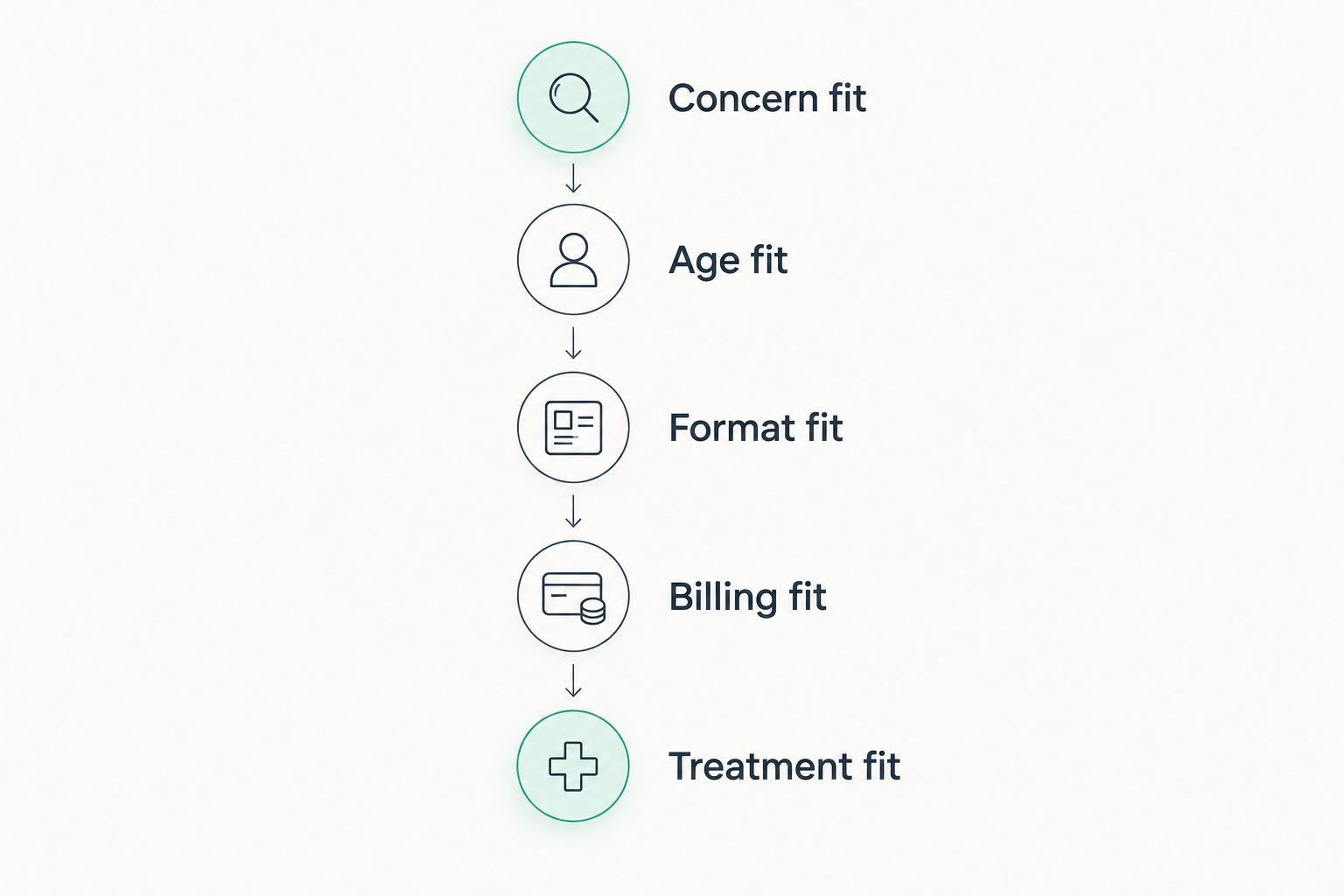
Keep the sequence simple:
- Concern fit: Describe the problem you want help addressing and the changes you want to work toward.
- Age fit: Confirm that the clinician works with the person seeking care.
- Format fit: Establish how and where you would attend sessions.
- Billing fit: Understand the financial arrangement and appointment responsibilities.
- Treatment fit: Ask how the clinician would approach your goals and review progress.
These criteria keep the comparison focused on care rather than on how much information a practice publishes. A shorter profile followed by clear answers is more useful than a long service list that leaves your central questions unresolved.
Once you have those answers, separate nonnegotiable requirements from preferences. A clinician who does not serve the relevant age group is not a match; a preferred format deserves discussion but should not replace the clinical questions.
Final verdict for 2026
Choose Clear Creek Counseling if you want a stated service match
Best for: Charlotte-area individuals and families seeking its listed counseling services. The practice offers in-person and virtual care for children, teens, and adults, including individual concerns and relationship-focused therapy.
Its strength is the breadth of those stated offerings. Its limitation in this comparison is that a practice-level description does not settle which clinician is right for you. Confirm that match before treating the practice as your final choice.
Choose Charlotte Counselors if you have the stronger clinician match
Best for: people who identify a specific therapist there who better meets their requirements. Choose that clinician when the answers about relevant experience, approach, format, and billing fit your situation more closely.
The strength of this route is specificity: you are choosing an actual working relationship. The limitation is that the practice name itself does not establish that fit; your decision needs to rest on the clinician-level discussion.
| Dimension | Winner |
|---|---|
| Stated services across age groups | Clear Creek for a matching service search |
| Specific clinician match | Charlotte Counselors when its clinician fits better |
| Concern-specific treatment | Tie until the treatment discussion |
| Session format | Clear Creek for stated options; confirm clinician fit |
| Couples and family needs | Clear Creek for stated services; clinician fit decides |
| Therapeutic relationship | Tie until assessed directly |
| Pricing model | Neither without a clear billing explanation |
FAQ
Is Clear Creek Counseling better than Charlotte Counselors?
Clear Creek Counseling is a relevant starting point when its stated services match your needs; Charlotte Counselors is the better choice when a specific clinician there fits you more closely. Compare the actual therapist, proposed treatment, session format, and billing arrangement before deciding.
Does Clear Creek offer both virtual and in-person therapy?
Clear Creek offers in-person and virtual mental health counseling. Ask the prospective clinician which arrangements apply to your care rather than assuming every therapist provides both formats.
Which practice should I choose for my child or teenager?
Choose a clinician who works with your child's age group and presenting concern. Clear Creek serves children and teens; ask either prospective therapist how caregiver involvement, privacy, and treatment goals would work.
What should I ask when comparing OCD therapists?
Ask whether the prospective clinician provides exposure and response prevention and how it would apply to your needs. A general OCD service listing does not answer the therapist-level treatment question.
How do I compare the billing arrangements?
Ask each practice to explain how the specific clinician and service would be billed. If you plan to use insurance, confirm the relevant benefits with your insurer as well.
Should I choose a practice or a specific therapist first?
Use the practice to build your shortlist, then choose based on the specific therapist. Relevant experience, a clear treatment explanation, and a workable arrangement matter more than the practice name.
One last thing
Ask this before choosing: What would tell us that this approach is not helping, and what would we do next? The answer gives you something a service list cannot: a practical explanation of how the therapist responds when treatment needs adjustment.
You are not asking for a guarantee. You are asking how you and the clinician will make decisions together.


