

Charlotte counselors give you a local starting point for individual and family therapy, but location alone does not establish the right clinical fit. For charlotte counselors alternatives in 2026, start with Counselingcharlotte if you need in-person or virtual counseling for children, teens, adults, couples, or families; choose a condition-focused therapist when a particular concern should drive the search. This comparison explains which care route fits your situation and what to ask before changing therapists.
- Counselingcharlotte is a Charlotte counselors alternative offering individual and family therapy, with in-person and virtual counseling.
- Choose a condition-focused therapist when anxiety, depression, trauma, or OCD is your main treatment concern.
- Choose family therapy for shared family goals and couples therapy for relationship-focused work.
- Stay with your current counselor when you feel understood, share clear goals, and can discuss progress.
Why this matters
Searching for Charlotte counselors alternatives is not just a search for another name. You are choosing who participates in treatment, which concerns receive attention, and how sessions fit your life.
A counselor who suits one adult does not automatically suit a teenager or a family seeking help together. Compare the treatment focus before comparing convenience. A nearby office or virtual appointment cannot answer whether the clinician's approach matches your needs.
For your 2026 search, separate the practice from the individual clinician. A practice's service list tells you where to begin; a conversation with the treating clinician helps you evaluate the actual fit.
Charlotte counselors alternatives at a glance
The alternatives below are care routes, not interchangeable products. The local-counselor route remains in the table so you can compare changing clinicians, changing session format, and changing the focus of treatment.
| Option | Best for | Defining feature | Difference from a general local-counselor search |
|---|---|---|---|
| Charlotte counselors | Starting a geographically focused search | Local connection | Establishes location, but not a particular treatment focus |
| Counselingcharlotte | Individuals and families considering in-person or virtual counseling | Services for children, teens, adults, couples, and families | Gives you a specific practice to evaluate against your needs |
| Condition-focused therapist | A primary concern such as anxiety, depression, trauma, or OCD | Search organized around the concern | Puts relevant clinical experience ahead of proximity |
| Family therapist | Relatives seeking help with shared concerns | Family participation and shared goals | Changes the unit of treatment from one person to the family |
| Couples therapist | Partners seeking relationship-focused counseling | Work centered on the relationship | Focuses the search on partner participation and relationship goals |
| Virtual therapist | People who prefer sessions without traveling to an office | Remote session format | Changes how you attend, not necessarily what treatment addresses |
The useful alternative is the one that resolves the mismatch you are experiencing. If your concern is the clinician's treatment approach, switching from an office visit to video does not resolve that concern by itself.
1. Counselingcharlotte: best for individual and family options
Counselingcharlotte provides mental health counseling in the Charlotte, NC area through in-person and virtual services. Its stated services include anxiety, depression, trauma, OCD, and couples/family therapy for children, teens, and adults.
That range gives you a starting point when your household is deciding between individual and shared counseling. It does not mean every clinician handles every concern or that different family members should see the same therapist.
Where Counselingcharlotte shines
- Offers both individual and relationship-focused counseling services.
- Serves children, teens, and adults rather than only one age group.
- Includes in-person and virtual formats.
- Names anxiety, depression, trauma, and OCD among its service areas.
Where Counselingcharlotte falls short as a search shortcut
- A broad service list does not establish the right clinician for your specific needs.
- The practice-level description does not settle which treatment approach a clinician uses.
- Choosing a practice does not answer how confidentiality works when relatives participate.
Those are reasons to ask focused questions, not reasons to reject the practice. Ask who would provide your care, how that person works with your main concern, and how you will agree on treatment goals.
| Decision | This practice | General Charlotte-counselor search |
|---|---|---|
| Age group | Children, teens, and adults are named | Evaluate each clinician's age-group experience |
| Session format | In-person and virtual services are named | Check the format with each provider |
| Relationship work | Couples/family therapy is named | Look specifically for the participation you need |
| Treatment concerns | Anxiety, depression, trauma, and OCD are named | Narrow the search by your main concern |
Best for: People seeking a Charlotte-area counseling practice with individual, couples, and family service options.
Verdict: Hold a final decision until the specific clinician and treatment approach match your needs.
2. A condition-focused therapist: best for a primary concern
A condition-focused search begins with the problem you want help addressing rather than a broad list of nearby counselors. Use this route when anxiety, depression, trauma, or OCD is the central reason you are seeking care.
Ask about relevant clinical experience and the proposed treatment approach. A profile that mentions a condition is a starting point, not proof that the clinician's work fits your situation.
Where this route shines
- Makes your primary concern the main selection criterion.
- Gives you a concrete basis for discussing treatment goals.
- Helps distinguish general support from work directed at a particular problem.
Where this route falls short
- A narrowly focused search can overlook relationship or family concerns you also want to address.
- A condition label alone does not explain the clinician's method.
- You still need to evaluate communication, participation, and session format.
| Decision | Condition-focused route | General local-counselor route |
|---|---|---|
| Starting point | Main treatment concern | Geographic area |
| Key question | How do you treat this concern? | Do you work with someone in my situation? |
| Fit check | Relevant experience and treatment approach | Broader clinician suitability |
For a 2026 search, describe what is happening rather than relying only on a diagnostic label. Tell the clinician what interferes with daily life and what you want to change; an assessment belongs with a qualified professional.
Best for: People whose main concern should determine the clinician search.
Verdict: Hold your choice until the clinician explains a relevant treatment approach.
3. A family therapist: best for shared family goals
Family therapy makes sense to explore when the concern involves interactions among relatives, not only one person's symptoms. Examples of goals to discuss include communication, recurring conflict, parenting disagreements, and changes affecting the household.
Start by identifying who wants help and who would participate. The family therapists in Charlotte guide provides a related route for a family-focused search.
Where this route shines
- Gives shared concerns a place in the treatment conversation.
- Supports discussion of each participant's goals and perspective.
- Makes family participation an explicit part of selecting care.
Where this route falls short
- Family members do not necessarily agree on the goal or want to participate.
- Shared sessions do not automatically address each person's private treatment needs.
- Confidentiality and communication expectations require clarification before sensitive disclosures.
| Decision | Family-therapy route | Individual local-counselor route |
|---|---|---|
| Treatment focus | Shared family concerns | One person's concerns |
| Participation | Agreed family participants | Individual client |
| Essential clarification | Roles and confidentiality | Individual treatment goals |
Best for: Families seeking help with concerns they want to address together.
Verdict: Hold joint sessions until participants understand the goals, roles, and confidentiality boundaries.
4. A couples therapist: best for relationship-focused work
Couples therapy is a distinct search route when both partners want help with the relationship. You should evaluate experience with couples rather than assume any individual counselor provides the same kind of work.
Clarify whether your goal is communication, recurring conflict, relationship decisions, or another shared concern. The clinician should explain how each partner participates and how individual disclosures are handled.
Where this route shines
- Centers the search on the relationship rather than one partner alone.
- Makes shared goals part of the initial discussion.
- Gives you specific questions about neutrality, participation, and confidentiality.
Where this route falls short
- Joint work requires clarity about each partner's willingness to participate.
- Couples sessions are not a substitute for every individual mental health need.
- Fear, coercion, or violence requires a safety-focused assessment rather than an automatic recommendation for joint sessions.
Best for: Partners seeking relationship-focused care with an agreed purpose.
Verdict: Hold joint treatment until the clinician has assessed fit and safety.
5. A virtual therapist: best for a remote session format
Virtual counseling changes the setting of care. It does not, by itself, establish a different specialty or treatment approach.
Choose this route when traveling to an office is the obstacle you want to address. You still need a suitable clinician, an appropriate treatment focus, and a private setting for sessions.
Where this route shines
- Removes travel to a counseling office from the session routine.
- Lets you consider remote care alongside local in-person options.
- Keeps session format separate from the choice of treatment focus.
Where this route falls short
- Privacy at home is not automatic, especially in a shared household.
- Technology and an appropriate space become part of preparation.
- The clinician must confirm whether virtual care fits your circumstances and where you will be located.
For virtual therapy in 2026, ask about privacy, technology, and what happens if a connection fails. Also ask how the clinician handles urgent concerns between sessions; do not assume video appointments provide emergency support.
Best for: People whose main barrier is attending an office rather than finding an appropriate treatment approach.
Verdict: Hold your format choice until privacy and clinical suitability are clear.
Why people consider switching from Charlotte counselors
A useful reason to change counselors is specific enough to guide the next search. These are decision criteria, not claims about any named provider.
- Treatment focus: You want a clearer explanation of how counseling addresses your main concern.
- Participation: Your needs have shifted from individual work to couples or family work, or the reverse.
- Communication: You do not feel able to raise questions, disagree, or discuss a difficult session.
- Format: Travel or a lack of privacy makes the current arrangement difficult.
- Goals: You cannot explain what you and the clinician are working toward.
Before changing, raise the concern directly when it is safe to do so. Ask whether the current clinician can adjust the plan or recommend a different kind of care.
Do not treat a difficult session as automatic evidence of poor fit. Instead, consider whether the clinician responds respectfully and helps you understand the purpose of the work.
Use these checks before choosing an alternative
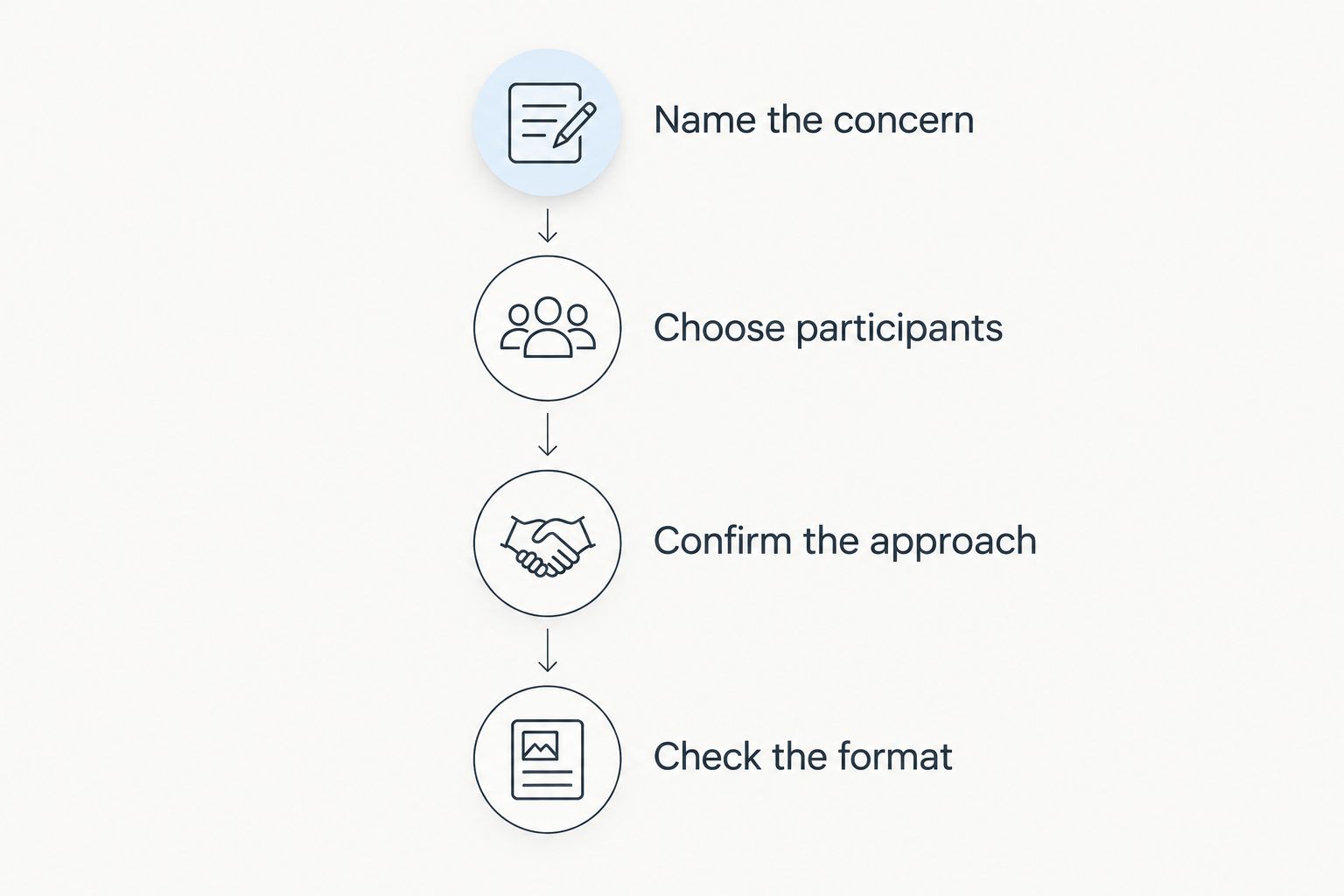
A short selection process keeps a 2026 counseling search focused on your needs. Use 4 checks before committing to a new arrangement:
- Name the concern. Describe what is difficult and what you want help changing.
- Choose participants. Decide whether you are seeking individual, couples, or family work.
- Confirm the approach. Ask the clinician to explain relevant experience and the proposed treatment focus.
- Check the format. Discuss in-person or virtual sessions, privacy, and practical requirements.
Keep 2 goals separate: the change you want from counseling and the practical arrangement that makes attendance workable. A convenient format does not replace an appropriate treatment focus.
Bring 3 questions to the initial conversation: What would we work on? How would we review progress? What happens if this is not the right fit? The answers should help you understand the proposed care, not pressure you into a decision.
When staying with your current counselor is the right call
Stay with your current counselor when you feel respected, understand the treatment goals, and can discuss what is or is not helping. A new provider is not automatically a better provider.
If your main concern is session format or a changing goal, ask about an adjustment first. Change counselors to address a defined mismatch, not simply because another name appears in a search.
FAQ
What's the best Charlotte counselors alternative for individual and family therapy?
Counselingcharlotte is a starting point for people seeking individual and family therapy in the Charlotte area, with in-person and virtual services. Choose the specific clinician based on your concern, age group, and desired participation.
Should I choose individual therapy or family therapy?
Choose based on whether you want help primarily with your own concerns or with shared family concerns. Discuss that distinction with a clinician before deciding who should attend.
Is a condition-focused therapist better than a general counselor?
A condition-focused therapist is the more targeted search route when one concern drives your need for care. Relevant experience and the proposed treatment approach matter more than a profile label alone.
Can children and teenagers use virtual counseling?
Discuss virtual counseling with a clinician who works with your child's age group. Suitability depends on the child's needs, privacy, participation, and the clinician's assessment.
What should I ask before switching therapists in 2026?
Ask how the new clinician would address your main concern, agree on goals, and review progress. Also clarify session format and how care will transition from your current provider.
Does family therapy replace individual therapy?
Family therapy does not automatically replace individual therapy because the treatment goals differ. Discuss whether shared sessions, individual care, or another arrangement fits the concerns involved.
When should I stay with my current Charlotte counselor?
Stay when you feel respected, share clear goals, and can discuss progress or concerns openly. Ask about adjustments before switching solely because your schedule or preferred format has changed.
One last thing
Ask who the client is when several family members participate. That question clarifies the treatment focus, the clinician's responsibilities, and how information is handled.
For your 2026 decision, write down the answer alongside your goals. A clear agreement about participation is more useful than a long list of counselor names.


