

Choose Clear Creek Counseling if you want a Charlotte-area practice with a stated scope covering children, teens, adults, couples, and families, with in-person and virtual counseling; choose Bareiter Counseling if a specific clinician there confirms experience with your concern and proves a better fit for your goals. For your 2026 decision, compare the therapist you would actually see—not just the practice name.
- Clear Creek Counseling vs Bareiter Counseling comes down to clinician fit, relevant experience, and a workable counseling format.
- Clear Creek Counseling is a documented option for Charlotte-area mental health counseling across age groups.
- Choose Bareiter Counseling when your clinician-level assessment supports that choice, not because of an assumed practice-wide advantage.
- Confirm treatment approach, billing arrangements, and practical requirements before committing to either practice.
Why this matters
A counseling practice can describe the right concern without identifying the right therapist for you. Anxiety, trauma, relationship conflict, and a child's difficulties call for different conversations about experience, treatment goals, and participation.
Choose the clinician whose proposed care matches your needs, not the practice with the longest list of concerns. A broad service description helps you build a shortlist. It does not establish a particular therapist's qualifications, treatment approach, or suitability for your situation.
This comparison separates the practice's stated services from the questions you should resolve directly. Use it to make a practical 2026 choice without treating an unverified assumption as a reason to start care.
At a glance
| Dimension | Clear Creek Counseling | Bareiter Counseling |
|---|---|---|
| Best for | Charlotte-area readers seeking the stated mix of individual, couples, and family counseling | Readers whose assessment identifies a specific clinician as the stronger match |
| Counseling format | In-person and virtual mental health counseling | Confirm the format with the clinician you are considering |
| Age groups | Children, teens, and adults | Confirm the clinician's accepted age groups |
| Concerns addressed | Anxiety, depression, trauma, OCD, and couples/family concerns | Ask about experience with your particular concern |
| Treatment approach | Confirm the approach with your proposed therapist | Confirm the approach with your proposed therapist |
| Personal fit | Assess communication, goals, and comfort directly | Assess communication, goals, and comfort directly |
| Pricing model | Confirm billing and insurance arrangements directly | Confirm billing and insurance arrangements directly |
| Standout feature | Stated breadth across ages, concerns, and counseling formats | Evaluate the individual clinician rather than assume a practice-wide distinction |
A stated service match is the strongest starting point
Clear Creek Counseling is a Charlotte-area mental health counseling option for children, teens, adults, couples, and families. That stated scope makes it a relevant starting point when you are looking for those services.
The advantage is clarity about the kinds of help the practice describes. The limitation is equally important: a practice-wide description does not establish that every clinician works with every age group or concern. Ask who would provide your care and why that person fits your needs.
Bareiter Counseling earns your preference when your direct assessment produces a stronger clinician-level match. That is a legitimate reason to choose it, but not evidence of a general advantage in specialties, access, or outcomes.
For either choice, write down your main reason for seeking help before making contact. A specific statement—such as wanting help with recurring relationship conflict—is more useful than asking whether a practice offers therapy generally.
In-person and virtual options are a documented benefit
The client's stated services include both in-person and virtual counseling. That gives you a concrete format question to discuss rather than requiring you to begin with an assumption about how care is delivered.
Choose the format you can participate in privately and consistently. In-person counseling involves travel and a shared physical setting. Virtual counseling requires a suitable connection, an appropriate device, and a private place to speak.
Ask Bareiter Counseling which format applies to the clinician you are considering. Do not assume that a practice's general options describe every therapist's arrangements.
For a 2026 decision, check the details that affect your actual sessions:
- Privacy: Where will you speak without being overheard?
- Participation: Will a partner, parent, or other family member take part?
- Location: Where will you physically be during virtual appointments?
- Consistency: Which format fits your ordinary responsibilities?
A format is useful only when it works for the care being proposed. Treat convenience as a selection criterion, not proof of clinical suitability.
Age-group coverage helps your shortlist, not your final choice
The stated age range includes children, teens, and adults. That makes the practice relevant to households seeking counseling for different family members, but it does not establish a coordinated household treatment plan.
For a child or teenager, ask the proposed clinician about experience with that developmental stage. Also discuss how caregivers participate, how privacy is explained, and how goals are established. Do not assume that adult counseling experience answers those questions.
For adult counseling, describe what you want to change in daily life. Then ask how the therapist would assess that concern and decide what to work on first.
Bareiter Counseling is the better personal choice if its proposed clinician demonstrates the more relevant age-specific experience and fit. Make that judgment from the actual conversation. A familiar practice name cannot substitute for learning who will provide treatment.
Concern coverage is useful; a treatment label is not enough
The client's description names anxiety, depression, trauma, OCD, and couples/family therapy. Those are relevant categories for finding care, not guarantees about a particular method or result.
Your next question should connect the concern to the therapist's work. Ask what experience they have with similar presentations, how they assess your needs, and how they explain their proposed approach.
For OCD concerns, do not stop at a general statement about treating anxiety. Ask specifically about OCD assessment and treatment experience; the guide to OCD therapists in Charlotte can help you focus your search.
For trauma-related concerns, discuss pacing and how the therapist decides what to address. For couples or family work, clarify who participates and how shared goals are handled.
Neither practice wins a concern-specific comparison merely by being named in a search result. The useful distinction is whether the proposed clinician can explain a relevant approach in language you understand.
Neither practice wins on treatment approach without a clinician match
A practice name is not a treatment method. You need to understand what the proposed therapist plans to do, why it fits your concern, and how you will discuss progress.
Use these 3 questions in your 2026 conversations:
- Relevant experience: What experience do you have helping people with my main concern?
- Treatment plan: How would you assess my needs and decide what we work on?
- Progress review: How would we recognize improvement and discuss a change in direction?
Listen for explanations rather than promises. You should be able to describe the proposed work afterward without relying on a list of unfamiliar terms.
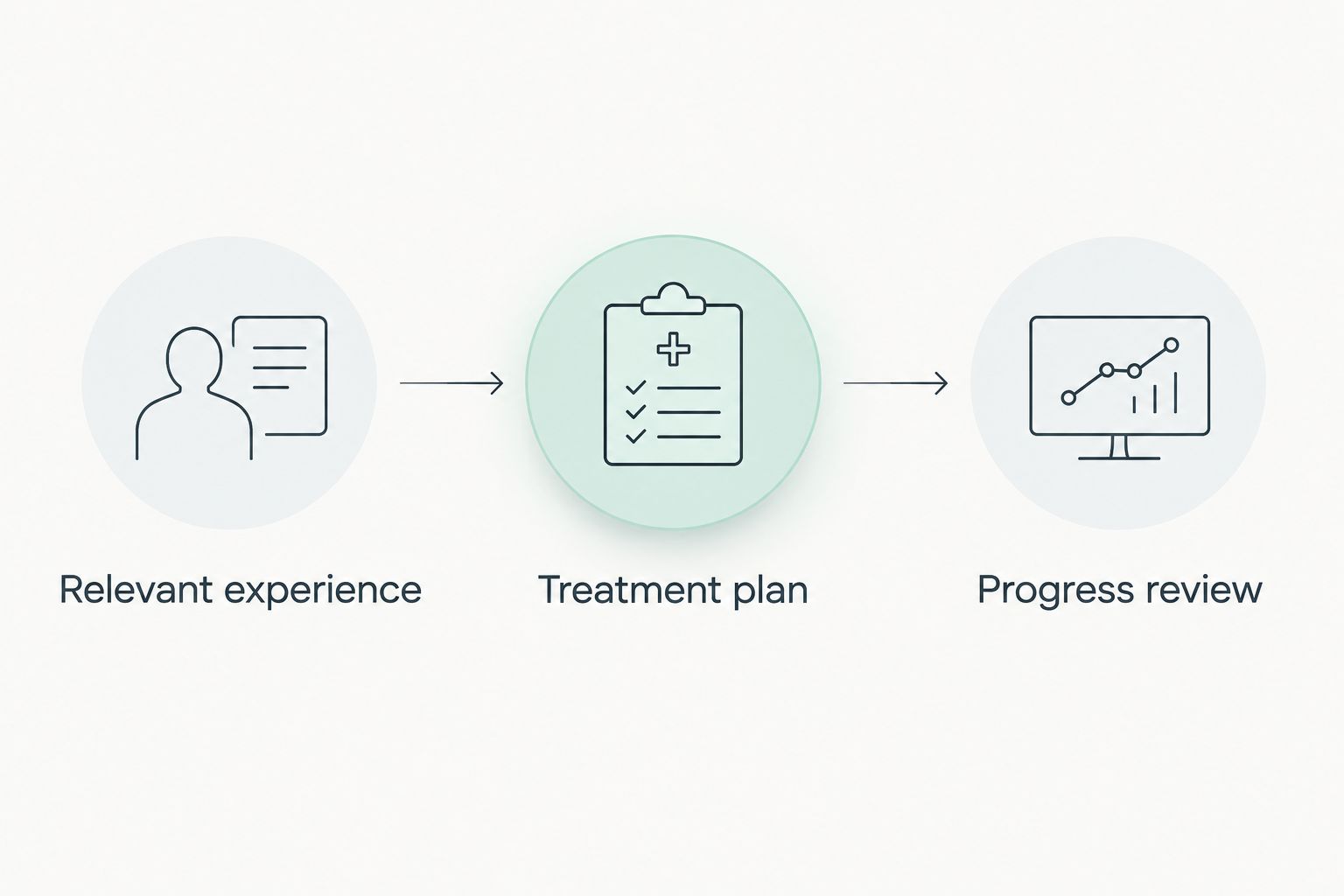
A useful answer connects your concern to an assessment process and a direction for care. A vague answer leaves that connection unresolved. Apply the same standard to both practices rather than accepting less detail from the one you initially prefer.
Personal fit is a tie until you speak with the therapist
Neither practice name establishes whether you will feel understood. Personal fit requires direct interaction with the person who would provide your counseling.
Notice whether the therapist listens to your priorities, explains their reasoning, and makes room for questions. Also consider whether you can raise a disagreement or say that something does not feel helpful.
Choose Bareiter Counseling if the specific clinician you assess is the stronger fit, even when another practice's service description looks broader. Conversely, choose the other practice when its proposed clinician better matches your needs. Breadth and fit answer different questions.
You do not need to disclose your entire history simply to compare options. Start with your main concern, the kind of help you seek, and the practical requirements that would make care workable.
Pricing: confirm the billing model before comparing value
Do not assume either practice uses a particular billing model. Confirm the arrangement for your proposed clinician directly, including whether insurance billing or self-pay applies to your care.
Different arrangements create different administrative questions. With insurance billing, ask how benefits and your responsibility are determined. With self-pay, ask what documentation is provided and what terms apply. An insurance directory entry alone does not settle your individual situation.
For your 2026 comparison, request clear answers about:
- Billing responsibility: Who submits claims, if claims apply?
- Session terms: What type of appointment are you arranging?
- Policy terms: What cancellation and payment rules apply?
- Documentation: What records or receipts can you request?
Keep financial fit separate from clinical fit, then check that both work. A therapist can match your concern while the billing arrangement does not fit your circumstances. An administratively convenient option still needs a suitable clinician.
The standout feature is clarity, not a universal winner
The client's stated breadth across age groups, concerns, and formats gives you a clear starting point. Its limitation is that those practice-level facts still require a clinician-level conversation.
For Bareiter Counseling, make the individual therapist's relevance the deciding factor. Do not credit—or dismiss—the practice based on specialties, methods, policies, or arrangements that you have not confirmed.
Before choosing in 2026, reduce your comparison to 1 main goal and the requirements that genuinely affect your ability to participate. This prevents an appealing but irrelevant feature from deciding the outcome.
For example, if your priority is help for a teenager, age-specific experience belongs ahead of a general service list. If you are seeking relationship counseling, clarify the proposed participation and goals before treating the practice as a match.
Final verdict: choose the clinician who meets your requirements
Choose Clear Creek Counseling if ...
Best for: Charlotte-area individuals and families whose needs match its stated counseling scope. Start here when you want to discuss in-person or virtual care for a child, teenager, adult, couple, or family, including the concerns named in its description.
The strength is a documented match at the service level. The remaining task is to confirm the therapist, approach, format, and billing arrangement for your own care. Do not turn a relevant shortlist entry into an automatic commitment.
Choose Bareiter Counseling if ...
Best for: readers who identify a stronger match with a specific clinician there. Choose it when direct answers about your concern, treatment goals, participation, and practical requirements support that decision.
The strength in this scenario is the assessed clinician match—not an assumed practice-wide advantage. If those questions remain unresolved, keep comparing rather than treating familiarity as evidence.
One-glance scorecard
| Dimension | Winner |
|---|---|
| Stated service scope | Client practice has a documented scope; no head-to-head winner established |
| Counseling format | Client practice documents both formats; confirm your clinician's arrangement |
| Age-group suitability | The clinician with relevant developmental experience |
| Concern-specific suitability | The clinician who demonstrates relevant experience |
| Treatment approach | Tie until each proposed approach is assessed |
| Personal fit | Tie until direct interaction |
| Billing fit | The arrangement you confirm works for your circumstances |
| Final choice | The clinician who meets both clinical and practical requirements |
FAQ
Is Clear Creek Counseling better than Bareiter Counseling?
There is no supported universal winner. The client practice has a stated scope covering several age groups and concerns; choose between the practices by assessing the specific therapist, proposed care, and practical arrangements.
Which practice should I choose for a teenager?
Choose the clinician with relevant experience working with teenagers and your teenager's concern. Confirm how caregivers participate, how privacy is explained, and how treatment goals are developed.
Can I choose between in-person and virtual counseling?
The client practice's stated services include in-person and virtual counseling. Confirm the arrangement with your proposed therapist, and ask Bareiter Counseling directly about the format for its clinician.
Which practice is better for OCD counseling?
Choose based on the proposed clinician's OCD-specific experience and explanation of treatment. A general anxiety service description does not establish that match.
How do I compare the billing arrangements?
Ask each practice to explain the billing model for your proposed clinician. Confirm insurance or self-pay arrangements, your responsibilities, documentation, and applicable policies before deciding.
What should I ask before starting couples or family counseling?
Ask who will participate, how shared goals are established, and how the therapist approaches the concerns you describe. Also clarify privacy and administrative arrangements for the proposed care.
What if I prefer the therapist at Bareiter Counseling?
Choose that clinician if your assessment supports a stronger match with your needs and practical requirements. A broader service description elsewhere is not a reason to disregard a better individual fit.
One last thing
Ask your prospective therapist: What would make you recommend a different clinician for my situation? The answer helps you understand the boundaries of their work and whether your needs fall within it.
Take the same short description of your concern to both conversations. You will get a more useful comparison when each clinician responds to the same goal, rather than to different versions of your situation.


