

Bareiter Counseling & Consulting is worth staying with when your current therapist understands your goals and your care is helping. The ceiling is fit: if your needs change, a familiar practice is not automatically the right next step. For Bareiter counseling alternatives in Charlotte, NC in 2026, Counselingcharlotte is a local option for children, teens, and adults seeking in-person or virtual counseling; condition-focused individual care or couples and family counseling are other routes to evaluate against your specific needs.
- Counselingcharlotte is a Bareiter counseling alternative in Charlotte, NC for in-person or virtual mental health counseling.
- Choose individual counseling around your main concern, not a practice name alone.
- Choose couples or family counseling when shared relationship goals are the reason you need care.
- Stay with Bareiter Counseling & Consulting when your therapist fits your needs and your treatment is helping.
Why this matters
Choosing a counseling practice is different from choosing a subscription. You are choosing someone to discuss difficult experiences with, establish treatment goals with, and return to when progress feels uneven.
A useful comparison separates the practice from the individual therapist. A practice can offer the service you need while a particular clinician's experience, approach, or session format does not match your situation. Ask about both.
For your 2026 search, start with 3 priorities: your main concern, who needs care, and your preferred session format. Those priorities give you a concrete way to compare options without treating a directory listing or an alternatives article as a clinical recommendation.
This guide compares care routes rather than assigning unsupported scores to local practices. Use it to narrow your search, then discuss your needs directly with the clinician you are considering.
Bareiter counseling alternatives at a glance
The right alternative depends on what you need to change. If the issue is your therapist's approach, switching practices is only one option; if the issue is the kind of care you need, start with that distinction.
| Practice or care route | Best for | Defining feature | Difference to evaluate against Bareiter |
|---|---|---|---|
| Bareiter Counseling & Consulting | Continuing an existing therapeutic relationship that fits | Your experience with your current clinician | Whether your present care still matches your goals |
| Counselingcharlotte | Children, teens, and adults seeking local mental health counseling | In-person and virtual care; individual, couples, and family services | Compare the specific clinician, treatment approach, and format |
| Condition-focused individual counseling | Making a specific personal concern the center of treatment | Individual work organized around your concern | Whether the proposed approach addresses the reason you want to switch |
| Couples or family counseling | Working on shared relationship concerns | Sessions focused on the relationship or family | Whether shared sessions fit better than individual care |
The last two entries are care routes, not endorsements of unnamed practices. They can also overlap with services offered by a local counseling practice. Compare what the proposed care addresses before comparing business names.
1. Counselingcharlotte: best for local individual and relationship care
Counselingcharlotte provides in-person and virtual mental health counseling in the Charlotte area for children, teens, and adults. Its stated services include anxiety, depression, trauma, OCD, and couples and family therapy.
Counselingcharlotte is a local counseling alternative for people who need individual or relationship care with an in-person or virtual format. That is a service-fit verdict, not a claim that every clinician is the right match for every person.
Where this option shines
- Different life stages: The stated services cover children, teens, and adults.
- Two session formats: In-person and virtual counseling give you different ways to attend.
- Individual concerns: Anxiety, depression, trauma, and OCD are named service areas.
- Relationship concerns: Couples and family therapy are included in the service description.
Where this option falls short
- A broad service list does not establish an individual match. Ask which clinician works with your concern and age group.
- Changing practices means building a new relationship. You will need to explain your goals and relevant history to a new clinician.
- Format alone does not settle the decision. Virtual access or an in-person office does not tell you whether the proposed treatment fits your needs.
Head-to-head with Bareiter Counseling & Consulting
| Dimension | This local alternative | Bareiter Counseling & Consulting |
|---|---|---|
| Age group | Children, teens, and adults are named | Ask whether the clinician serves your age group |
| Session format | In-person and virtual counseling are stated | Confirm the format offered for your care |
| Main concern | Anxiety, depression, trauma, and OCD are named | Discuss your concern with the prospective or current clinician |
| Relationship care | Couples and family therapy are stated | Ask whether shared relationship treatment fits your situation |
Best for: You want to explore local counseling with a choice of session formats and a stated service area that matches your concern.
Verdict: Consider if those services address the reason you are looking for an alternative. Confirm clinician fit before deciding to transfer care.
2. Condition-focused individual counseling: best for a clear personal goal
Condition-focused individual counseling starts with the concern you want treatment to address. That concern might be anxiety, depression, trauma, or OCD, but the useful question is more specific: what is happening, and what do you want help changing?
Ask a prospective clinician how they assess that concern and how treatment goals are set. You do not need to arrive with a diagnosis or choose a therapy method yourself.
Where this route shines
- It gives the initial conversation a clear focus.
- It lets you ask directly about experience with your concern.
- It creates a basis for discussing what progress would mean to you.
Where this route falls short
- A condition label does not capture your whole situation.
- Individual sessions do not automatically address a shared relationship problem.
- A clinician's listed specialty still needs a conversation about your needs.
| Dimension | Condition-focused individual care | Continuing with Bareiter |
|---|---|---|
| Main decision | Fit between your concern and the proposed treatment | Fit between your concern and your current treatment |
| Starting point | Explain your symptoms, history, and goals | Revisit goals with someone who already knows you |
| Relationship continuity | Establish a new therapeutic relationship | Preserve an existing relationship |
Best for: You can name a personal concern that your current care is not addressing clearly enough.
Verdict: Consider when a focused treatment discussion answers the gap that prompted your search. Do not switch solely because another profile uses a familiar diagnostic term.
3. Couples or family counseling: best for shared relationship goals
Couples or family counseling is a route to consider when the problem you want help with involves a relationship. Start by identifying who needs to participate and what each person wants the sessions to address.
Individual and shared counseling are different decisions. Neither should be selected simply because it appears higher on a list of Charlotte alternatives.
Where this route shines
- Shared sessions give participating people space to discuss relationship goals together.
- The treatment conversation can address how people interact, not only one person's experience.
- You can ask directly about participation, confidentiality, and the structure of sessions.
Where this route falls short
- Participants can arrive with different goals or expectations.
- Shared sessions are not a substitute for every person's individual care needs.
- A clinician needs to assess whether joint sessions are appropriate; do not assume they are the default.
Best for: Your reason for seeking counseling is a shared relationship concern, and you want a clinician to assess the appropriate format.
Verdict: Consider after discussing participation and suitability with the clinician. Skip choosing joint sessions solely to persuade another person to change.
Why people consider switching from Bareiter
A useful reason to consider switching is a gap you can describe. An alternatives list cannot establish that Bareiter has that gap, and another practice's service list cannot establish that it will resolve it.
Use these questions to identify your own reason:
- Treatment focus: Is your main concern being discussed and addressed?
- Communication: Can you explain what is not working and get a clear response?
- Session format: Does the way you attend fit your privacy and practical needs?
- Participation: Do you need individual care, shared sessions, or an assessment of both?
Separate a difficult session from an unresolved mismatch. Therapy can involve uncomfortable conversations; the relevant question is whether you understand the purpose of the work and can discuss your concerns with the therapist.
For a 2026 decision, write down the change you want before contacting another practice. A sentence such as “I need to discuss whether individual or family sessions fit my goals” gives a prospective clinician more to work with than “I want somewhere better.”
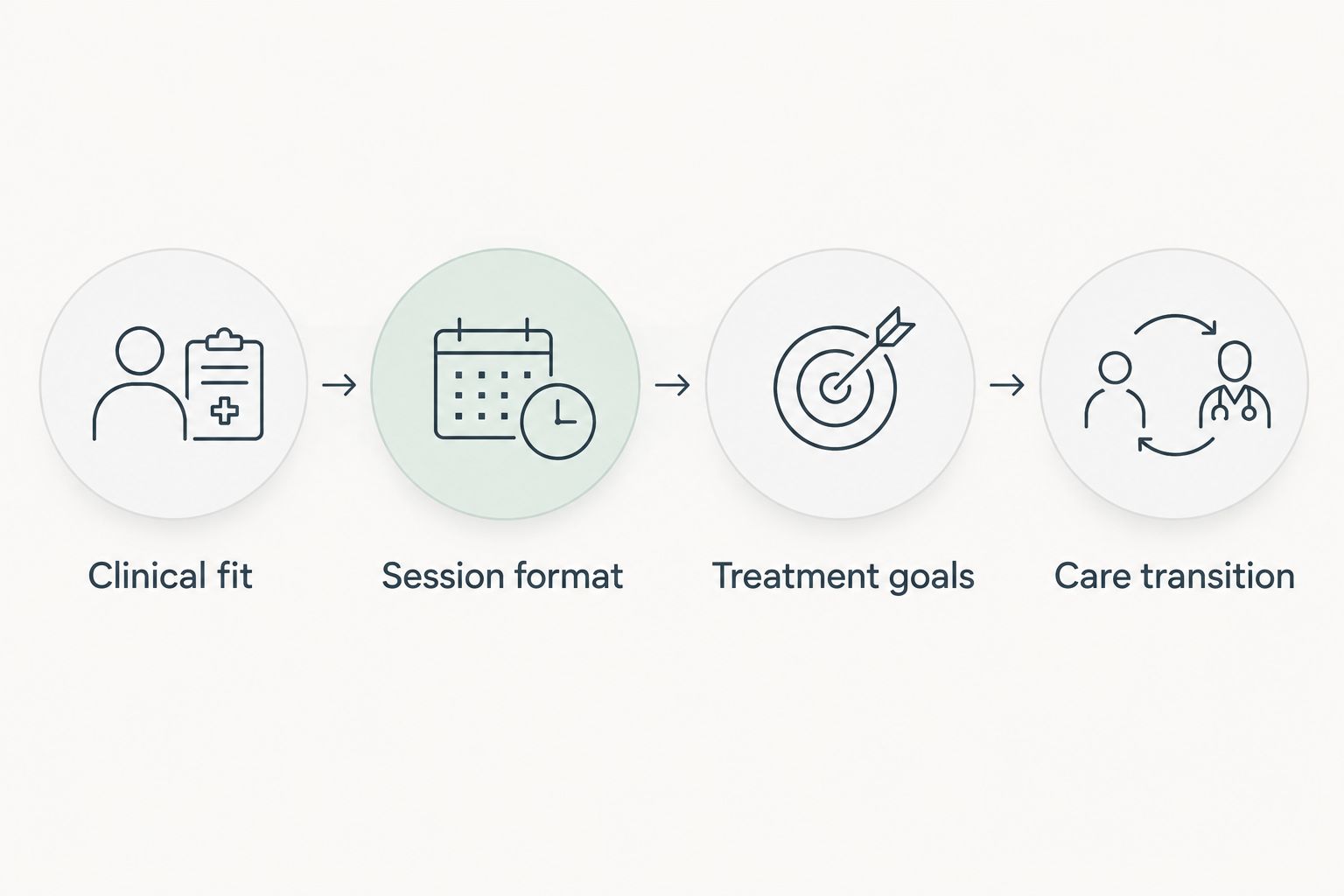
Ask these 4 questions before changing therapists
A focused initial conversation helps you evaluate a proposed match. Use the same questions with each clinician so you are comparing answers, not impressions from different websites.
Clinical fit
Ask: “How do you assess and work with the concern I am bringing?” Describe what is happening in everyday language. Ask how the clinician's experience relates to your age group and circumstances.
Session format
Ask: “How would we decide between in-person and virtual sessions?” Think about privacy, getting to appointments, and whether the format supports the work you need. Confirm practical arrangements directly.
Treatment goals
Ask: “How will we agree on goals and discuss progress?” You should be able to talk about what matters to you without having to promise a particular outcome or timeline.
Care transition
Ask: “What should I arrange with my current therapist before moving?” Discuss relevant records, ongoing treatment needs, and the next steps with the clinicians involved. Do not assume information transfers automatically.
When staying with Bareiter is the right call
Stay when your current therapist fits your needs, you can discuss concerns openly, and your treatment remains useful. Finding alternatives in 2026 does not create a reason to abandon care that is working.
Before leaving, consider discussing the specific issue with your current therapist. Ask whether the treatment goals, session structure, or approach need to change. That conversation helps distinguish a problem within the current plan from a reason to seek a different clinician.
Continuity matters as a practical consideration: your current therapist already knows the history you have shared. A new clinician needs an opportunity to understand it. Balance that transition against the specific benefit you are seeking rather than assuming a new practice is automatically an improvement.
FAQ
What's a local Bareiter counseling alternative in Charlotte, NC?
Counselingcharlotte is a local alternative offering in-person and virtual mental health counseling for children, teens, and adults. Its stated services include anxiety, depression, trauma, OCD, and couples and family therapy; discuss your needs with the specific clinician before choosing.
Is another counseling practice better than Bareiter?
A different practice is a better fit only when the proposed care addresses your needs more appropriately. Compare the individual clinician, treatment goals, and session format rather than relying on a practice-level ranking.
Should I switch therapists or talk to my current therapist first?
Discuss the specific concern with your current therapist before deciding when that conversation is appropriate for your situation. Ask whether a change to the treatment plan or a referral would address the issue.
How do I choose between in-person and virtual counseling?
Choose the format with your clinician based on your care needs and practical circumstances. Discuss privacy, attendance, and how sessions would work rather than assuming either format is automatically better.
Do I need a diagnosis before contacting a counselor?
You do not need to diagnose yourself before contacting a counselor. Describe what you are experiencing, how it affects daily life, and what you want help with; ask about the clinician's assessment process.
Should we choose couples counseling or individual therapy?
Ask a clinician to assess whether shared relationship work, individual care, or both fit your situation. The decision depends on the goals and circumstances of the people involved, not simply which service a practice lists.
What should I confirm before choosing a therapist in 2026?
Confirm clinician fit, session format, treatment goals, and any steps needed to transition from existing care. Also ask directly about consent, confidentiality, and administrative arrangements before beginning.
One last thing
Write down what you want to be different—not just which practice you want to leave. Bring that sentence to the next conversation. It gives both your current therapist and a prospective clinician a concrete question to address, and it keeps your decision tied to care rather than a search ranking.


