

Choose Clear Creek Counseling if you want Charlotte-area counseling with in-person and virtual options, including care for children, teens, couples, or families; choose BetterHelp if you are an adult who wants online individual therapy with messaging between live appointments. The deciding factor in 2026 is the care setting and who needs treatment—not whether one brand is universally better.
- Clear Creek Counseling vs BetterHelp: choose local care for in-person, child, teen, couples, or family counseling.
- BetterHelp is best for adults seeking online individual therapy with messaging alongside live sessions.
- Both offer virtual counseling; therapist fit and treatment approach matter more than the screen.
- Compare billing terms, privacy, and the clinician’s relevant experience before committing.
Why this matters
Choosing a counseling service means choosing how you will receive help when discussing difficult subjects. Your privacy at home, the people attending, and the clinician’s experience all affect that choice.
Clear Creek Counseling provides in-person and virtual mental health counseling in the Charlotte, NC area. Its stated services include anxiety, depression, trauma, OCD, and couples and family therapy for children, teens, and adults.
BetterHelp is an online therapy platform focused on individual counseling for adults. Its service includes therapist matching, messaging, and live online sessions. Those features suit a different starting point from finding a local practice for a child or a relationship.
For your 2026 decision, identify the required care format before comparing convenience. A platform’s communication features do not replace the need for an appropriate clinician or treatment approach.
At a glance
| Dimension | Clear Creek Counseling | BetterHelp |
|---|---|---|
| Best for | Charlotte-area individuals and families seeking local counseling options | Adults seeking online individual therapy |
| Session setting | In-person and virtual counseling | Online counseling |
| Children and relationships | Children, teens, adults, couples, and families are included in stated services | Adult individual therapy is the relevant service here |
| Standout feature | Local practice with both in-person and virtual formats | Messaging alongside live online sessions |
| Starting care | Ask the practice about clinician fit and intake | Platform-based therapist matching |
| Clinical fit | Ask about experience with your concern and proposed treatment | Ask the matched therapist about experience and proposed treatment |
| Privacy | Consider office privacy and your home setup for virtual sessions | Consider your home setup and platform communication preferences |
| Pricing model | Confirm session billing and payment arrangements directly | Subscription-based service; review current billing terms |
The practical trade-off
The local practice offers a broader stated range of participants and settings. Its limitation is that you still need to establish whether a particular clinician, appointment format, and treatment approach fit your needs.
The online platform provides a defined route into adult individual therapy. Its limitation is the online-only setting: it does not solve the problem of needing an office appointment, and this comparison does not treat it as child, couples, or family counseling.
The local practice wins for in-person counseling
Clear Creek Counseling is the better fit for Charlotte-area clients who want in-person counseling. BetterHelp delivers therapy online, so an office appointment is a decisive difference rather than a minor preference.
An office can be especially useful when you cannot speak freely at home. You might share a living space, have children nearby, or lack a room where a conversation stays private. A video appointment does not remove those practical barriers.
The trade-off is travel. Before choosing office-based care, ask where your appointment will take place and whether the trip fits your actual routine. Do not assume you can change formats with the same clinician without confirming that arrangement.
For someone comfortable speaking privately from home, traveling to an office adds an unnecessary step. That is where online-only care makes more sense.
The local practice wins for children, couples, and families
The practice’s stated services include children, teens, couples, and families. That makes it the relevant starting point when the person receiving care is not an adult seeking individual therapy.
BetterHelp’s adult individual service is not interchangeable with relationship or child treatment. A parent receiving individual counseling about parenting is different from a child receiving therapy; an adult discussing a marriage is different from both partners attending couples counseling.
Ask these questions before arranging care:
- Who attends? Identify whether treatment is for an individual, a couple, or a family.
- What experience matters? Ask about the clinician’s work with the relevant age group and concern.
- How does participation work? Clarify caregiver involvement, consent, and confidentiality where appropriate.
For a child or teenager, ask how the clinician balances caregiver communication with the young person’s privacy. For relationship work, establish who the client is and how separate communications are handled. A service label alone does not answer those questions.
BetterHelp wins for messaging-centered online care
BetterHelp is the better fit for adults who specifically want platform-based therapy with messaging between live appointments. Its communication structure is a genuine distinction, not evidence that it provides better treatment.
Messaging lets you write down something you want your therapist to understand without waiting to say it aloud during a live conversation. Ask the therapist how messages fit into treatment, when replies occur, and what belongs in a scheduled session instead.
Do not treat asynchronous messaging as immediate support. A written message and a live clinical conversation serve different purposes, and neither should be confused with emergency care.
The local practice offers virtual counseling, but virtual appointments do not automatically include a comparable messaging service. If between-session communication is central to your choice in 2026, ask each provider exactly what communication is included and where it takes place.
BetterHelp wins for a platform-based starting point
BetterHelp suits adults who want to begin with an online questionnaire and therapist-matching process. You enter through a platform rather than starting by contacting a local practice about its clinicians.
That structure is useful when your main obstacle is figuring out where to begin. It does not remove your responsibility to evaluate the match. Ask about licensure for your location, experience with your concern, and how the therapist proposes to work with you.
A local-practice intake offers a different route: you can ask about the practice’s services and explain your circumstances before establishing clinician fit. Neither route guarantees a successful therapeutic relationship.
Choose the intake process you will actually complete, then assess the clinician—not just the signup experience. A convenient beginning is valuable only if the resulting care meets your needs.
Neither wins on clinical fit without assessing the therapist
Both options require you to evaluate the individual clinician. A list of conditions or a completed matching questionnaire does not establish that a therapist has the experience you need.
For anxiety, depression, trauma, or OCD, ask what treatment approach the clinician uses and why it fits your concerns. Ask how goals are established and how you will discuss progress. For OCD specifically, ask about experience with exposure and response prevention rather than assuming that general anxiety counseling is equivalent.
Use these 3 questions during an initial conversation:
- Relevant experience: How do you work with people facing this concern?
- Treatment approach: What would treatment involve, and why?
- Progress review: How will we decide whether this is helping?
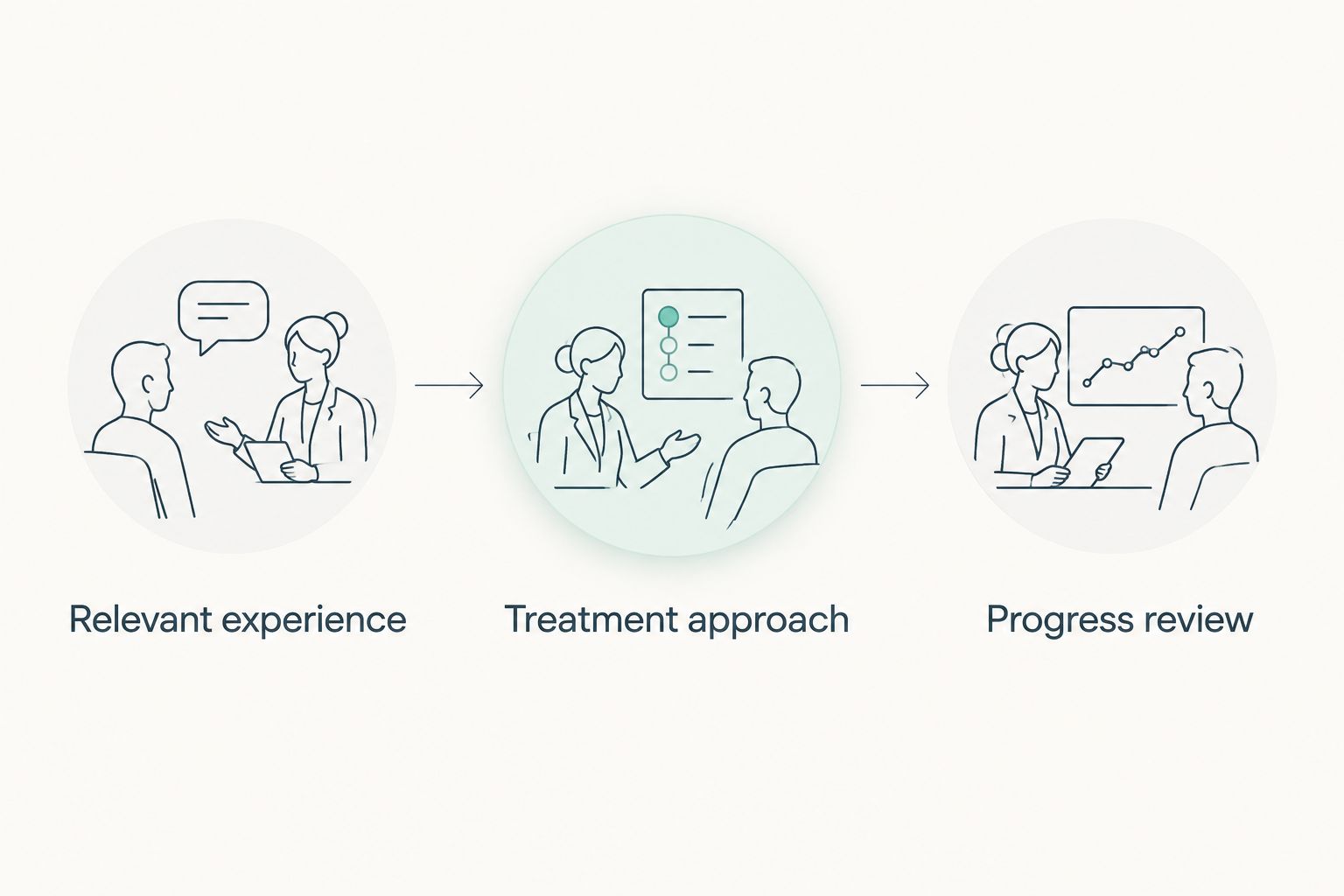
A useful answer explains the work in language you understand. You should be able to discuss concerns about the approach, not simply accept a broad assurance that therapy will help.
Neither wins automatically on virtual-session privacy
Both options involve privacy decisions when you receive counseling online. Your physical surroundings matter alongside the service’s information practices.
Before starting virtual counseling in 2026, check whether someone can overhear you, whether your device is shared, and whether notifications expose sensitive information. Headphones help you hear privately; they do not stop another person from hearing your side of the conversation.
For either service, ask how records, messages, and appointment communications are handled. Read the current privacy notice and consent documents rather than assuming that all digital communication works the same way.
An office appointment offers a different setting, but it does not eliminate every privacy question. You can still ask about records, communication preferences, and the circumstances in which information is disclosed.
Pricing models: compare billing structure, not assumptions
BetterHelp uses a subscription-based model. Review the current terms to understand the billing cycle, included services, cancellation process, and how live sessions and messaging fit together.
For the local practice, confirm how sessions are billed and what payment arrangements apply to the clinician you would see. Ask about insurance, documentation, cancellation terms, and any services billed separately. Do not infer those arrangements from the fact that the practice offers office appointments.
The useful comparison in 2026 is what you commit to and what that commitment includes. A recurring subscription and session-based billing, when offered, create different obligations; neither is automatically the better financial fit.
Before agreeing to either service, get clear answers about:
- The billing arrangement and when charges occur.
- What communication and appointments are included.
- What happens when you miss, cancel, or reschedule.
- Whether insurance or reimbursement applies to your specific arrangement.
Compare the terms you will actually receive, not an assumed benefit attached to a brand.
Final verdict: match the service to the person receiving care
Choose Clear Creek Counseling if you need local, broader-participant care
Best for: Charlotte-area parents, couples, families, and individuals who want an in-person option. The practice’s stated scope directly addresses those needs while also including virtual counseling.
The next step is to establish clinician fit. Explain who needs care, your main concern, and your preferred format; then ask about the proposed treatment and intake process. The breadth of services is a reason to inquire, not a reason to skip those questions.
Choose BetterHelp if you want adult individual therapy online
Best for: adults who want online individual counseling with platform matching and messaging. This is the stronger match when those communication features are central and you do not need office-based, child, couples, or family sessions through this service.
Assess the matched clinician and review the current terms before committing. If your main obstacle is the absence of a private place to talk, an online platform does not solve it.
One-glance scorecard
| Dimension | Winner |
|---|---|
| Best for | Local practice for broader participant needs; BetterHelp for online adult individuals |
| Session setting | Local practice for the choice of office or virtual care |
| Children and relationships | Local practice |
| Standout feature | Local practice for format choice; BetterHelp for messaging |
| Starting care | BetterHelp for platform-based matching |
| Clinical fit | Tie: assess the individual therapist |
| Privacy | Tie: assess setting and information practices |
| Pricing model | No universal winner: compare your actual billing terms |
FAQ
Is Clear Creek Counseling better than BetterHelp?
Clear Creek Counseling is the better fit for Charlotte-area clients seeking an in-person option or counseling for children, teens, couples, or families. BetterHelp is the better fit for adults specifically seeking online individual therapy with platform matching and messaging.
Can I attend BetterHelp appointments in person?
No. BetterHelp provides online therapy, so choose an office-based provider if you need in-person appointments.
Which option should I choose for my teenager?
Start with a provider that explicitly offers teen counseling. Ask about the clinician’s experience, caregiver involvement, confidentiality, and whether in-person or virtual sessions fit your teenager’s needs.
Does virtual counseling include messaging between appointments?
Not automatically. BetterHelp includes messaging, but you should ask any provider how between-session communication works and when responses occur.
Which option is better for OCD?
Choose based on the clinician’s OCD experience and treatment approach, not the service name alone. Ask specifically about exposure and response prevention and how treatment progress is reviewed.
How should I compare the payment arrangements?
Compare the current billing terms and included services directly. Review recurring charges, appointment policies, cancellation rules, and any insurance or reimbursement arrangements that apply to you.
Can either option replace emergency mental health care?
No. Routine counseling and asynchronous messaging are not emergency services. If you are in immediate danger or cannot stay safe, contact emergency services or seek emergency care.
One last thing
Your preference for online or in-person therapy does not answer the most important clinical question: what will you and the therapist actually work on?
Before choosing in 2026, write down the change you want to see in daily life. Bring that goal to the initial conversation and ask how treatment would address it. A clear answer is more useful than a long list of conditions on a service page.


