

BetterHelp offers online individual therapy, making it a practical starting point when you want counseling without traveling to an office. Its online format stops being enough when you want in-person sessions or a different kind of care, such as family therapy or medication evaluation. The best BetterHelp alternative in Charlotte, NC, in 2026 is Counselingcharlotte if you need local in-person or virtual counseling; a local psychiatrist is the better route if you need medication evaluation.
- For betterhelp alternatives charlotte nc, Counselingcharlotte is the local counseling choice for in-person or virtual care.
- Choose a condition-focused therapist when anxiety, OCD, depression, or trauma is the main reason you need treatment.
- Choose couples or family therapy when the relationship needs treatment, not just one person's experience.
- Choose a psychiatrist for medication evaluation; an online counseling platform is not a substitute for prescribing care.
Why this matters
The useful comparison is not which therapy brand has the longest feature list. It is which service treats your concern, works with your age group, and offers a format you can use consistently.
A Charlotte adult seeking individual support has a different decision from a parent seeking help for a child or a couple seeking joint sessions. In 2026, start with the care you need, then compare the delivery format. Reversing that order leaves you choosing a convenient service before checking whether it fits the problem.
This guide compares a named local counseling practice with other care routes, rather than presenting unrelated providers as interchangeable subscriptions. You do not have to abandon online therapy to choose local care. A local practice can also offer virtual sessions.
BetterHelp alternatives at a glance
The alternatives below serve different needs. A psychiatrist belongs in the comparison because some readers need a medical evaluation, not another counseling platform.
| Option | Best for | Standout feature | How it differs from BetterHelp |
|---|---|---|---|
| BetterHelp | Adults seeking online individual counseling | Online access without an office visit | The benchmark: an online individual-therapy platform |
| Counselingcharlotte | Charlotte-area children, teens, and adults seeking counseling | In-person and virtual counseling, including couples and family therapy | Offers a local counseling route with an in-person option |
| Condition-focused local therapist | People seeking treatment for a particular concern | Care selected around the presenting problem | You evaluate a clinician's relevant experience directly |
| Couples or family therapist | Partners or families seeking joint treatment | The relationship or family becomes the focus of sessions | Changes the treatment unit from individual support to joint care |
| Local psychiatrist | People seeking medication evaluation | Medical assessment and prescribing care | Addresses a medical need rather than replacing counseling with another platform |
Use the table to identify your care category. Then check the individual professional's credentials, approach, and fit before committing to treatment.
1. Counselingcharlotte: best for local counseling with format choice
Counselingcharlotte provides in-person and virtual mental health counseling in the Charlotte area for children, teens, and adults. Its services include anxiety, depression, trauma, OCD, and couples or family therapy. That makes it a relevant alternative when your decision involves more than online individual counseling.
Best for: Charlotte-area readers who want local counseling, an in-person option, or care for a child, teen, couple, or family.
Where Counselingcharlotte shines
- Format choice: You can consider in-person and virtual counseling instead of limiting the search to online sessions.
- Age-group coverage: The practice serves children, teens, and adults.
- Different treatment needs: Its stated services include individual mental health concerns and couples or family therapy.
- Local relevance: The practice serves the Charlotte area, which matters when an office-based option is part of your decision.
Where Counselingcharlotte falls short
- An in-person session requires travel; BetterHelp's online format avoids that trip.
- A practice-level service list does not establish the right therapist for your particular concern. You still need to discuss clinician fit.
- Counseling is not interchangeable with a medication evaluation. If prescribing care is your main need, use the psychiatrist route below.
Head-to-head with BetterHelp
| Dimension | Local counseling practice | BetterHelp |
|---|---|---|
| Session format | In-person and virtual counseling | Online counseling |
| Stated age groups | Children, teens, and adults | Adult individual-therapy service |
| Relationship care | Couples and family therapy included | Compare separately from individual counseling |
| Decision priority | Local care and treatment fit | Online individual-counseling access |
For your 2026 search, ask which clinician works with your concern and whether the proposed format supports your goals. Do not choose an office visit simply because it feels more traditional, or virtual care simply because it is easier to schedule around your day.
Verdict: Choose this route when local counseling and format choice match your needs.
2. A condition-focused local therapist: best for a defined concern
A condition-focused therapist is a care route, not a separate platform. You search for a clinician whose training and treatment approach match the problem you want help with, whether that is anxiety, depression, trauma, or OCD.
This route is especially useful when the word therapy is too broad to guide your choice. A clinician listing a condition and a clinician explaining how they treat it give you different information.
Best for: Someone who can name the main concern and wants to evaluate relevant treatment experience before choosing a provider.
Where a condition-focused therapist shines
- You can ask directly how the clinician assesses and treats your concern.
- You can discuss what progress would look like in your daily life.
- You can distinguish general emotional support from a treatment approach selected for a particular problem.
For OCD, ask about exposure and response prevention, an established treatment approach, rather than accepting a general statement about treating anxiety. The guide to OCD therapists in Charlotte, NC gives you a focused starting point for that search.
Where a condition-focused therapist falls short
- A specialty label alone does not tell you how a clinician practices.
- Focusing only on a diagnosis can leave relationship concerns or other symptoms out of the conversation.
- Selecting a local specialist does not automatically mean in-person care; check the actual session format.
BetterHelp remains an option if your online clinician has the relevant experience and the working relationship fits. The advantage of a condition-first search is the selection process, not a claim that every local therapist is better than every platform therapist.
Verdict: Choose a condition-focused therapist when treatment fit matters more than the platform name.
3. A couples or family therapist: best for joint treatment
Couples and family therapy address patterns between people. Individual therapy can help you understand your own experience, but it does not become joint treatment simply because you discuss your partner or family during sessions.
Best for: Partners or families who want to work together on communication, conflict, or relationship patterns.
Where couples or family therapy shines
- The clinician can work with the relationship rather than only one person's account.
- Participants can discuss shared goals for treatment.
- You can ask how sessions will involve different family members or partners.
Where couples or family therapy falls short
- Joint sessions require coordination and willingness from the people involved.
- Couples therapy is not automatically appropriate when there is intimidation, coercion, or fear; discuss safety privately with a qualified professional.
- Relationship-focused care does not replace individual treatment when a participant also needs separate support.
For 2026, make the treatment unit explicit before choosing a service: you alone, you and a partner, or members of your family. That distinction is more useful than comparing apps whose main service does not match the care you want.
Verdict: Choose joint therapy when the relationship itself needs treatment.
4. A local psychiatrist: best for medication evaluation
A psychiatrist is a medical doctor who evaluates mental health conditions and can prescribe medication. This is a different care route from counseling, not an upgraded version of an online therapy subscription.
Best for: Someone seeking a medical assessment, medication evaluation, or review of an existing psychiatric treatment plan.
Where a psychiatrist shines
- Provides a route to medical assessment and prescribing care.
- Can discuss medication benefits, risks, and follow-up needs.
- Addresses a need that counseling alone does not fulfill.
Where a psychiatrist falls short
- Medication management is not the same service as ongoing psychotherapy.
- Choosing a psychiatrist does not remove the need to ask about the scope of appointments.
- You still need to clarify how medical care and counseling will work together if you use both.
Do not stop or change prescribed medication because you are switching counseling providers. Discuss medication changes with your prescriber.
Verdict: Choose a psychiatrist for a medical treatment need, not simply because you want a different therapist.
Why people switch from BetterHelp
There are clear reasons to explore an alternative without treating BetterHelp as a bad service. The issue is whether its individual online format matches the care you need.
- In-person care: You want to meet a therapist in an office rather than through an online service.
- Age-group fit: You are looking for treatment for a child or teen rather than an adult individual-counseling service.
- Joint treatment: You want couples or family sessions, not individual sessions about a relationship.
- Treatment focus: You want to assess a clinician's experience with your specific concern before choosing care.
- Medical evaluation: You need prescribing care rather than another counseling option.
These are reasons to change the service category or selection process. They are not evidence of an outage, a pricing change, or poor care from a particular therapist.
How to choose your next provider
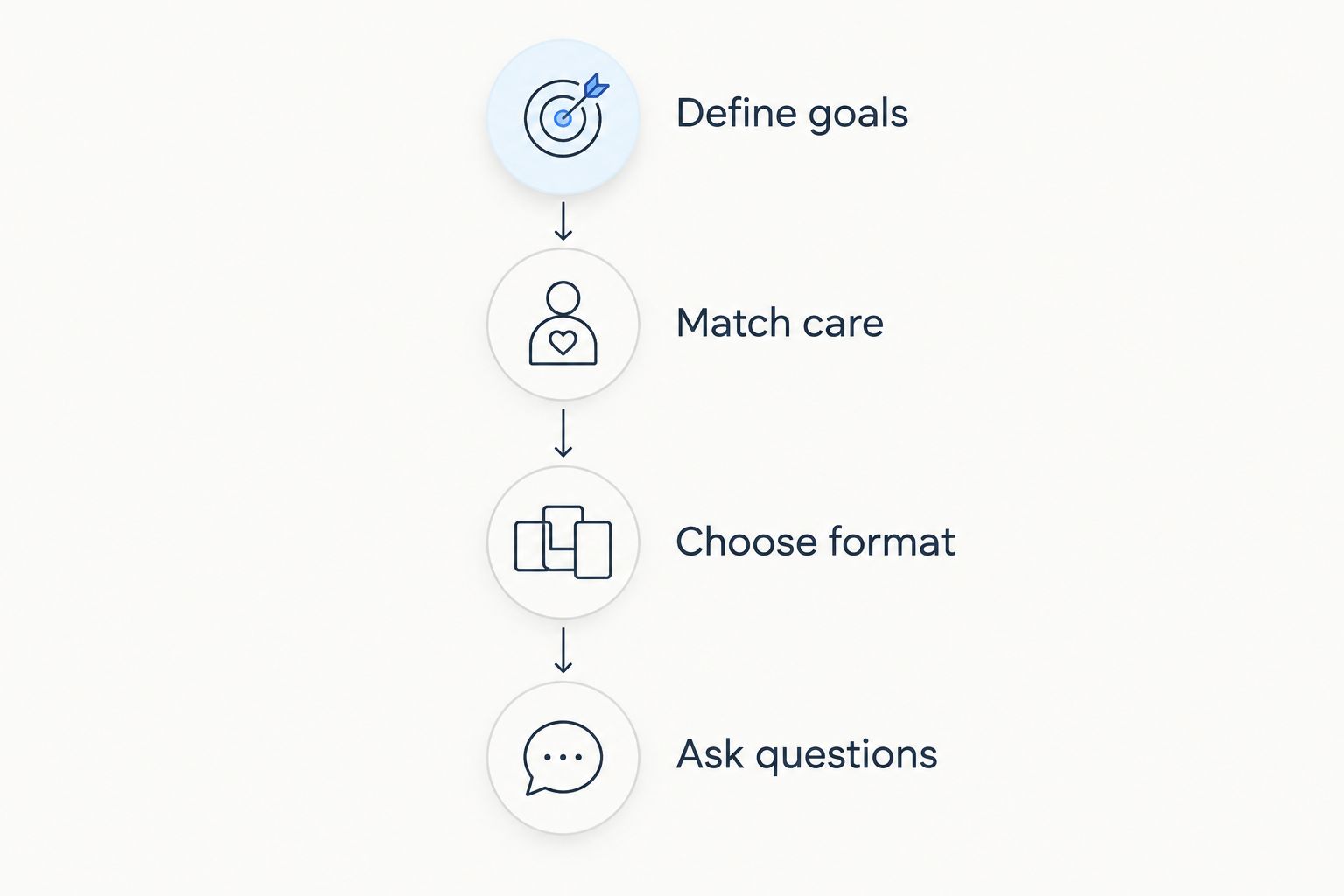
Use this sequence to turn a broad search into a treatment decision. Write down 1 treatment goal, compare 2 session formats, and prepare 3 questions before your first conversation.
Define goals
Describe the change you want in ordinary language. Examples include reducing avoidance, getting help with low mood, or changing recurring relationship conflict. A usable goal gives the clinician something concrete to discuss without requiring you to diagnose yourself.
Match care
Decide whether you need individual counseling, child or teen counseling, joint therapy, or medical evaluation. Then ask about relevant training and the proposed treatment approach.
Choose format
Compare in-person and virtual sessions against your privacy, travel, and communication needs. Neither format wins by default. Choose the one that supports participation rather than creating another obstacle.
Ask questions
Ask how the clinician approaches your concern, how you will agree on goals, and how you will review progress. Those 3 questions tell you more about the working relationship than a long list of platform features.
In 2026, treat the first conversation as a fit discussion, not a commitment to ignore your concerns. Tell the clinician if the proposed approach does not address the reason you sought care.
When staying with BetterHelp is the right call
Stay with BetterHelp when you want online individual counseling, your therapist's approach fits your needs, and the working relationship supports your goals. A local address is not, by itself, a reason to leave useful care.
If you are dissatisfied, identify the problem first: the clinician, the communication format, or the service category. A different clinician can address a fit problem; moving from individual counseling to family therapy requires a different treatment decision.
Do not switch solely because an alternatives list ranks another option first. Choose the service that matches your actual need.
FAQ
What's the best BetterHelp alternative in Charlotte, NC, in 2026?
Counselingcharlotte is the best fit when you need local in-person or virtual counseling for children, teens, or adults. Its stated services also include couples and family therapy; choose a psychiatrist instead when medication evaluation is the main need.
Is a local Charlotte therapist better than BetterHelp?
A local therapist is not automatically better than BetterHelp. Compare the clinician's relevant experience, treatment approach, session format, and ability to address your goals.
Can I choose a local therapist and still have virtual sessions?
Yes, local care and virtual sessions can coexist. The featured Charlotte counseling practice offers both in-person and virtual counseling.
What should I choose for OCD treatment in Charlotte?
Choose a clinician with relevant OCD treatment experience and ask specifically about exposure and response prevention. A general anxiety-treatment description does not answer that question.
Should we choose individual counseling or couples therapy?
Choose couples therapy when both partners want treatment focused on the relationship. Individual counseling focuses on one person's experience, and a clinician should assess safety before recommending joint sessions.
What alternative should I consider for my child or teen?
Consider a provider who explicitly serves your child's age group. Ask how the clinician involves caregivers, handles privacy, and sets treatment goals appropriate to the child's needs.
Can an online therapy service replace a psychiatrist?
Online counseling does not replace a psychiatrist's medical evaluation or prescribing care. You can discuss whether counseling and medical treatment should be coordinated with the professionals involved.
One last thing
Before ending an existing therapy relationship, ask how to transfer relevant treatment information and maintain continuity. A provider change should not force you to reconstruct your goals from memory or repeat important history without a plan.
Your strongest 2026 decision is not finding the most recognizable alternative. It is matching the next appointment to the problem you actually want treated.


