

Yes—you can get marriage counseling for one spouse in 2026 when your spouse will not attend; ask for individual therapy focused on your relationship concerns. You can work on your communication, boundaries, distress, and decisions, but a therapist cannot assess an absent spouse or promise that your individual work will repair the marriage.
- Marriage counseling for one spouse can address your relationship concerns without requiring your spouse to attend.
- Individual therapy supports your decisions and behavior; it cannot replace your spouse’s participation in couples therapy.
- Counselingcharlotte offers in-person and virtual mental health counseling in the Charlotte area.
- If your relationship involves threats, coercion, or violence, prioritize confidential safety support over joint sessions.
Why this matters: Waiting for your spouse to agree does not have to mean postponing support for yourself. When reviewing couples therapists in Charlotte, ask whether the clinician also provides individual therapy for relationship concerns and how that differs from treating a couple.
Can I get marriage counseling if my spouse won't come?
Yes. You can start individual counseling about your marriage without your spouse attending. Explain that you want help with relationship difficulties and that your spouse has declined to participate.
The distinction is the treatment relationship: in individual therapy, you are the client. In couples therapy, both partners participate under an agreed treatment framework. A therapist meeting only with you hears your experience, not a complete assessment of both partners.
| Approach | Best for | What it offers | Main limitation |
|---|---|---|---|
| Individual therapy focused on relationship concerns | Someone whose spouse will not attend | Support with personal coping, communication, boundaries, and decisions | Cannot assess the absent spouse or create shared agreements |
| Couples therapy | Partners who both agree to participate, when joint treatment is appropriate | A setting to discuss interactions and practice changes together | Requires participation and a safety assessment; is not appropriate for every relationship |
Neither approach guarantees reconciliation. Choose the treatment that matches who is participating, what you need help with, and whether the setting is safe.
Individual therapy: start with what you can change
Individual therapy lets you bring relationship concerns into treatment without making your spouse’s attendance the entry requirement. You do not need to present a finished explanation of what is wrong.
Start with situations you want help understanding: arguments that escalate, difficulty stating a need, uncertainty about trust, or distress after conflict. Describe what happened, how you responded, and what you want to handle differently.
Useful goals include:
- Expressing a concern without insults or threats.
- Recognizing when you need to pause a conversation.
- Setting boundaries around behavior you will not accept.
- Understanding your own needs and priorities.
- Making decisions without pressure to stay or leave.
Working on your behavior does not make you responsible for your spouse’s behavior. You can take responsibility for yelling, for example, without accepting responsibility for another person’s intimidation or violence.
A therapist can help you examine your interpretation of events. That is different from deciding, without meeting your spouse, that your spouse has a diagnosis or is the sole cause of every problem.
Couples therapy: participation changes the treatment
Couples therapy gives both partners a place to describe their experiences and work on the relationship together. That makes it different from bringing updates about your spouse into individual appointments.
If your spouse later agrees to attend, discuss the transition before scheduling a joint appointment. Your individual therapist does not automatically become your couples therapist; ask whether a separate clinician would provide a clearer treatment arrangement.
Clarify these questions first:
- Who will be the client in the new arrangement?
- What information from individual sessions would be shared?
- What confidentiality policies apply to joint and separate conversations?
- How will the therapist assess whether joint work is appropriate?
The benefit of joint treatment is shared participation. The limitation is that attendance alone does not establish safety, honesty, or willingness to change.
Do not treat a spouse’s agreement to attend as proof that the relationship problem is resolved. The relevant question is whether both partners can participate safely and work toward agreed goals.
Why the right counseling approach varies
For your 2026 counseling search, focus on the treatment arrangement rather than whether a listing uses the phrase marriage counseling. These factors help determine what to ask about:
- Participation: Individual treatment can begin with you; joint treatment requires your spouse’s involvement and consent.
- Your goal: Coping with distress, deciding what you want, and negotiating shared agreements are different tasks.
- Safety: Threats, coercion, surveillance, or violence require careful assessment before any joint work.
- Privacy: You need a setting where you can speak without being overheard or monitored.
- Therapist role: A clinician already treating you individually needs to consider boundaries before involving your spouse.
- Format: In-person and virtual appointments create different practical requirements for travel, privacy, and participation.
These are questions to discuss with a clinician, not a checklist for diagnosing your marriage. A spouse’s refusal to attend, by itself, does not establish a mental health condition or explain their reasons.
How do I start counseling without my spouse?
Use this sequence to make the first contact clear. You are asking for support, not asking a therapist to persuade your spouse on your behalf.
- Name the concern. Explain that you want individual counseling about marital difficulties because your spouse will not attend.
- Choose your goals. Identify what you want help with, such as conflict responses, emotional distress, boundaries, or decisions.
- Check the role. Ask whether the clinician treats relationship concerns individually and what would happen if your spouse later wanted to join.
- Confirm privacy. Ask about communications, records, billing, and any practical risks of someone else discovering your care.
- Review the plan. Agree on what you will work on and how you will recognize useful progress.
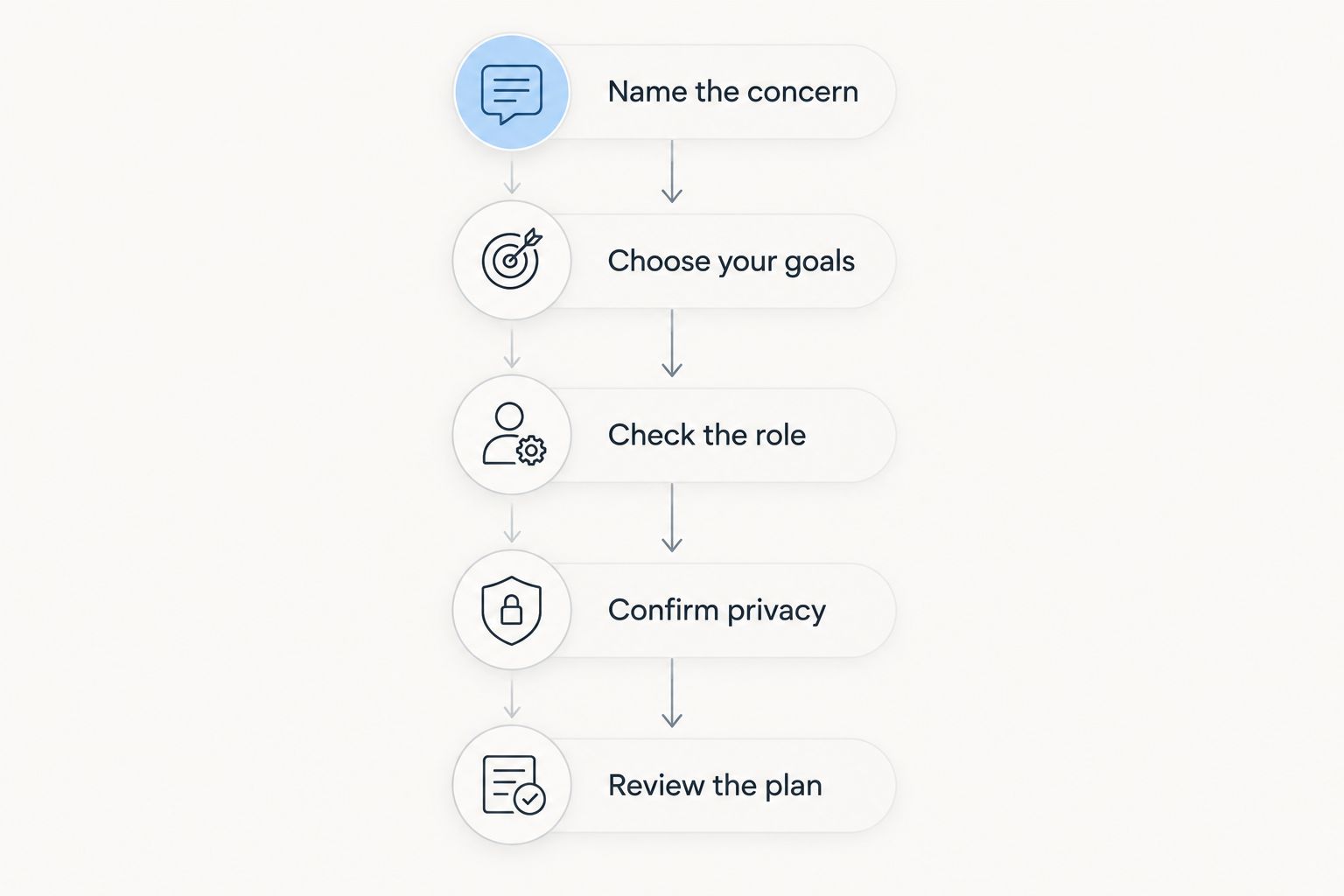
Before the appointment, write a short account of a recent interaction and its effect on you. Include your own response, not just your spouse’s actions. You do not need to gather evidence to win an argument in therapy.
For a 2026 appointment, also confirm the current consent and communication arrangements directly with the provider. Do not assume that a spouse’s absence answers every question about insurance notices, shared accounts, or access to messages.
What can I work on if my spouse changes nothing?
You can work on actions and decisions that do not depend on your spouse’s cooperation. That includes how you respond to conflict, when you end an unproductive conversation, and what support you seek outside the relationship.
A boundary describes what you will do. For example, you can decide to stop a conversation when insults begin and revisit it only when speaking feels safe. You cannot make a boundary that guarantees another person will stop insulting you.
Progress also includes greater clarity. You might become better able to name a need, recognize a pattern, or decide what conditions you require to continue the relationship.
Measure your individual therapy by your goals, not by whether your spouse becomes the person you want. Relationship repair requires more than your effort alone.
If a proposed communication exercise increases fear or retaliation, tell the clinician. Do not keep practicing a technique simply because it sounds constructive in a safe relationship.
How do I invite my spouse without pressuring them?
Choose a calm moment, describe your concern, and make a specific request. Avoid presenting therapy as a place where an expert will prove your spouse wrong.
Keep the invitation separate from your decision to get support. You can explain that you would welcome joint work while also making clear that you plan to seek individual counseling for your own needs.
Ask what concerns your spouse has about attending, rather than supplying an explanation for their refusal. They might name a concern you can discuss with a prospective therapist; they might simply decline.
An invitation is not consent. Do not conceal the purpose of an appointment, arrange a surprise joint session, or use children to deliver the request.
If your spouse declines again, bring that response to your individual therapist. The next task is deciding how you want to respond—not designing a stronger persuasion campaign.
When should safety come before marriage counseling?
If your relationship includes threats, physical violence, sexual coercion, stalking, or control over your communications and movements, seek confidential safety support. Joint counseling is not a substitute for a safety assessment, and disclosures in a shared session can create risks outside the appointment.
Tell a clinician privately if you fear consequences for speaking honestly. Avoid discussing sensitive plans on a device or account your spouse monitors, and do not assume an online session is private because you are wearing headphones.
In the United States, call 911 for immediate danger or a medical emergency. Call or text 988 for suicide or mental health crisis support; these are emergency and crisis resources, not marriage-counseling appointment lines.
For your 2026 care plan, privacy belongs in the initial conversation—not only after a difficult session. Ask how the provider can communicate with you safely and what limits apply to confidentiality.
What should I look for in a Charlotte provider?
Look for a clinician who can explain the difference between individual relationship work and couples treatment. Ask about relevant experience, the proposed treatment approach, and how progress will be reviewed.
Counselingcharlotte is an option for Charlotte-area adults seeking mental health counseling in person or virtually. Its described services include couples and family therapy alongside care for concerns such as anxiety, depression, and trauma.
That service range is a starting point, not a promise that a particular clinician or treatment arrangement fits you. Ask Counselingcharlotte whether individual counseling focused on your marriage matches your needs and which clinician would be appropriate.
The practical benefit of a provider offering both formats is the choice of setting. The limitation is that neither format removes the need for privacy, an appropriate clinician, and clear treatment goals.
Ask about individual relationship counseling
Explain that your spouse will not attend and ask about a suitable treatment arrangement.
Will counseling alone save my marriage?
Individual counseling cannot guarantee that your marriage will survive. It can support changes in your behavior and help you make clearer decisions, but it cannot supply your spouse’s participation, honesty, or commitment.
Tell your therapist whether you hope to stay married, feel undecided, or are considering separation. Treatment should help you examine your options rather than impose a preferred outcome.
Do I need my spouse's permission to get therapy?
An adult generally does not need a spouse’s permission to seek individual mental health counseling. Consent requirements depend on your legal circumstances, so ask the provider if someone has legal authority concerning your care.
Permission and privacy are separate questions. Shared insurance, billing notices, devices, or account access can reveal that you are receiving services even when your spouse does not attend.
What if my spouse wants to join later?
Ask your therapist to review the treatment arrangement before your spouse joins. Discuss consent, confidentiality, goals, and whether a different couples clinician would be appropriate.
Do not assume that inviting your spouse into an existing individual appointment automatically creates couples therapy. Both partners need to understand the clinician’s role before joint work begins.
FAQ
Is marriage counseling for one spouse really individual therapy?
Marriage counseling for one spouse usually means individual therapy focused on relationship concerns. Confirm who the client is and what treatment goals apply before starting.
Can a marriage counselor tell me what is wrong with my spouse?
A counselor who has not assessed your spouse cannot reliably diagnose your spouse from your account alone. The clinician can help you examine behaviors, their effects on you, and your responses.
Should I tell my spouse I am going to therapy?
Whether to tell your spouse depends on your circumstances and safety. If disclosure could trigger threats, monitoring, or retaliation, discuss safe communication with a clinician or domestic violence advocate first.
Is online counseling private enough for marriage problems?
Online counseling requires a private place where you can speak without being overheard or monitored. Ask about device security, messages, and an alternative arrangement if privacy at home is not possible.
Will insurance cover individual therapy about my marriage?
Insurance coverage depends on your plan, the service, and applicable clinical requirements. Ask the provider and insurer how the proposed treatment is billed; individual attendance alone does not establish coverage.
Can Counselingcharlotte help with relationship concerns?
Counselingcharlotte describes in-person and virtual mental health counseling in the Charlotte area, including couples and family therapy. Ask whether individual treatment focused on your relationship concerns is an appropriate fit.
How long should I wait for my spouse before starting therapy?
You do not have to wait for your spouse to agree before seeking individual support. Start by explaining your concerns and asking a clinician about an appropriate treatment plan.
One last thing
You do not need to prove that your marriage is failing to deserve support. For your first appointment in 2026, bring a concrete situation, its effect on you, and a change you want help making.
That gives therapy a useful starting point even if your spouse never attends. Seeking support is a decision about your care—not a verdict on the future of your marriage.


