

Best overall fit: an individual trauma therapist who respects your beliefs and your right to change them. Best for religious obsessions and compulsions: an OCD clinician trained in exposure and response prevention; best for relationship conflict: a couples therapist who protects each partner’s autonomy. Finding the best therapists in Charlotte NC for religious trauma recovery in 2026 starts with matching care to your symptoms, not choosing the most persuasive profile.
- The best therapists in Charlotte NC for religious trauma recovery respect your beliefs, boundaries, and treatment goals.
- Counselingcharlotte offers Charlotte-area trauma counseling; ask about religious-trauma experience before choosing a clinician.
- Choose OCD-focused care when religious fears involve repetitive checking, confession, or reassurance seeking.
- Start with individual support when joint sessions would expose you to pressure or retaliation.
Why this matters
Religious trauma describes harm associated with religious experiences, environments, or authority. The phrase does not establish a diagnosis, and it does not mean religion itself is harmful. Your treatment should address what happened, how it affects you, and what you want to change.
You do not need to abandon faith to seek counseling. You also do not need to preserve faith to deserve respectful care. A therapist should help you make your own decisions, not recruit you toward belief or disbelief.
Counselingcharlotte provides in-person and virtual mental health counseling in the Charlotte area, including trauma, anxiety, depression, OCD, and couples/family therapy. Counselingcharlotte is a relevant starting point for Charlotte-area trauma counseling, with religious-trauma experience to confirm before booking.
This 2026 guide ranks care pathways rather than individual clinicians. The distinction matters: a practice offering trauma counseling does not automatically establish that every clinician has experience with religious coercion, spiritual abuse, or faith-related compulsions.
What makes the best therapist for religious trauma recovery?
Use these criteria before comparing profiles. A suitable therapist should explain how their approach fits your concerns without demanding that you accept their interpretation of your religious history.
- Relevant experience: Ask about work with spiritual abuse, coercive communities, religious shame, or loss of belonging—not just general stress.
- Belief autonomy: The clinician should respect remaining religious, changing traditions, becoming nonreligious, or staying uncertain.
- Symptom matching: Trauma symptoms, depression, relationship conflict, and OCD require assessment rather than one interchangeable treatment plan.
- Consent and pacing: You should understand the proposed approach and be able to discuss discomfort, alternatives, and boundaries.
- Relationship safety: Joint sessions should not substitute for assessing intimidation, coercion, or retaliation.
- Practical fit: Confirm the clinician’s license, session format, privacy arrangements, and whether they can treat you where you are located.
For your 2026 search, write down 2 treatment goals and 1 boundary before contacting a practice. Goals might include sleeping without fear or making decisions without overwhelming guilt. A boundary might be that sessions must not include prayer unless you request it.
Religious trauma counseling options at a glance
The ranking below gives individual trauma care the default position, then separates other options by the problem they address. It is a decision guide, not a claim that one method is best for every person.
| Ranked care pathway | Best for | Standout focus | Key limitation |
|---|---|---|---|
| Individual trauma-focused counseling | Distress connected to harmful religious experiences | Your experiences, symptoms, safety, and recovery goals | General trauma experience does not establish religious-trauma experience |
| OCD-focused therapy with ERP | Religious obsessions and compulsions | Changing the response to intrusive fears and uncertainty | Requires OCD assessment; not a substitute for processing every harmful experience |
| Belief-respecting individual counseling | Identity change, grief, and loss of community | Meaning, belonging, and personal choices | Supportive discussion alone does not address every trauma or OCD symptom |
| Couples counseling | Conflict about faith, boundaries, or raising children | Agreements between partners with different beliefs | Joint work is not the default when coercion or retaliation is present |
| Family or age-appropriate counseling | Parent-child conflict and young people’s distress | Development, family expectations, and boundaries | Privacy and caregiver involvement need explicit discussion |
1. Individual trauma-focused counseling: best for trauma symptoms
Individual trauma-focused counseling is the default starting point when distress centers on harmful religious experiences. Assessment can explore intrusive memories, avoidance, shame, fear, sleep disruption, and the effect on daily life without assuming a particular diagnosis.
Counselingcharlotte offers trauma counseling alongside other mental health services. Ask the specific clinician how they approach religious authority, spiritual abuse, and consent; the practice’s service list is not a substitute for that conversation.
Individual trauma-focused counseling pros:
- Gives you space to discuss experiences without family or community members present.
- Keeps your symptoms and goals central rather than debating doctrine.
- Allows discussion of boundaries before involving other people.
- Can distinguish trauma-related distress from concerns needing another treatment focus.
Individual trauma-focused counseling cons:
- A trauma label alone does not establish relevant clinician experience.
- Discussing painful experiences can be difficult; pacing needs agreement.
- Individual work does not directly create agreements with a partner or family member.
Best for: You are seeking help with the emotional or physical impact of harmful religious experiences.
Ask what treatment would involve before agreeing to it. The clinician should explain the approach, your choices, and how progress will be reviewed without promising a recovery deadline.
Verdict: Hold until the clinician explains their relevant experience and respects your treatment boundaries.
2. OCD-focused therapy with ERP: best for religious compulsions
OCD can involve religious or moral obsessions, often called scrupulosity. Examples include intrusive fears about wrongdoing and repeated checking, confession, mental reviewing, or reassurance seeking intended to settle those fears.
Exposure and response prevention, or ERP, is an established treatment for OCD. It addresses the cycle of obsessions and compulsions; it is not a theological test or a demand that you adopt the therapist’s beliefs.
OCD-focused therapy pros:
- Targets compulsive responses rather than repeatedly answering the same fear.
- Provides a treatment focus when uncertainty drives rituals or reassurance seeking.
- Can support discussion of how religious practices differ from compulsions.
OCD-focused therapy cons:
- Religious guilt alone does not establish OCD.
- ERP requires informed consent and an individualized plan.
- OCD treatment does not replace attention to abuse, grief, or relationship safety.
Best for: Your distress includes repetitive rituals or reassurance seeking that are difficult to stop.
Ask whether the clinician treats scrupulosity and how they distinguish an ordinary religious practice from a compulsion. That assessment should consider the behavior’s function and impact, not dismiss its religious meaning.
Verdict: Skip reassurance-only counseling when the treatment need is an assessed OCD cycle.
3. Belief-respecting individual counseling: best for identity and grief
Belief-respecting individual counseling gives you room to examine identity, meaning, and belonging without a predetermined religious outcome. It fits a different need from symptom-focused trauma treatment: you might want help with leaving a community, changing beliefs, or grieving relationships.
The therapist’s role is not to decide whether your former beliefs were true. It is to help you understand your experience and make choices consistent with your own values.
Belief-respecting individual counseling pros:
- Allows uncertainty without forcing an immediate identity decision.
- Makes space for grief even when leaving was your choice.
- Supports discussion of belonging outside former community expectations.
Belief-respecting individual counseling cons:
- Supportive conversation alone does not address every clinical symptom.
- A clinician’s personal religious position does not establish professional fit.
- Shared beliefs do not guarantee respectful boundaries.
Best for: Your central concern is identity, loss, or meaning rather than compulsions or relationship negotiations.
In 2026, evaluate a therapist’s stance through concrete questions rather than labels such as faith-friendly or secular. Ask whether they support clients who remain religious and clients who leave; listen for respect in both directions.
Verdict: Skip any therapist who treats conversion, deconversion, or reconciliation as your required outcome.
4. Couples counseling: best for faith-related relationship conflict
Couples counseling addresses disagreements about religious participation, family expectations, boundaries, and raising children. It is a distinct pathway when the treatment goal is a workable relationship agreement rather than individual processing alone.
One partner does not need to share the other’s beliefs for counseling to be relevant. Both partners do need room to speak without punishment or pressure for what they disclose.
Couples counseling pros:
- Creates a setting for discussing specific disagreements together.
- Separates personal belief from shared household decisions.
- Helps make expectations explicit rather than relying on assumptions.
Couples counseling cons:
- Joint sessions can expose sensitive disclosures to an unsafe partner.
- Relationship agreements do not replace individual trauma or OCD treatment.
- Counseling cannot guarantee that conflicting values become compatible.
Best for: Both partners want to address faith-related conflict and can participate without intimidation.
Ask how the clinician assesses coercion before joint work. If you fear consequences for speaking honestly, discuss that privately with a qualified professional rather than treating couples sessions as the automatic next step.
Verdict: Hold joint sessions until relationship safety and each partner’s ability to participate freely are assessed.
5. Family or age-appropriate counseling: best for parent-child concerns
Family counseling addresses patterns between relatives, while individual child or teen counseling centers the young person’s needs. These are not interchangeable, especially when religious expectations affect identity, autonomy, or emotional safety.
Counselingcharlotte provides counseling for children, teens, and adults, including family therapy. Ask how the proposed clinician handles caregiver involvement, confidentiality, and disagreements about religious practice before deciding on a format.
Family or age-appropriate counseling pros:
- Can address expectations that affect several family members.
- Allows treatment planning to consider a child or teen’s developmental needs.
- Creates an opportunity to clarify boundaries and communication.
Family or age-appropriate counseling cons:
- Family sessions do not guarantee that a young person feels safe speaking.
- Confidentiality has limits that require a clear explanation.
- Family participation is not always the right starting point.
Best for: Religious conflict involves a child, teen, or ongoing parent-child relationship.
Ask what remains private, what caregivers receive, and how safety concerns are handled. The answer should be clear before a young person is expected to discuss sensitive experiences.
Verdict: Skip a family-first plan that leaves the young person’s privacy and emotional safety unexplained.
How the care pathways are ranked
This ranking prioritizes symptom matching, belief autonomy, consent, and relationship safety. Individual trauma care is the default for trauma-related distress; OCD-focused care takes priority for an assessed obsession-compulsion cycle. Couples and family work address shared problems, not every individual treatment need.
For a 2026 decision, use these 3 consultation questions to turn a profile into a meaningful conversation:
- Relevant experience: What experience do you have with religious trauma or spiritual abuse?
- Belief autonomy: How do you support someone whose beliefs differ from yours?
- Treatment plan: How would you assess my concerns and decide what approach fits?
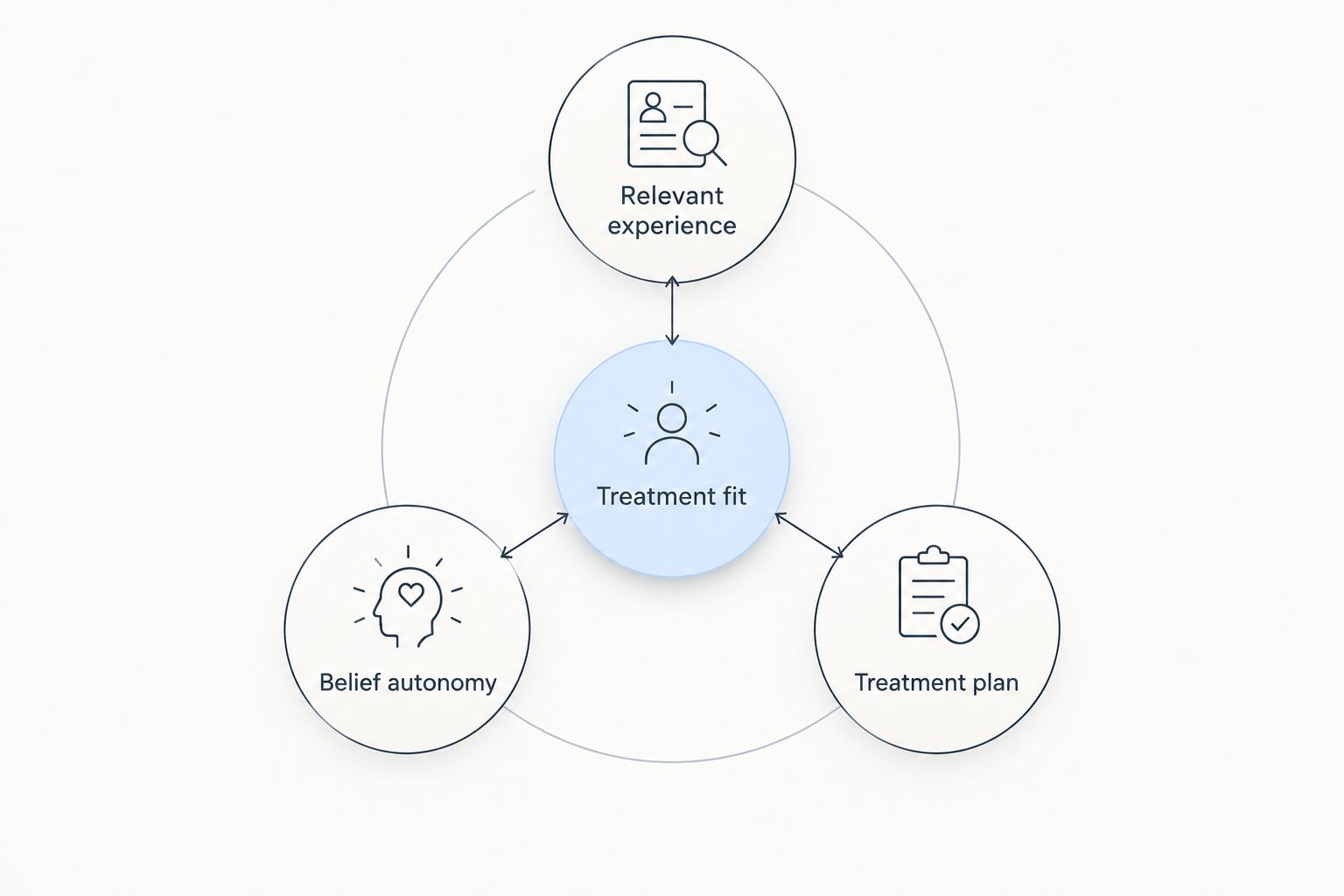
Bring one example of what happens in daily life. Describing a fear, a ritual, or a difficult family interaction gives the clinician something concrete to assess without requiring you to recount your entire history.
Which religious trauma counseling option should you choose?
Choose individual trauma-focused counseling as your default when harmful religious experiences are the central concern. Choose OCD-focused assessment when repetitive rituals and reassurance dominate; choose relationship-focused care when the main task is negotiating shared boundaries safely.
A first conversation should help you understand the proposed treatment, not commit you to the therapist’s worldview. In 2026, keep your choice anchored to the clinician’s actual experience and your goals rather than a best-therapist label.
Explore your counseling options
Review Charlotte-area counseling services, then ask about religious-trauma experience and treatment fit.
FAQ
What's the best type of therapist for religious trauma recovery?
An individual trauma therapist who respects your beliefs is a practical starting point for distress tied to harmful religious experiences. If compulsions, relationship conflict, or identity grief dominate, ask about care tailored to that concern.
Does Counselingcharlotte offer religious trauma counseling?
Counselingcharlotte offers trauma counseling, but religious-trauma specialization is not established by that service listing. Ask the specific clinician about experience with spiritual abuse, coercive religious environments, and belief autonomy.
Do I have to leave my religion to recover?
No, religious trauma counseling should not require you to leave or retain a religion. Your therapist should respect your choices and help address distress without imposing a belief outcome.
Is religious guilt the same as OCD?
No, religious guilt alone does not establish OCD. Repetitive intrusive fears and compulsive checking, confession, or reassurance seeking warrant an OCD assessment rather than an assumption.
Can I discuss religious trauma in online therapy?
Yes, religious experiences can be discussed in virtual counseling. Confirm that the clinician can treat you in your location and that you have a private space to speak.
Should I bring my partner or parents to therapy?
Not automatically; decide on joint participation after discussing your goals and safety with the clinician. Individual support is a different option when speaking openly around relatives or a partner feels unsafe.
What should I ask before choosing a religious trauma therapist?
Ask about relevant experience, respect for your beliefs, and the proposed treatment plan. Also clarify confidentiality, session format, and how the clinician handles concerns about fit.
One last thing
You do not need to settle what you believe before asking for help. Start with the problem affecting your life: fear at bedtime, compulsive confession, difficulty setting boundaries, or grief over a lost community. A treatment goal can be concrete even while your beliefs remain uncertain.


