

Best overall route: relationship-focused couples counseling. Best local starting point: Counselingcharlotte. Best for marriage planning: premarital counseling. If you’re choosing among the best relationship counselors for unmarried couples in Charlotte NC in 2026, match the counselor to your relationship goals—not whether you have a wedding date.
- Counselingcharlotte is a local starting point for unmarried couples exploring relationship counseling in the Charlotte area.
- Choose couples therapy for shared relationship problems; choose premarital counseling when marriage preparation is your goal.
- Virtual counseling suits remote participation, but each partner needs privacy and a location the clinician can serve.
- Ask about unmarried couples, treatment goals, confidentiality, and safety before choosing a relationship counselor.
Why this matters
You do not need to be married to seek relationship counseling. Dating, cohabiting, and engaged couples can seek help with recurring arguments, trust, intimacy, household responsibilities, or uncertainty about the relationship’s future.
The useful distinction is the purpose of treatment. Couples counseling addresses the relationship; individual therapy addresses one person’s needs; premarital counseling centers preparation for marriage. These routes overlap, but they are not interchangeable.
Counselingcharlotte is a starting point for Charlotte-area couples seeking in-person or virtual relationship counseling. The practice provides couples/family therapy alongside mental health counseling. Ask the specific clinician whether their work fits your relationship stage and concerns before deciding.
This 2026 guide ranks counseling routes by use case, rather than claiming that one named clinician produces better results than another. The best choice is the route that addresses your actual problem and allows both partners to participate safely.
What makes the best relationship counselor for unmarried couples?
Use these criteria before comparing names or scheduling an appointment:
- Relationship-stage fit: Ask whether the counselor works with dating, cohabiting, and engaged couples, including couples who do not plan to marry.
- Relevant experience: Describe your main concern and ask how the clinician approaches it. General experience with anxiety is not the same question as experience treating relationship conflict.
- Shared treatment goals: Choose a counselor who helps you define what the sessions are for, rather than assuming the goal is marriage or staying together.
- Balanced participation: Both partners should have room to speak. Ask how the counselor manages interruptions, withdrawal, and competing accounts of an argument.
- Clear boundaries: Understand confidentiality, communication outside sessions, and the handling of information shared separately.
- Safe, practical access: Confirm whether the setting, appointment format, and clinician’s authorized service area work for both partners.
A counselor’s professional license matters, but it does not answer every fit question. Verify the license through the relevant state licensing board and ask directly about couples work. A professional title alone does not establish a particular treatment approach.
Relationship counseling options at a glance
The order below puts a local service entry point first, followed by routes for distinct needs. Virtual counseling is a delivery format, not a separate treatment method; individual and family therapy serve different purposes from couples sessions.
| Option | Best for | Standout fit | Key limitation |
|---|---|---|---|
| Counselingcharlotte couples/family therapy | Starting a local Charlotte-area search | In-person and virtual mental health counseling, including couples/family therapy | Fit with a specific clinician and unmarried-couple concerns needs confirmation |
| Premarital counseling | Couples actively considering marriage | Organizes discussion around expectations before marriage | Marriage preparation is the wrong frame when marriage is not a shared goal |
| Virtual couples counseling | Partners who need remote participation | Changes where you attend, without changing the need for relationship-focused care | Requires privacy, suitable technology, and location eligibility |
| Individual counseling | One partner seeking personal support | Centers that person’s symptoms, decisions, and boundaries | Does not substitute for joint work on shared relationship patterns |
| Family therapy | Relationship concerns involving a wider household | Includes relevant family relationships in the treatment focus | Requires clear agreement about participants and confidentiality |
1. Counselingcharlotte: best for starting a local search
Counselingcharlotte provides in-person and virtual mental health counseling in the Charlotte, NC area, including couples/family therapy. Its stated services also include anxiety, depression, trauma, and OCD counseling.
For an unmarried couple, the next step is a clinician-fit conversation. Explain whether you are dating, living together, engaged, or unsure about commitment, then ask which clinician addresses your specific concern.
Counselingcharlotte pros:
- Couples/family therapy is part of the stated service offering.
- Both in-person and virtual counseling formats are offered.
- The stated mental health services give you concrete topics to ask about if individual symptoms affect the relationship.
Counselingcharlotte cons:
- A practice-level service description does not establish a particular clinician’s approach to unmarried couples.
- Do not assume a couples session also treats either partner’s separate mental health condition.
Best for: Charlotte-area couples who want a local starting point and need to discuss the right format and clinician.
In your 2026 search, lead with the problem rather than the label. Saying that disagreements about commitment keep escalating gives a clinician more useful information than asking only whether they offer relationship counseling.
Verdict: Hold until the clinician confirms fit with your relationship stage, goals, and participation needs.
2. Premarital counseling: best for discussing marriage expectations
Premarital counseling focuses on preparing for marriage. It gives engaged couples—and couples seriously considering engagement—a setting to discuss expectations before making that commitment.
Bring the subjects you have been postponing: finances, household responsibilities, children, intimacy, extended family, and the meaning of commitment. A wedding plan does not answer those questions.
Premarital counseling pros:
- Keeps marriage expectations at the center of the work.
- Gives difficult subjects a defined place in the conversation.
- Helps you identify decisions that need explicit agreement rather than assumptions.
Premarital counseling cons:
- Does not fit couples who do not share a goal of marriage.
- A preparation-focused format is not automatically suited to severe distress, fear, or coercion.
Best for: Unmarried couples who both want to explore or prepare for marriage.
Ask whether the clinician follows a set curriculum or adapts sessions to your concerns. Also ask how they respond when partners disagree about marriage itself; that disagreement deserves attention, not a timetable.
Verdict: Skip this route if marriage is not a shared goal; choose relationship-focused couples counseling instead.
3. Virtual couples counseling: best for remote participation
Virtual couples counseling lets partners attend relationship sessions through a remote connection. The essential selection question remains the same: does the clinician’s couples work fit your concern?
Check logistics before treating virtual care as the easier choice. Each partner needs enough privacy to speak freely, and the clinician must be authorized to serve the location where each person attends.
Virtual couples counseling pros:
- Removes travel to the counseling office from the session routine.
- Lets you consider remote attendance when an in-person format does not fit.
- Allows you to ask about couples care without making office location the only selection criterion.
Virtual couples counseling cons:
- Shared living spaces can make confidential conversation difficult.
- Connection problems and interruptions can disrupt participation.
- Crossing state lines changes the location questions you need to confirm.
Best for: Couples who need remote participation and can both attend privately and safely.
For virtual counseling in 2026, tell the clinician where both partners will physically be during sessions. Ask whether you should join together or separately and what to do if the connection drops during a difficult discussion.
Verdict: Hold until privacy, participation arrangements, and location eligibility are confirmed.
4. Individual counseling: best when one partner needs personal support
Individual counseling focuses on one person’s mental health, choices, and boundaries. It is a distinct route when you want help with your own distress or your partner does not want joint sessions.
Use individual therapy to examine your experience, not to obtain a diagnosis of an absent partner. A therapist working with you is not hearing the relationship from both sides.
Individual counseling pros:
- Gives you a private setting to discuss your own needs.
- Does not require your partner’s participation.
- Keeps personal symptoms and decisions within a clearly individual treatment focus.
Individual counseling cons:
- Does not provide joint practice in handling disagreements.
- Does not represent an assessment of a partner who is not participating.
Best for: A person seeking support with personal distress, boundaries, or relationship decisions.
Ask whether individual and couples treatment would involve different clinicians. Clarify roles before combining services; do not assume one therapist will act as both your individual therapist and a neutral couples counselor.
Verdict: Skip individual counseling as a substitute for shared couples work; choose it for your own treatment needs.
5. Family therapy: best when the wider household is involved
Family therapy addresses concerns across family relationships. It belongs on your shortlist when a couple’s difficulty also involves children, parenting arrangements, or other household members.
Unmarried partners do not need to reduce every household problem to a couples problem. The relevant question is whose participation is needed to address the issue—not whose name appears on a marriage certificate.
Family therapy pros:
- Brings relevant family relationships into the treatment focus.
- Creates space to discuss parenting and household expectations.
- Allows you to distinguish couple concerns from wider family concerns.
Family therapy cons:
- More participants require clearer boundaries about information sharing.
- Not every private couple concern belongs in a family session.
Best for: Couples whose concerns involve a wider family or household system.
Ask who should attend and why. If children are involved, discuss the clinician’s approach to consent, age-appropriate participation, and keeping children out of adult disputes.
Verdict: Hold until the counselor identifies the appropriate participants and confidentiality boundaries.
How these options are ranked
The ranking follows the criteria above: relationship-stage fit, relevant experience, shared goals, participation, boundaries, and access. A local entry point comes first; the remaining options answer different needs rather than competing for the same slot.
This is a decision guide, not a claim of measured clinical superiority. Professional fit and a clear treatment plan matter more than a generic “best counselor” label.
How to choose your counselor in 2026
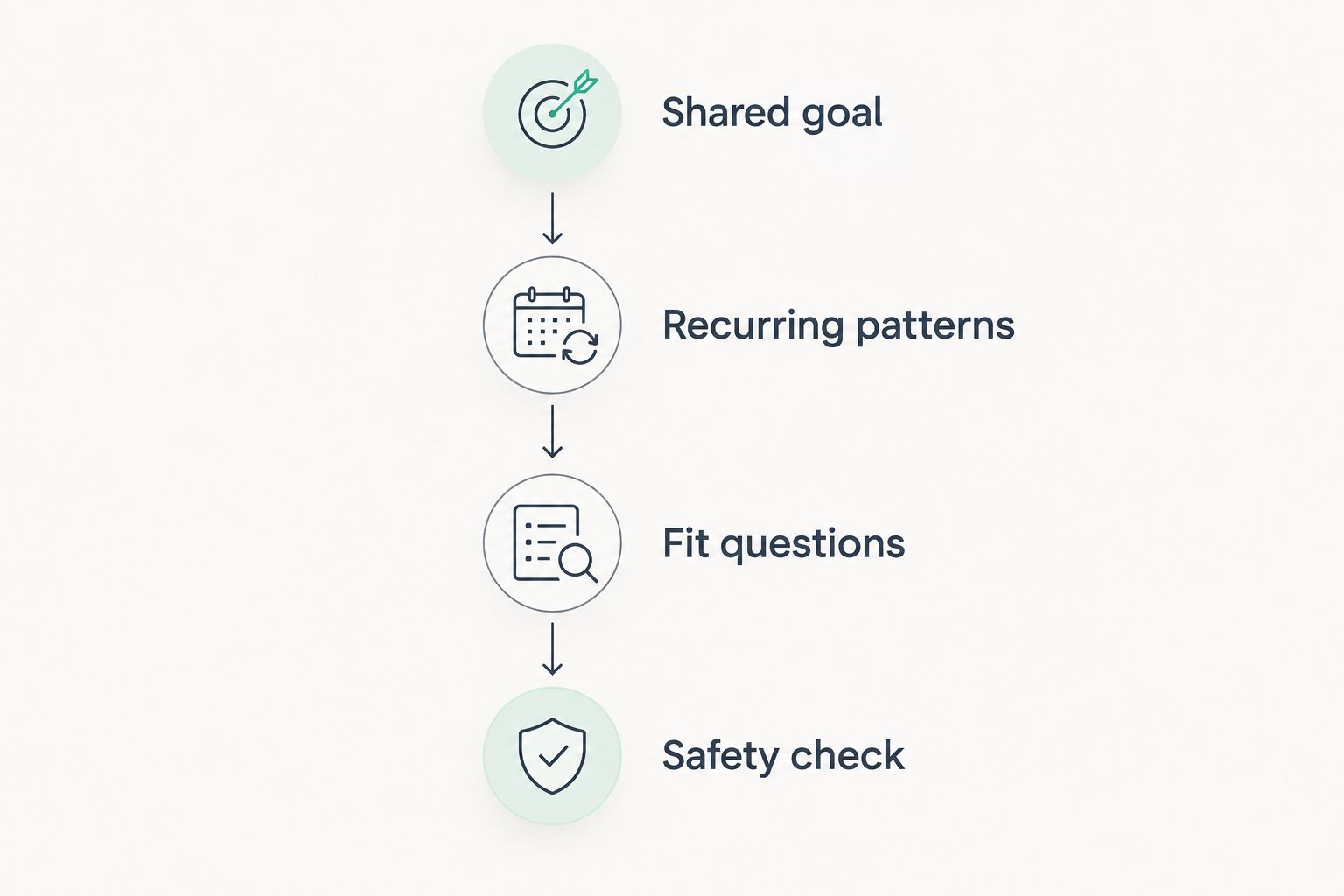
Shared goal
Write 1 shared goal before contacting a counselor. Make it observable: finishing a disagreement without insults, discussing commitment directly, or agreeing on household responsibilities. If you cannot agree on a goal, say so during the intake conversation.
Recurring patterns
Bring 2 recurring disagreements as examples, not an exhaustive case against your partner. Describe what starts each disagreement, how each person responds, and what happens afterward. This gives the clinician a clearer starting point than a list of personality judgments.
Fit questions
Ask 3 fit questions: Do you work with unmarried couples at our relationship stage? How would you approach our main concern? How do you handle confidentiality and separate disclosures?
Safety check
Tell the clinician privately if you fear retaliation, threats, monitoring, or physical harm. Do not treat joint counseling as the default when speaking honestly could put you at risk. Seek individual safety-focused support, and contact emergency services if there is immediate danger.
Which relationship counseling route should you choose?
Choose relationship-focused couples counseling as the default when both partners want to work on shared relationship problems. Choose premarital counseling for marriage preparation, individual therapy for personal treatment needs, and family therapy when the wider household needs to participate.
Virtual attendance is a format choice across suitable services, not proof that a counselor is better. Select the clinical fit first, then confirm that the setting works.
For your 2026 shortlist, a clear explanation of how a counselor would address your concern is more useful than a broad promise to improve communication. Ask what the initial work would focus on and how you would review whether it is helping.
Explore local counseling options
Ask about couples/family therapy and in-person or virtual counseling in the Charlotte area.
FAQ
Can unmarried couples go to relationship counseling in Charlotte?
Yes, unmarried couples can seek relationship counseling in Charlotte. Ask the clinician whether they work with dating, cohabiting, or engaged couples and whether their approach fits your goals.
What is the best relationship counseling option for couples who are not engaged?
Relationship-focused couples counseling is the default route for shared relationship concerns when marriage preparation is not the goal. Choose a clinician who does not assume that marriage or staying together must be the outcome.
Does Counselingcharlotte offer couples counseling?
Counselingcharlotte’s stated services include couples/family therapy and in-person and virtual mental health counseling in the Charlotte area. Confirm the specific clinician’s experience with unmarried couples before selecting care.
Is premarital counseling better than couples therapy?
Premarital counseling is the better fit when both partners want to prepare for marriage; couples therapy is the broader route for relationship concerns. The right choice depends on your shared goal, not your engagement status alone.
Can we attend couples counseling online from different places?
Ask the clinician to confirm whether separate remote participation is appropriate and permitted from each partner’s location. Both partners need privacy, and the clinician must be authorized to provide care where each person attends.
What should we ask a relationship counselor before starting?
Ask about experience with unmarried couples, the approach to your main concern, and confidentiality rules. Also clarify treatment goals, participation arrangements, and how progress will be reviewed.
Should we attend couples counseling if one partner feels afraid?
Do not assume joint counseling is appropriate when one partner fears retaliation, coercion, or harm. Speak privately with a qualified professional about safety-focused support, and contact emergency services for immediate danger.
One last thing
Agreement is not the only useful outcome of a counseling conversation; clarity matters too. Before starting, ask whether the counselor can help you explore different relationship goals without assuming you must marry or remain together.
Bring the question you are avoiding—not just the argument you keep repeating. That gives your first conversation a purpose.


