

Best starting point for broader couples support: Counselingcharlotte. Best format for a shared setting: in-person counseling. Best format for avoiding travel: virtual counseling. This 2026 guide to the best premarital counselors in Charlotte NC compares these care routes and explains how to choose a counselor around your relationship goals—not a generic ranking.
- Counselingcharlotte provides Charlotte-area couples therapy; ask whether a clinician offers premarital counseling suited to your goals.
- Choose the best premarital counselors in Charlotte NC by relevant experience, shared goals, and relationship fit.
- In-person counseling offers a shared setting; virtual counseling removes travel but requires privacy.
- Premarital counseling should address difficult decisions, not certify that a marriage will succeed.
Why this matters
Choosing premarital counseling means choosing someone to help you discuss decisions that continue after the wedding. Communication matters, but so do money, family boundaries, parenting expectations, intimacy, and the way you respond when agreement is difficult.
The best counselor for your relationship is the one whose experience and approach match the conversations you need to have. A convenient appointment format helps you attend; it does not establish that a clinician is the right fit.
For your 2026 search, separate the provider decision from the format decision. First decide what help you need, then determine whether meeting in person or virtually supports that work. Do not let proximity become the only selection criterion.
What makes the best premarital counselor
Use these criteria before comparing providers or booking an appointment:
- Relevant experience: Ask about work with engaged couples and the issues you want to address. General relationship experience and a dedicated premarital approach are not interchangeable.
- Shared goals: Both partners should understand what the counseling is intended to accomplish. A wedding requirement, conflict support, and planning for married life are different starting points.
- A clear approach: Ask how sessions move from identifying concerns to practicing different conversations. A named method matters less than understanding what you will actually do.
- Room for both perspectives: You need space to disagree without turning the counselor into a referee who declares a winner.
- Clinical boundaries: Ask how the counselor handles individual concerns, private disclosures, and situations where joint sessions are inappropriate.
- Practical fit: Confirm the setting, privacy arrangements, scheduling process, and requirements for attending together before committing.
Write down 3 discussion topics before contacting a counselor. This is a preparation exercise, not a required treatment standard. Specific topics make it easier to ask whether the clinician's work matches your needs.
For example, replace a broad goal such as better communication with a concrete one: discussing shared finances without shutting down. That gives both you and the counselor something useful to evaluate.
Premarital counseling options at a glance
These are care routes, not interchangeable providers. The provider entry identifies a Charlotte-area counseling service; the format entries help you decide how to attend. Neither format proves a clinician has premarital expertise.
| Option | Best for | Standout feature | Key limitation |
|---|---|---|---|
| Counselingcharlotte | Couples seeking relationship support with broader counseling needs | Charlotte-area couples/family therapy alongside mental health counseling | Confirm that the selected clinician works with premarital goals |
| In-person counseling | Couples who want a shared counseling setting | Both partners meet in the same physical space | Travel and coordinated attendance are necessary |
| Virtual counseling | Couples who want to avoid travel | Sessions take place remotely | Private space and a workable connection are necessary |
Use this comparison to narrow your next step in 2026. Start with the care you need, then choose a setting that allows both partners to participate without distraction.
1. Counselingcharlotte: best for broader couples support
Counselingcharlotte provides in-person and virtual mental health counseling in the Charlotte area, including couples/family therapy. Its stated services also include counseling for anxiety, depression, trauma, and OCD, serving children, teens, and adults.
That makes it a starting point when you want relationship counseling and also need to ask how individual mental health concerns fit into the care plan. Do not assume that every clinician handles every listed concern or offers a dedicated premarital program; ask about the specific clinician and your goals.
Counselingcharlotte pros:
- Couples/family therapy is an explicitly stated service.
- Both in-person and virtual counseling are offered.
- The stated service scope includes several mental health concerns you can raise when discussing care.
Counselingcharlotte fit considerations:
- Couples therapy does not automatically mean a structured premarital program.
- A broad service scope does not establish the expertise of an individual clinician.
- The provider decision still requires a conversation about your relationship goals and preferred format.
Best for: Charlotte-area couples who want to explore relationship counseling while asking about broader mental health needs.
Before choosing this route, explain what you want to address before marriage. Ask whether the clinician supports that work directly, how joint sessions are organized, and whether separate individual care needs discussion.
Verdict: Hold until you confirm premarital fit with the selected clinician.
2. In-person counseling: best for a shared setting
In-person premarital counseling brings both partners into the same counseling space. You do not need to manage a video connection during the conversation, and the setting separates the appointment from household tasks and interruptions.
Choose this format because the physical setting supports your participation—not because face-to-face counseling is automatically better. The counselor's experience, the working relationship, and your ability to engage still matter.
In-person counseling pros:
- Both partners participate in a shared physical setting.
- You can attend without managing a video platform.
- A separate counseling space creates a clear boundary around the appointment.
In-person counseling cons:
- Both partners need to coordinate travel and attendance.
- The trip adds a practical commitment beyond the session itself.
- A nearby office does not establish that the clinician matches your goals.
Best for: Couples who prefer discussing sensitive issues together in a dedicated counseling space.
When comparing in-person options in 2026, check whether both partners can attend consistently. Also discuss how you will handle the time immediately afterward, especially if an appointment raises an unresolved disagreement.
You do not have to finish every difficult conversation on the trip home. Agree on whether you will pause, reflect separately, or continue talking when you can both give the issue your attention.
Verdict: Hold if attending together creates a practical barrier; choose it when the shared setting helps both partners engage.
3. Virtual counseling: best for avoiding travel
Virtual premarital counseling lets you meet remotely rather than travel to a counseling office. The format works around location, but it still requires an environment where both partners can speak openly.
Treat a remote appointment as a counseling session, not a call you fit around errands. Privacy, attention, and a working connection are part of the setup.
Virtual counseling pros:
- Neither partner needs to travel to an office for the appointment.
- You can participate from a suitable private location.
- The format separates the choice of counseling from the need to make a trip.
Virtual counseling cons:
- Household interruptions can interfere with participation.
- Connection or audio problems can interrupt difficult conversations.
- A private location is essential; being at home does not guarantee privacy.
Best for: Couples who prefer remote participation and can protect a private, interruption-free setting.
Ask how the clinician handles partners joining from different locations. Also confirm any location requirements before attending; do not assume that a virtual appointment can take place from anywhere.
For your 2026 planning, identify a backup response to a dropped connection. Decide how you will reconnect and avoid continuing a sensitive argument while the counselor is disconnected.
Verdict: Hold if privacy is uncertain; choose it when both partners can participate privately and attentively.
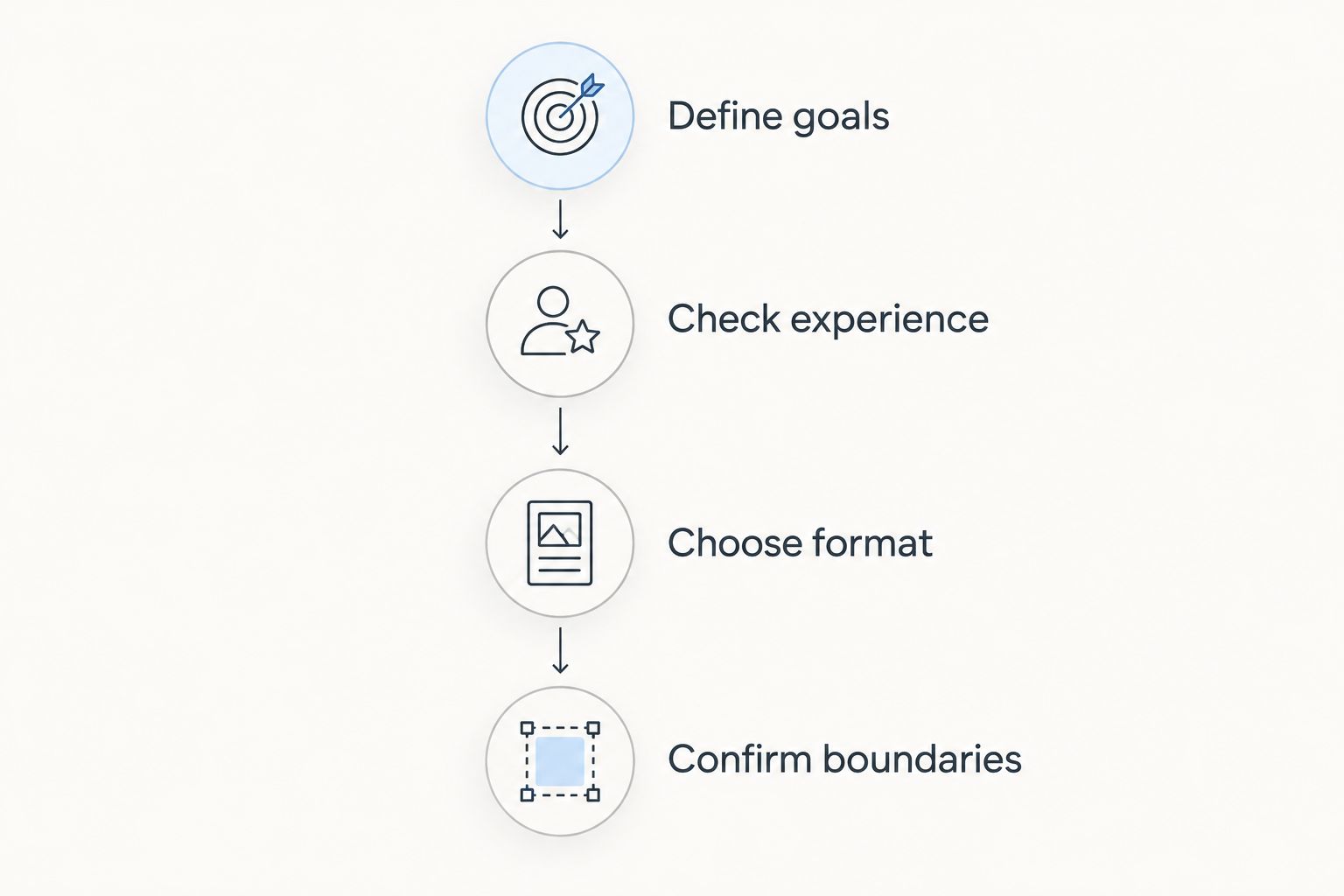
How to choose your counselor
Use a simple sequence rather than collecting names without a decision rule. The purpose is to find a clinician whose work matches your needs and a setting you can actually use.
Define goals
Each partner should write down 2 personal goals for counseling. Compare them before making contact, and distinguish shared priorities from goals only one partner currently holds.
You do not need identical lists. You do need an honest discussion about whether both partners are willing to work on the concerns being raised.
Check experience
Ask the clinician how they work with engaged couples and the specific topics on your list. Request an explanation of the approach in plain language rather than choosing by a credential or method name alone.
If family pressure, religious expectations, cultural differences, or individual symptoms matter to your relationship, bring them into this conversation. Ask about relevant experience rather than assuming understanding.
Choose format
Compare the in-person and virtual options against your actual circumstances. Focus on privacy, attendance, travel, and each partner's ability to speak comfortably.
Choose 1 shared priority for the appointment setting. That priority might be a separate counseling space or avoiding travel; it should reflect what helps you participate, not what looks most convenient on paper.
Confirm boundaries
Ask how the clinician handles private messages, individual conversations, records, and confidentiality in couples work. Understand these arrangements before sharing sensitive information separately.
Also ask what happens if the clinician recommends a different type of care. A useful care plan distinguishes relationship work from concerns that require another setting or specialist.
Questions that make a consultation useful
You do not need to disclose your entire relationship history during an initial inquiry. Give enough detail to establish fit, then ask questions that reveal how the counseling would work.
- What experience do you have working with engaged couples?
- How would you approach the topics we want to address?
- Do you use a structured premarital process or build sessions around our goals?
- How do you handle disagreement when one partner feels unheard?
- What are your policies for individual conversations within couples counseling?
- How do you decide whether joint counseling is appropriate?
- What should we expect from the first appointment?
Listen for clear explanations, not promises about your marriage. Counseling should help you examine patterns and decisions; no provider can guarantee a particular relationship outcome.
In 2026, also confirm the administrative details directly with the provider. Appointment arrangements and participation requirements belong in that conversation, not in assumptions based on a directory listing.
When joint counseling is not the first step
Premarital counseling is not a substitute for safety planning. If your partner threatens you, controls your movements, or retaliates when you speak honestly, seek confidential individual support before arranging joint sessions.
Do not use a shared appointment to disclose something that puts you at risk afterward. A qualified clinician can discuss safety and whether a joint setting is appropriate without requiring you to confront your partner first.
Ordinary disagreement and fear of retaliation are different situations. Tell the clinician about safety concerns privately before choosing the format or scheduling a joint conversation.
How these options are ranked
The order prioritizes a provider starting point, then separates the appointment formats by use case. It is not a claim that one clinician has better outcomes than another, or that one format produces better marriages.
The selection criteria remain the same across all three routes: relevant experience, shared goals, a clear approach, space for both perspectives, clinical boundaries, and practical fit. Choose for the work you need to do, not the position of an option in a list.
Which premarital counseling route should you choose?
Start with Counselingcharlotte if you want to explore Charlotte-area couples therapy alongside questions about broader mental health care. Confirm that the selected clinician supports your premarital goals before committing.
Choose in-person counseling when a shared setting helps both partners participate. Choose virtual counseling when avoiding travel matters and you can protect privacy. If you are undecided, prioritize relevant clinician experience before deciding on the setting.
FAQ
What's the best premarital counselor in Charlotte NC for us?
The best premarital counselor for you is one whose experience matches your relationship goals and who gives both partners room to participate. Ask about work with engaged couples, the topics you want to address, and the approach to joint sessions.
Does Counselingcharlotte offer premarital counseling?
Counselingcharlotte lists couples/family therapy among its services; confirm dedicated premarital counseling directly with the selected clinician. Explain your goals before marriage and ask whether the clinician's approach fits them.
Is virtual premarital counseling better than in-person counseling?
Neither format is automatically better for your relationship. In-person counseling provides a shared setting, while virtual counseling avoids travel and requires a suitable private location.
What should we discuss in premarital counseling?
Discuss the decisions and patterns that matter to your future marriage, including money, family boundaries, parenting expectations, intimacy, and conflict. Bring specific examples rather than treating every topic as a problem you must have.
Do we need relationship problems to attend premarital counseling?
No, you can seek premarital counseling to clarify expectations and discuss future decisions without presenting a current crisis. Explain whether your goal is preparation, help with recurring disagreements, or both.
How many premarital counseling sessions do we need?
Agree on the scope and session plan with your clinician rather than assuming a fixed number. Your goals, the counselor's approach, and the concerns that emerge should inform that discussion.
Can we attend premarital counseling if we disagree about getting married?
Tell the counselor that marriage itself is an unresolved decision. The counseling goal should address that uncertainty rather than assume both partners have already chosen the same outcome.
One last thing
Do not make your wedding date the deadline for resolving every relationship question. Ask the counselor to help you distinguish decisions that need agreement before marriage from conversations that will continue throughout married life.
A useful first step is to bring one topic you handle well and one that repeatedly gets stuck. The contrast gives you a concrete starting point without reducing your relationship to a list of problems.


