

Best starting point for local in-person or virtual couples care: Counselingcharlotte. Best for recurring arguments: skills-focused couples counseling. Best for setting expectations after the wedding: premarital-style counseling; this 2026 guide helps you choose the right kind of support rather than treating every marriage counselor as interchangeable.
- Counselingcharlotte is a local starting point when newlyweds want in-person or virtual couples counseling.
- The best marriage counselors in Charlotte NC for newlyweds match your relationship goals, not just your location.
- Choose skills-focused couples therapy for recurring arguments and premarital-style counseling for shared expectations.
- Ask about therapist credentials, experience with newlyweds, confidentiality, and how progress will be reviewed.
Why this matters
Newlywed counseling does not have to begin with a crisis. You can use it to discuss responsibilities, money, intimacy, family boundaries, or disagreements before those subjects become harder to address. The useful question is not whether your marriage is troubled enough; it is what you want help changing.
A directory ranking cannot answer that question for you. A clinician who suits a couple working through emotional distance is not automatically the right choice for partners who want practical help discussing household responsibilities.
Counselingcharlotte is a local option for newlyweds seeking in-person or virtual couples counseling in the Charlotte area. Use that as a starting point, then assess the individual therapist. This 2026 shortlist separates a named practice from counseling approaches so you can make a decision based on fit, not assume that every listed option is a different provider.
What makes the best marriage counselor for newlyweds?
Use these criteria before choosing a counselor. Credentials matter, but the conversation about your needs matters too.
- Relevant experience: Ask whether the therapist works with couples early in marriage and with the specific concerns you want to address.
- A clear approach: The counselor should explain what sessions involve, how both partners participate, and how the approach connects to your goals.
- Balanced participation: Ask how the therapist handles interruptions, withdrawal, and disagreements without turning sessions into arguments about who is right.
- Appropriate credentials: Verify the individual clinician's current North Carolina license through the relevant licensing board. A practice name is not a substitute for checking the treating professional.
- Practical access: Choose an in-person or virtual format you can attend consistently, with privacy and workable scheduling for both partners.
- Safety and confidentiality: Ask about private conversations, clinical records, and situations in which joint counseling is not appropriate.
Bring 1 shared goal to your first conversation with a prospective therapist. A useful example is learning to discuss spending without either partner shutting down; a vague request to fix everything gives you less to evaluate.
Newlywed counseling options at a glance
The order below starts with a local practice and then separates approaches by purpose. The counseling approaches are options to discuss with prospective clinicians, not claims about services offered by every practice.
| Option | Best for | Standout feature | Key limitation |
|---|---|---|---|
| Counselingcharlotte | Local couples care with a choice of format | In-person and virtual counseling in the Charlotte area | You still need to assess the individual therapist's fit |
| Skills-focused couples counseling | Recurring disagreements | Practice with specific communication and conflict habits | Communication exercises alone do not address every relationship concern |
| Premarital-style counseling after marriage | Setting shared expectations | Structured discussion of everyday married life | Planning alone does not resolve entrenched conflict |
| Emotion-focused couples counseling | Emotional distance and repeated withdrawal | Attention to feelings and patterns beneath arguments | Requires willingness to discuss vulnerable experiences |
| Family-systems-informed couples counseling | Boundaries with relatives and household roles | Examines the wider relationships affecting the marriage | Wider context must not displace the couple's immediate goals |
1. Counselingcharlotte: best for choosing a local care format
Counselingcharlotte provides in-person and virtual mental health counseling, including couples and family therapy, in the Charlotte area. For newlyweds, the relevant starting point is couples counseling rather than assuming that either partner needs an individual diagnosis.
Choose this option when you want to explore local care and decide whether attending together in person or virtually fits your routine. The practice's service range does not establish which clinician is right for you; ask about the person who would conduct your sessions.
Counselingcharlotte pros:
- Couples therapy is part of the stated service offering.
- In-person and virtual formats give you different ways to attend.
- Family therapy is also offered when wider family relationships are relevant.
Counselingcharlotte considerations:
- The practice name alone does not establish a particular therapist's experience with newlyweds.
- Confirm the clinician's approach, credentials, and confidentiality arrangements before starting.
Best for: Newlyweds seeking a Charlotte-area practice with both in-person and virtual counseling.
Ask how the therapist would work with your specific goal, whether both partners attend the initial appointment, and how progress is discussed. Verdict: Buy into this option only after confirming the individual clinician's fit.
2. Skills-focused couples counseling: best for recurring disagreements
Skills-focused couples counseling centers on what you do during difficult conversations. A therapist can help you examine patterns such as interrupting, escalating, avoiding a topic, or agreeing to something that neither partner follows through on.
Choose this approach when you can identify a repeating interaction and want to practice a different response. The aim is not to eliminate disagreement; it is to discuss differences without making the conversation itself the larger problem.
Skills-focused couples counseling pros:
- Connects sessions to specific situations you recognize at home.
- Gives both partners behaviors to practice between appointments.
- Creates a clear basis for discussing whether conversations are changing.
Skills-focused couples counseling cons:
- Scripts and exercises are not substitutes for addressing safety concerns.
- A narrow focus on communication can leave grief, trust, or emotional distance insufficiently addressed.
Best for: Newlyweds whose arguments repeatedly follow the same pattern.
Bring 3 recent disagreements as examples, not evidence for a prosecution. Describe what started each conversation, what each partner did, and how it ended. Verdict: Buy into this approach when changing a recurring interaction is your primary goal.
3. Premarital-style counseling: best for shared expectations
Premarital-style counseling can remain useful after the wedding because the subjects do not expire on your wedding day. You can discuss money decisions, household responsibilities, intimacy, relationships with relatives, and hopes about children without treating different expectations as proof of incompatibility.
Choose this approach when the marriage is generally workable but important assumptions remain unspoken. Ask the clinician whether they use structured relationship discussions with already-married couples; do not assume every premarital service has the same scope.
Premarital-style counseling pros:
- Gives everyday expectations a place in the conversation.
- Helps distinguish agreements from assumptions.
- Supports discussion of decisions before they become urgent disputes.
Premarital-style counseling cons:
- A checklist of topics is not a treatment plan for entrenched conflict.
- General planning can feel beside the point when one partner needs an immediate concern addressed.
Best for: Newlyweds building shared expectations about married life.
In 2026, choose the scope of counseling based on what you need now, not the label attached to your wedding stage. Verdict: Buy into this approach for expectation-setting; skip it as the sole response to serious unresolved conflict.
4. Emotion-focused couples counseling: best for emotional distance
Emotion-focused couples counseling examines the feelings and relationship patterns beneath surface disagreements. Rather than discussing only the disputed task or comment, you explore what the interaction means to each partner and how each responds to feeling disconnected.
Choose this approach when practical agreements do not seem to change the emotional pattern. Ask the therapist to explain their training and how they would work with withdrawal, pursuit, defensiveness, or difficulty expressing needs.
Emotion-focused couples counseling pros:
- Makes emotional connection an explicit part of the work.
- Looks beyond the topic of an argument to the interaction around it.
- Gives vulnerable concerns a place alongside practical disagreements.
Emotion-focused couples counseling cons:
- Discussing vulnerable feelings can be uncomfortable.
- Emotional exploration does not replace concrete agreements about everyday responsibilities.
Best for: Newlyweds who feel disconnected despite attempts to solve practical problems.
You do not need to arrive with polished emotional language. You do need a therapist who can explain how both partners will participate without pressuring disclosure. Verdict: Buy into this approach when emotional distance is the central concern.
5. Family-systems-informed counseling: best for family boundaries
Family-systems-informed couples counseling examines how wider relationships and learned family patterns affect your marriage. The focus can include expectations from relatives, household roles, caregiving responsibilities, and disagreements about who participates in couple decisions.
Choose this approach when conflict repeatedly involves people outside the marriage. Looking at the wider system does not mean inviting relatives into sessions; ask the therapist who would attend and why.
Family-systems-informed counseling pros:
- Makes outside relationships part of the discussion.
- Helps you examine inherited expectations about marriage and responsibility.
- Keeps boundary decisions connected to the couple's shared goals.
Family-systems-informed counseling cons:
- Discussion of family history can distract from an immediate decision without clear goals.
- Understanding a family pattern does not automatically produce agreement about a boundary.
Best for: Newlyweds struggling with relatives' expectations or household roles.
Write down the decision you want to make together before exploring its history. Verdict: Buy into this approach when family boundaries drive the conflict; hold if your main need is elsewhere.
How this shortlist is ranked
This 2026 guide prioritizes the match between your concern and the counseling option. The local practice comes first because it offers couples counseling and both attendance formats; the remaining options each address a distinct reason newlyweds seek support.
The criteria are relevant experience, a clear approach, balanced participation, credentials, practical access, and safety. The order is not a claim that one therapeutic approach outperforms another for every marriage. Use the table as a decision guide, then evaluate the clinician who would actually treat you.
How to choose your marriage counselor
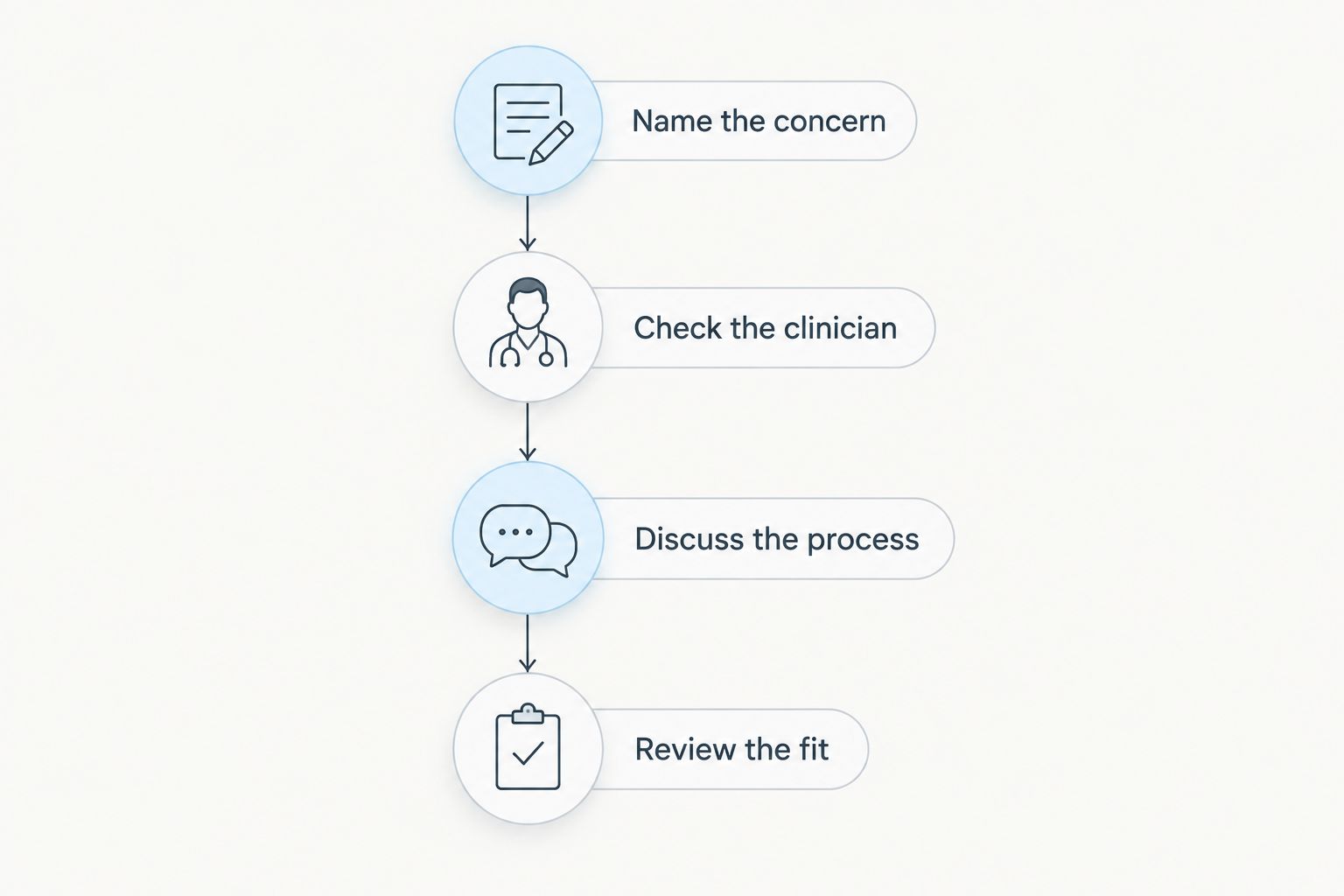
Name the concern
Each of the 2 partners should describe what they want to change without diagnosing the other person. Compare the descriptions and identify a shared target, even if you disagree about how the problem started.
For example, deciding how to divide household responsibilities is more actionable than asking a therapist to make your partner more considerate. Keep your own perspective, but give the counselor something observable to work with.
Check the clinician
Verify the treating professional's license and ask about experience with couples facing your concern. Ask what approach they use and what that means in an ordinary appointment.
Listen for a clear explanation rather than a list of credentials alone. You should understand how the proposed work relates to the reason you are seeking counseling.
Discuss the process
Ask whether sessions are joint, whether individual meetings form part of treatment, and how private disclosures are handled. Clarify what happens when partners disagree about the goals.
These questions belong before sensitive information is shared. They are especially useful if either partner expects the therapist to keep individual conversations separate from couples work.
Review the fit
Discuss what progress would look like and how you will revisit it with the therapist. Examples include addressing a difficult subject without abandoning the conversation or reaching an agreement about responsibilities.
A challenging appointment is not automatically a poor fit. Persistent confusion about the goals, however, deserves a direct conversation with the clinician.
When joint counseling is not the first step
If you fear retaliation for what you say, experience coercive control, or face violence, start with confidential individual support and safety planning rather than assuming joint counseling is appropriate. Tell the professional about the safety concern before arranging sessions together.
Couples counseling is not an emergency service. In the United States, call 911 for immediate danger; call or text 988 for suicide or mental health crisis support. Do not wait for a routine counseling appointment when urgent help is needed.
Which marriage counseling option should you choose?
Start with the concern, then choose the clinician. For a local practice offering in-person or virtual couples care, consider Counselingcharlotte and ask about the therapist who would work with you.
Choose skills-focused counseling for recurring arguments, premarital-style discussions for expectations, emotion-focused work for disconnection, or family-systems-informed work for boundaries. In 2026, the most useful next step is a focused inquiry that explains your goal and asks how the clinician would address it.
FAQ
What's the best marriage counselor in Charlotte NC for newlyweds?
The best fit is a licensed clinician whose couples-counseling experience matches your shared goal. Counselingcharlotte is a local option offering in-person and virtual couples counseling; assess the individual therapist before deciding.
Should newlyweds go to counseling even without a major problem?
You can seek couples counseling without a major crisis. Sessions can focus on expectations, responsibilities, communication, or family boundaries rather than repairing a severe breakdown.
Is premarital counseling still useful after the wedding?
Premarital-style discussions can be useful after marriage when shared expectations need attention. Ask whether the clinician works with already-married couples and can adapt the scope to your concerns.
Is online marriage counseling better than in-person counseling?
Neither format is automatically better for every couple. Compare privacy, participation, travel, and your ability to attend consistently, then ask the clinician whether virtual sessions suit your circumstances.
What should we ask a marriage counselor before starting?
Ask about credentials, experience with newlyweds, treatment approach, confidentiality, and how goals are reviewed. Both partners should understand what participation involves before sharing sensitive information.
How many counseling sessions do newlyweds need?
There is no single session count that fits all newlyweds. Discuss your goals with the clinician and agree on how you will review progress rather than assuming a fixed course guarantees a result.
What if my spouse does not want marriage counseling?
You can seek individual counseling to explore your own concerns and choices. Individual work does not substitute for your spouse's participation or give a clinician a basis to diagnose an absent partner.
Can marriage counseling help if one partner feels unsafe?
Safety needs assessment before joint counseling begins. If you fear retaliation, coercive control, or violence, seek confidential individual support and safety planning; call 911 for immediate danger.
One last thing
Do not choose a therapist because you expect an ally against your spouse. Choose someone who can help you define the work, understand each partner's perspective, and address harmful patterns without confusing fairness with ignoring safety.
Before sending an inquiry, each partner can finish this sentence: I want counseling to help us change this specific interaction. Comparing those answers gives you a useful starting point before the first appointment.


