

Psychology Today gives you a broad therapist directory, but a profile cannot establish whether a clinician fits your needs. If your Charlotte search has become a cycle of browsing without a clear next step, switch to a route that answers your specific question about treatment or coverage. The best Psychology Today alternative in 2026 is Counselingcharlotte for contacting a Charlotte counseling practice directly; your health plan’s provider directory is better for starting with network participation.
- Psychology Today alternatives Charlotte NC: choose Counselingcharlotte for direct contact about in-person or virtual mental health counseling.
- Your health plan’s provider directory is best for beginning an insurance-focused therapist search.
- TherapyDen offers another therapist directory; compare individual clinicians rather than directory names.
- Stay with Psychology Today when you want to compare therapists across separate practices.
Why this matters
A directory helps you find names. A conversation helps you decide whether to pursue care with a particular clinician. Those are different tasks.
For your 2026 Charlotte therapist search, choose the route that resolves your next decision: local counseling, insurance participation, another set of profiles, or a referral. A longer list is not a substitute for a clearer match.
Psychology Today alternatives at a glance
| Option | Best for | Standout function | Difference from Psychology Today |
|---|---|---|---|
| Psychology Today | Comparing therapists across practices | Searchable therapist profiles | The benchmark directory option |
| Counselingcharlotte | Contacting a Charlotte counseling practice directly | In-person and virtual counseling for children, teens, and adults | A care provider rather than a multi-practice directory |
| Your health plan’s provider directory | Beginning with network participation | Provider listings associated with your insurance plan | Organizes your search around coverage rather than a general therapist directory |
| TherapyDen | Exploring another therapist directory | Profiles with an emphasis on inclusive therapist search | An additional directory, not a replacement for contacting clinicians |
| Your primary care clinician | Asking for a referral with medical context | A referral conversation informed by your health concerns | Begins with a clinical conversation rather than browsing profiles |
1. Counselingcharlotte: best for direct local counseling inquiries
Counselingcharlotte provides mental health counseling in the Charlotte, NC area, with in-person and virtual services for children, teens, and adults. Its stated services include anxiety, depression, trauma, OCD, and couples and family therapy. Choose this route when you want to discuss care with a practice rather than continue comparing directory profiles.
The distinction is practical: you are asking a provider about your situation, not asking a search platform to narrow a list. Describe the concern you want help with, who needs counseling, and your preferred session format. Then ask which clinician’s experience matches that combination.
Where Counselingcharlotte shines
- Direct practice contact: Your inquiry concerns counseling services rather than another round of directory searching.
- Different age groups: The practice serves children, teens, and adults.
- Individual and relationship concerns: Its stated scope includes mental health concerns, couples therapy, and family therapy.
- Session format choice: In-person and virtual counseling are part of its service description.
Where Counselingcharlotte falls short
- A single practice does not give you the cross-practice comparison that a broad directory provides.
- A service category does not establish a particular clinician’s treatment approach; ask about the work relevant to your concern.
- If your main question is insurance participation, resolve that directly rather than treating the practice’s service description as a coverage answer.
Counselingcharlotte versus Psychology Today
| Dimension | Counselingcharlotte | Psychology Today |
|---|---|---|
| Type of resource | Counseling practice | Therapist directory |
| Search breadth | One practice’s services | Profiles across separate practices |
| Stated local services | Charlotte-area in-person and virtual counseling | Search for individual therapists serving your location |
| Next useful action | Ask about clinician fit for your needs | Shortlist profiles, then contact clinicians |
Best for: People seeking direct contact about Charlotte mental health counseling for themselves, a child or teen, a couple, or a family.
Verdict: Hold your selection until the practice answers your treatment-fit questions. A relevant service offering is a reason to inquire, not proof that every clinician is the right match.
2. Your health plan’s provider directory: best for coverage-led searches
Your health plan’s provider directory is the most relevant starting point when network participation controls your choice. It connects the search to your plan rather than beginning with the entire local therapy market. That makes it a different route, not a better directory for every situation.
For a coverage-led search in 2026, identify your exact plan before contacting clinicians. An insurer’s name alone does not settle whether a specific clinician participates in your particular network. Confirm participation with both the plan and the practice before making a coverage-dependent decision.
Where your health plan’s directory shines
- Coverage-focused starting point: You begin with providers listed in connection with your health plan.
- Administrative direction: Your insurer can answer questions about your plan’s mental health benefits.
- A clear screening question: You can ask whether the individual clinician participates in your exact network.
Where your health plan’s directory falls short
- A network listing does not establish the clinician’s experience with your specific concern.
- Provider directories can contain inaccurate information, so confirm details directly.
- Network participation and clinical fit are separate questions; satisfying one does not settle the other.
Your health plan’s directory versus Psychology Today
| Dimension | Your health plan’s directory | Psychology Today |
|---|---|---|
| Starting point | Your insurance plan | Therapist profiles |
| Main decision supported | Network participation | Which clinicians to investigate |
| Treatment-fit assessment | Requires a clinician conversation | Also requires a clinician conversation |
| Essential follow-up | Confirm the exact plan and clinician | Confirm profile details with the clinician |
Before choosing this route, decide whether insurance participation is a requirement or simply a preference. If it is a requirement, screen for it early. Otherwise, you risk spending time assessing a clinician you cannot use under your intended payment arrangement.
Best for: People whose therapist search must begin with their insurance network.
Verdict: Hold your selection until the plan and practice confirm participation. Do not treat a directory entry as the final coverage decision.
3. TherapyDen: best for another directory perspective
TherapyDen is a therapist directory with an emphasis on inclusive search. It gives you another place to investigate clinicians when you want to look beyond Psychology Today. The useful comparison is between individual therapists, not between directory brands.
Read profiles for evidence that relates to your goals: the populations a clinician works with, the concerns they address, and how they describe their approach. A profile’s language can help you prepare questions, but it does not replace the answers you get from the clinician.
Where TherapyDen shines
- Another search route: You can explore therapist profiles outside Psychology Today.
- Inclusion-focused framing: Its directory emphasizes inclusive therapist search.
- Useful comparison material: Profiles give you information to investigate during direct contact.
Where TherapyDen falls short
- It remains a directory rather than the practice providing your treatment.
- Inclusive language does not, by itself, establish clinical experience with your particular concern.
- A profile cannot demonstrate how you will experience working with that therapist.
TherapyDen versus Psychology Today
| Dimension | TherapyDen | Psychology Today |
|---|---|---|
| Resource type | Therapist directory | Therapist directory |
| Distinct emphasis | Inclusive therapist search | Broad therapist search |
| Provider selection | Compare individual profiles | Compare individual profiles |
| Final fit decision | Requires direct contact | Requires direct contact |
In 2026, use TherapyDen to broaden a shortlist, not to restart an endless search. Once a profile addresses your priorities, move from reading to asking. More tabs do not answer questions about treatment.
Best for: People who want another directory perspective and an inclusion-focused search route.
Verdict: Hold your selection until you have discussed your needs with the clinician. Changing directories does not remove that step.
4. Your primary care clinician: best for a referral conversation
Your primary care clinician offers a different starting point: a conversation about your concerns and a request for a mental health referral. This route is useful when you want to discuss mental health alongside your broader medical history. It does not replace the assessment a mental health professional provides.
Where a primary care referral shines
- You can explain your mental health concerns in the context of your health history.
- You can ask what type of mental health professional to contact.
- You can request a referral rather than starting with an unfamiliar list of names.
Where a primary care referral falls short
- A referral is not a guarantee of therapist fit.
- You still need to confirm the referred clinician’s scope, session format, and insurance participation when relevant.
- A referral conversation is not the same as beginning therapy.
Best for: People who want help identifying an appropriate referral route, especially when medical and mental health questions overlap.
Verdict: Hold the referral as a starting point, not a final endorsement of fit. Ask the referred clinician the same questions you would ask someone found through a directory.
Why people switch from Psychology Today
The reason to change your search route is a mismatch between what a directory provides and what you need next. Psychology Today supports profile comparison. It cannot make the clinical or practical decision for you.
Switch routes when one of these describes your search:
- You want direct contact: A local practice inquiry moves the conversation from profiles to services and clinician fit.
- Coverage comes first: Your health plan’s directory starts with the insurance question you need to resolve.
- You want another perspective: TherapyDen provides an additional directory to investigate.
- You need referral guidance: Your primary care clinician gives you a place to discuss where to start.
These are reasons to choose a different process, not evidence that Psychology Today provides poor care. A directory is not your therapist. Neither its brand nor a practice’s name should replace an assessment of the individual clinician.
For a focused 2026 search, identify the unanswered question before opening another website. If you already have relevant profiles, the next move is usually direct inquiry rather than collecting more names.
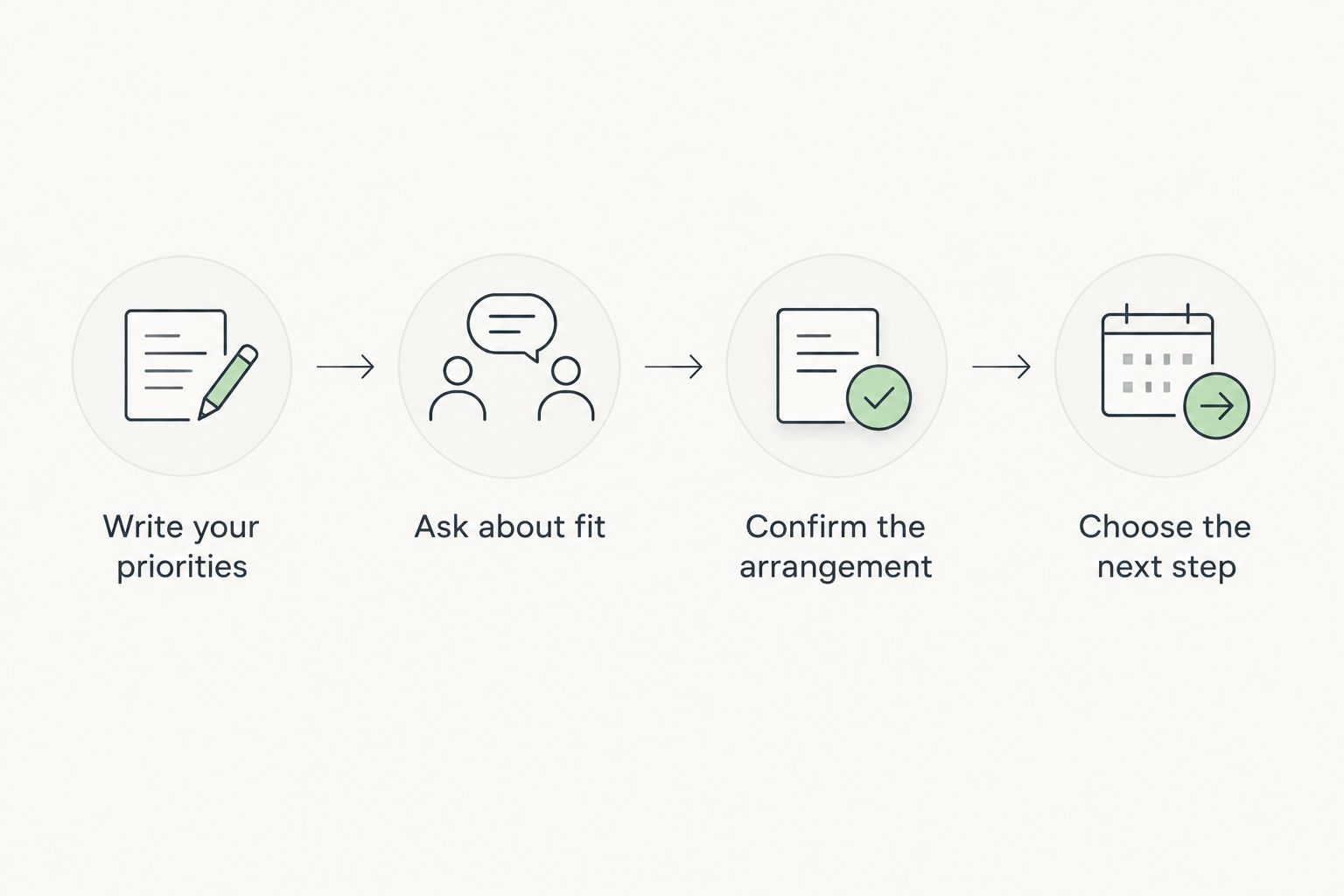
How to choose without restarting your search
Use the same criteria across every route. Otherwise, you end up comparing a directory’s search features with a practice’s services instead of comparing the clinicians who would provide your care.
Write your priorities
Write 3 priorities before contacting anyone: your main concern, who needs therapy, and your preferred format. Keep the description brief enough to use consistently in each inquiry.
For example, a parent seeking help for a teen’s anxiety should ask about teen counseling experience, not simply whether the practice lists anxiety. A couple should ask about couples work rather than assuming individual counseling experience answers the relationship question.
Ask about fit
Prepare 4 questions for the practice or clinician:
- Do you work with people facing the concern I have described?
- What approach do you use for this concern, and how would you explain it?
- How do you establish goals and review progress?
- What should I understand about session format, confidentiality, and insurance participation?
These questions are a conversation guide, not a diagnostic test. Listen for answers that address your situation rather than repeating the profile’s wording. If an answer leaves you uncertain, ask for clarification before deciding.
Confirm the arrangement
Compare 2 routes only when they resolve different needs—for example, a direct local practice inquiry and an insurance-directory search. Check that the session format works for you and that any coverage requirement has been answered.
For child or teen counseling, ask how caregiver involvement works and how confidentiality is explained. For couples or family therapy, ask how the clinician structures participation and goals. Do not assume the answers are identical across practices.
Choose the next step
Select the route that answers your most important question clearly. You do not need to prove that one directory is universally better than another; you need a defensible next step for your own care.
Keep your inquiry focused on information the recipient needs to assess fit. You can describe your concern without writing a detailed personal history into every website form.
When staying with Psychology Today is the right call
Stay with Psychology Today when you want to compare individual therapists across separate practices. That is a legitimate reason to use a directory. You do not need to switch simply because another search option exists.
If you have found profiles that address your concerns, contact those clinicians before starting over. Ask about experience, treatment approach, and the practical arrangements that matter to you. The profile is the introduction; the conversation is the next stage.
For your 2026 decision, judge the route by whether it produces useful answers. Stay with Psychology Today if it helps you build a relevant shortlist; switch when a different route better answers your next question.
FAQ
What’s the best Psychology Today alternative in Charlotte, NC?
Counselingcharlotte is a direct-practice alternative for Charlotte-area in-person or virtual mental health counseling. If insurance participation is your first requirement, begin with your health plan’s provider directory instead.
Is a local counseling practice better than Psychology Today?
A local counseling practice is better for asking directly about its clinicians and services; Psychology Today is better for comparing profiles across practices. Neither route establishes therapist fit without further discussion.
Can I find a Charlotte therapist without using a directory?
Yes, you can contact a counseling practice directly or ask your primary care clinician for a referral. You still need to discuss treatment experience, session format, and any insurance requirements with the individual provider.
Is TherapyDen an alternative to Psychology Today?
Yes, TherapyDen is another therapist directory, with an emphasis on inclusive search. Compare individual clinicians and confirm the details that matter to your care rather than choosing solely by directory brand.
How do I find a therapist who participates in my insurance network?
Start with your health plan’s provider directory, then confirm the exact clinician and plan with both the insurer and the practice. A listing alone does not settle your coverage questions.
What should I ask before choosing a therapist for my teen?
Ask about the clinician’s experience with teens and the specific concern your teen faces. Also ask how caregiver involvement, confidentiality, and treatment goals work.
Should I choose in-person or virtual therapy in Charlotte?
Choose the format after discussing your needs and the treatment arrangement with the clinician. Counselingcharlotte provides both in-person and virtual counseling, so you can ask about either format during your inquiry.
One last thing
The most useful alternative is not always another website. It can be a better question: What experience does this clinician have with the problem I want help addressing? Ask that before treating a polished profile, a directory listing, or a referral as a decision.
A search route should help you reach that conversation. It should not become the task that keeps you from having it.


