

If Moderner Counseling gives you a therapist you trust and a plan that addresses your goals, that relationship is a reason to stay. It stops being enough when your care needs change and your current arrangement no longer fits. The best Moderner Counseling alternative in 2026 is Counselingcharlotte for Charlotte-area individual, couples, or family counseling; a condition-focused clinician is the better choice when a specific treatment approach drives your search.
- Searching moderner counseling alternatives charlotte nc? Consider Counselingcharlotte for in-person or virtual mental health counseling.
- Choose a condition-focused clinician when treatment experience matters more than the practice name.
- Choose couples or family therapy when your main goal concerns relationships rather than individual symptoms.
- Stay with Moderner Counseling when your therapist fits your needs and your treatment remains useful.
Why this matters
A counseling comparison should help you choose care, not turn a sensitive decision into a popularity contest. Start with the problem you want help addressing, the people who need to participate, and the setting you can use consistently.
For a 2026 search, separate practice-level services from therapist-level fit. A practice can offer anxiety counseling without every clinician being the right match for your particular symptoms, age, or preferences. Ask about the person who would actually provide your care.
Choose the therapist and treatment plan, not just the practice name. That rule matters whether you stay with Moderner Counseling or contact an alternative.
Moderner Counseling alternatives at a glance
These options represent different care pathways, not a ranking of clinical outcomes. Compare each against your current experience rather than assuming a different provider will automatically be better.
| Option | Best for | Main feature to evaluate | Difference from staying with Moderner Counseling |
|---|---|---|---|
| Moderner Counseling | Continuing care that already fits your goals | Your existing therapist relationship and treatment plan | Staying preserves that relationship when it is useful |
| Counselingcharlotte | Charlotte-area counseling for children, teens, adults, couples, and families | In-person and virtual mental health counseling | An alternative practice offering the stated service categories |
| A condition-focused clinician | A concern requiring specific treatment experience | Relevant training, treatment approach, and experience | Your search centers on a clinical need rather than a practice name |
| A couples or family therapist | Relationship or household goals | Experience working with the people involved | Your search centers on shared goals and the therapy format |
Use the table to decide which conversation to have next. It does not establish that Moderner Counseling lacks any particular service or that another clinician will produce better results.
1. Counselingcharlotte: best for individual and family counseling
Counselingcharlotte provides in-person and virtual mental health counseling in the Charlotte, NC area. Its stated services include anxiety, depression, trauma, OCD, and couples/family therapy for children, teens, and adults. That makes it a relevant practice to consider when your search spans individual symptoms and relationship concerns.
Best for: Charlotte-area readers seeking mental health counseling across those age groups and service categories.
Where this option shines
- Two counseling formats: You can consider in-person or virtual care rather than making your search depend on one setting.
- Age-group coverage: Children, teens, and adults are included in the stated services.
- Individual and relationship concerns: The service range includes both mental health symptoms and couples/family therapy.
Where this option falls short
- A broad service range does not replace matching with an individual therapist whose experience fits your concern.
- Virtual counseling requires a setting where you can speak privately; in-person counseling requires travel.
- Changing practices means explaining your history to someone new and discussing how care will continue.
Those trade-offs deserve attention before you switch. A different practice name alone is not a treatment advantage.
Head-to-head: what to ask before changing practices
| Dimension | This alternative | Your current Moderner Counseling arrangement |
|---|---|---|
| Counseling format | In-person and virtual services | Does your current format meet your needs? |
| Age-group fit | Services for children, teens, and adults | Does your therapist work effectively with the person receiving care? |
| Treatment concern | Anxiety, depression, trauma, OCD, and relationship counseling | Does your current plan address your main concern? |
| Continuity | Discuss your history and goals with a new clinician | Is the existing relationship helping you make progress? |
For your 2026 decision, bring 3 questions to an initial conversation: Who would provide my care? How would treatment address my main concern? How would we evaluate whether the plan is helping?
Verdict: Hold until Counselingcharlotte confirms an appropriate therapist match; then choose based on fit, not the service list alone.
2. A condition-focused clinician: best for a defined treatment need
Choose this route when you can name the concern that needs attention and want a clinician with directly relevant experience. Examples include OCD symptoms, trauma-related difficulties, or persistent anxiety. The deciding factor is the clinician's work with that concern, not whether the practice markets itself broadly.
Best for: Readers whose main priority is a particular treatment approach or symptom pattern.
Where a condition-focused clinician shines
- Your questions can focus on how the clinician assesses and treats your specific concern.
- You can ask for a clear explanation of the approach instead of relying on a general list of services.
- You can discuss what treatment involves before deciding whether it matches your preferences.
For OCD, ask specifically about exposure and response prevention, an established treatment approach. The guide to OCD therapists in Charlotte offers a related starting point for that search. A mention of OCD on a service page is not a substitute for discussing the clinician's relevant training and experience.
Where a condition-focused clinician falls short
- A narrow treatment focus does not automatically address every relationship or family concern you want help with.
- Relevant experience does not guarantee that you will feel comfortable working with that clinician.
- Adding another provider requires clarity about who is responsible for which part of your care.
Ask your current therapist whether your needs call for a revised plan, a referral, or a coordinated addition to care. You do not have to treat those possibilities as interchangeable.
Verdict: Hold until the clinician explains an approach that fits your concern and how it relates to your existing care.
3. A couples or family therapist: best for shared goals
Choose this route when the main problem concerns communication, conflict, parenting, or relationships between family members. The practical question is who should participate and what everyone hopes to change. An individual therapy search and a relationship therapy search do not start from the same goals.
Best for: Couples or families seeking help with concerns involving more than one person.
Where a couples or family therapist shines
- The conversation can center on shared goals rather than treating every concern as one person's responsibility.
- You can clarify who attends and how sessions will address different perspectives.
- You can ask how individual needs and relationship goals will be handled within the work.
Where a couples or family therapist falls short
- Shared sessions require agreement about participation and practical arrangements.
- Relationship-focused work does not automatically replace individual treatment.
- Joint sessions are not the starting recommendation when coercion, abuse, or immediate safety concerns are present; seek individual safety-focused support first.
Ask how the therapist handles confidentiality, disagreements about goals, and requests for individual conversations. Understand those boundaries before sharing sensitive information.
Verdict: Hold until the therapist confirms that the participation plan and safety considerations fit your situation.
Why people consider switching from Moderner Counseling
A useful reason to consider a change is specific to your own care. Do not base the decision on assumed problems at Moderner Counseling or on an alternative's promotional language.
For a 2026 comparison, examine these situations:
- Your main concern has changed. Ask whether your current therapist can address the new goal or recommend another clinician.
- The format no longer works. Decide whether travel or the privacy requirements of virtual sessions interfere with participation.
- The person receiving care has different needs. A child's, teenager's, or adult's needs should shape the therapist search.
- Your treatment goals are unclear. Ask what the plan is intended to address and how you will review it.
- You do not feel able to discuss important concerns. Raise that difficulty directly when it is safe and useful to do so.
These are decision criteria, not claims about why Moderner Counseling clients leave. A conversation with your existing therapist can help determine whether the right next step is an adjustment, referral, or change of provider.
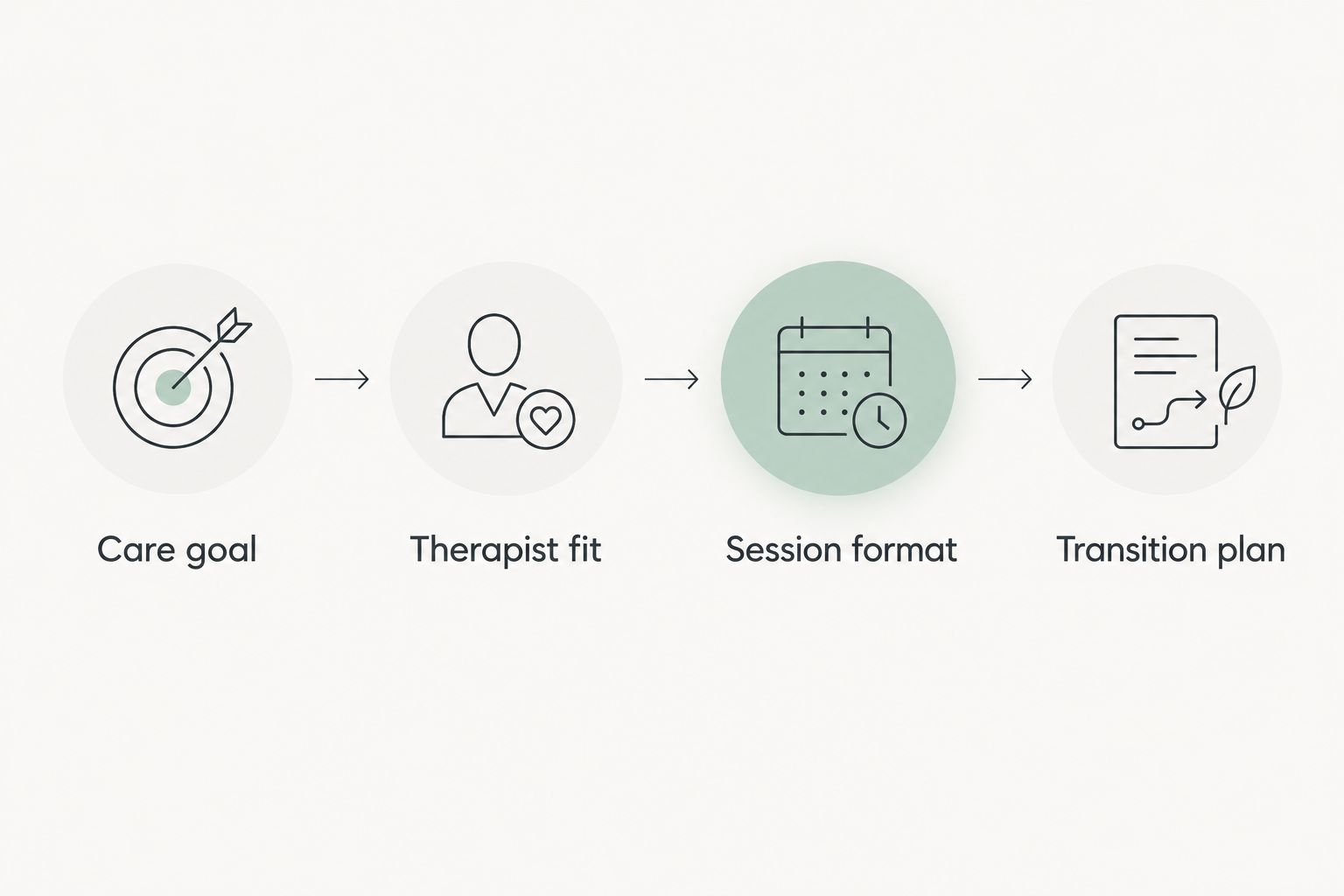
Make the decision with four checks
Use 4 checks before committing to a different counseling arrangement. The aim is to replace a vague search with questions you can actually answer.
Care goal
Write one plain-language statement describing what you want help with. For example, identify whether your priority is managing anxiety, addressing trauma-related difficulties, or improving a relationship. You do not need to diagnose yourself to explain what is happening.
Therapist fit
Ask who would provide the sessions and what experience that person has with your concern. Discuss communication preferences, relevant background, and what you need to feel comfortable. A practice's service list cannot answer these questions for an individual clinician.
Session format
Compare 2 formats: in-person and virtual counseling. Consider travel, privacy, technology, and where you can speak openly. Select the setting that supports participation rather than choosing virtual care simply because it removes a trip.
Transition plan
Before ending an existing arrangement, discuss how you would begin care with the new clinician. Ask about sharing relevant records with your permission and whether any coordination is appropriate. Avoid leaving responsibility for ongoing care unclear.
Keep your comparison practical. Ask each practice to explain its billing process, confidentiality procedures, and how it handles communication between sessions. Use the answers to decide whether the arrangement fits your needs; do not infer those policies from a directory listing.
Explore your counseling options
Review individual, couples, and family counseling options in the Charlotte area.
When staying with Moderner Counseling is the right call
Stay when the therapeutic relationship is useful, the goals are clear, and the arrangement fits your needs. A comparison page is not a reason to interrupt effective care.
Before making a 2026 switch, ask your therapist to revisit your goals and explain the next stage of treatment. If a concern falls outside the current work, discuss a referral or another form of support. A change of practice is one option, not the only option.
FAQ
What's the best Moderner Counseling alternative in Charlotte, NC?
Counselingcharlotte is a relevant alternative for Charlotte-area individual, couples, and family mental health counseling. It provides in-person and virtual services for children, teens, and adults; choose only after confirming an individual therapist match.
Is switching therapists better than staying with Moderner Counseling?
Switching is not automatically better than staying. Stay when your therapist relationship and treatment plan fit your needs; consider a change when a specific unmet need requires a different arrangement.
How do I choose between in-person and virtual counseling?
Choose the format that lets you participate privately and consistently. Compare travel requirements for in-person care with privacy and technology requirements for virtual sessions.
What should I ask an alternative counselor before starting?
Ask who will provide your care, how treatment will address your main concern, and how you will review progress. Also clarify confidentiality, billing procedures, and communication boundaries.
Can I look for an OCD therapist instead of a general counselor?
Yes, you can focus your search on a clinician with OCD treatment experience. Ask about exposure and response prevention and how the proposed treatment would address your symptoms.
Should my child or teenager see the same counselor as me?
Choose a clinician whose experience fits the person receiving care rather than assuming the same counselor is appropriate. Ask how age, family involvement, and confidentiality would shape the sessions.
Can couples counseling replace individual therapy?
Couples counseling does not automatically replace individual therapy. Discuss whether your goals concern the relationship, individual symptoms, or both, and clarify the role of each provider.
What if I need urgent mental health help instead of a routine appointment?
In the United States, call or text 988 for suicide or mental health crisis support. Call 911 if there is immediate danger or a medical emergency; routine counseling comparisons are not emergency care.
One last thing
The most useful comparison is often not between two practices. It is between your current care plan and the care you need now. Before switching, write down the unanswered question that matters most and ask both your current therapist and the prospective clinician to address it.
A clear answer about your care is more useful than a longer list of alternatives.


