

Choose Clear Creek Counseling if you want in-person or virtual counseling for yourself, your child, or your family in the Charlotte area; choose LifeStance Health if you want to consider psychotherapy and psychiatric medication services within a national outpatient organization. This 2026 comparison separates those care needs so you can choose a clinician, not just a company name.
- Clear creek counseling vs lifestance health comes down to local counseling needs versus access to therapy and psychiatry.
- Clear Creek Counseling is a strong fit for Charlotte-area individual, couples, and family counseling.
- LifeStance Health is the better starting point when psychiatric medication services are central to your search.
- Both offer in-person and virtual care; confirm the individual clinician’s specialty, insurance participation, and appointment format.
Why this matters
A counseling search and a medication search are not the same decision. Psychotherapy addresses concerns through therapeutic work with a clinician. Psychiatric medication care requires an appropriately authorized prescriber; booking a therapy appointment does not automatically arrange that service.
For your 2026 search, begin with the problem you want help addressing. The Clear Creek Counseling practice description identifies anxiety, depression, trauma, OCD, and couples and family therapy for children, teens, and adults in the Charlotte area. That makes it a relevant starting point for those counseling needs, without establishing which individual clinician is the right match.
LifeStance Health provides outpatient mental health services that include psychotherapy and psychiatry. Its broader service mix matters when medication evaluation belongs in your care plan, but the organization’s name alone does not establish a particular provider’s clinical fit.
At a glance
| Dimension | Clear Creek Counseling | LifeStance Health |
|---|---|---|
| Best for | Charlotte-area individuals, couples, and families seeking counseling | People seeking therapy, psychiatric services, or both |
| Geographic focus | Charlotte, NC area | National outpatient organization; select a relevant location and clinician |
| Appointment format | In-person and virtual counseling | In-person and virtual mental health care |
| Counseling scope | Anxiety, depression, trauma, OCD, couples and family therapy | Psychotherapy; confirm the individual clinician’s specialty |
| Children and families | Counseling for children, teens, and adults, including couples and families | Child, adolescent, and adult services; confirm family or couples work with the clinician |
| Medication evaluation | Arrange an appropriately authorized prescriber if medication evaluation is needed | Psychiatry is part of the organization’s service mix |
| Standout feature | Explicit Charlotte-area counseling focus across ages and relationship needs | Therapy and psychiatric services within one organization |
| Pricing model | Confirm session billing, insurance participation, and payment terms | Confirm appointment billing, insurance participation, and payment terms |
The table identifies service fit, not treatment quality. Neither practice name proves that a clinician has the training, approach, or therapeutic relationship you need. Use the comparison to narrow your inquiry, then evaluate the person who would actually provide care.
Clear Creek Counseling is the clearer local counseling fit
Best for: Charlotte-area residents whose main goal is counseling. The practice explicitly serves local children, teens, adults, couples, and families through in-person and virtual appointments. That description directly matches a search for counseling in Charlotte.
LifeStance Health’s national footprint serves a different selection need: you begin with an organization operating across multiple markets, then narrow to the relevant clinician and location. National reach is not evidence of better therapy, just as a local focus is not evidence of a better therapeutic relationship.
For a local counseling search, ask practical questions before comparing organizational size:
- Where would your in-person appointments take place?
- Does the prospective clinician work with your age group and concern?
- Which appointment format would support consistent attendance?
- Who would provide follow-up if your care needs change?
The local option’s strength is the direct match to a stated Charlotte counseling need. Its limitation is equally important: that practice description does not establish a medication service or prove the suitability of every clinician.
LifeStance Health is the better starting point for psychiatry
Best for: people specifically seeking a psychiatric evaluation or medication management. Psychiatry is part of LifeStance Health’s service mix, making it the more direct organizational match when prescribing care is central to your search.
Do not confuse access to both service categories with a coordinated treatment plan. A therapist and a prescriber have different responsibilities, and being within one organization does not establish how those clinicians communicate about your care.
Before booking, ask whether you are arranging psychotherapy, a psychiatric evaluation, or another appointment type. Also ask how communication works if you see separate clinicians. Your consent, the providers’ roles, and their actual coordination process matter more than whether their billing carries the same organization name.
The tradeoff is specificity. A broad organization offers multiple service categories, but you still need to identify the right professional for your concern. Choose the service you need before choosing the organization that houses it.
Both support in-person and virtual care
Best for: people choosing an appointment format around privacy and attendance. Both options offer in-person and virtual care, so format alone does not decide this comparison.
Virtual therapy removes the trip to an office, but it still requires a setting where you can speak privately. An in-person appointment provides a separate clinical setting but requires travel. Neither format wins simply because it sounds more convenient.
For your 2026 decision, picture an ordinary appointment day rather than an ideal one. Consider work, school, transportation, caregiving, and whether someone else can overhear you at home. If you expect to alternate formats, ask the specific clinician whether that arrangement is possible rather than assuming it follows from an organization offering both.
For a child or teen, discuss caregiver involvement and privacy before the appointment. The right arrangement should support the clinical work, not merely fit an open space in the family calendar.
Both offer therapy; the clinician decides the specialty fit
Best for: people seeking psychotherapy for a defined concern. Both organizations offer therapy, but that shared category does not establish identical methods or clinician expertise.
For anxiety, depression, trauma, or OCD, describe what you experience and what it disrupts. Difficulty sleeping, avoiding school, repeated checking, relationship conflict, and intrusive thoughts call for more specific discussion than asking whether someone treats stress.
Ask 3 questions when you contact a prospective therapist:
- How do you assess the concern I am describing?
- What treatment approach would you consider, and why?
- How would we review whether treatment is helping?
These questions do not require you to diagnose yourself. They help you hear whether the clinician can explain a plan in plain language. A useful answer connects your concern, the proposed work, and a way to review progress without promising a guaranteed outcome.
For an OCD-focused search, the guide to OCD therapists in Charlotte, NC provides a more targeted comparison than a general provider search.
Clear Creek Counseling explicitly includes couples and family work
Best for: people whose treatment goal concerns a relationship or family system. Couples and family therapy appear directly in the practice description, making the practice a clear option to investigate for that type of counseling.
Individual therapy and relationship therapy are not interchangeable appointments. Before booking, explain who wants to attend and what you want to address. Ask the prospective clinician how they structure participation and handle communication outside sessions.
For a child or teen, clarify whether you are seeking individual treatment with caregiver involvement, family therapy, or help with a relationship concern. Those requests overlap, but they do not describe the same work.
LifeStance Health also serves children, adolescents, and adults. For couples or family treatment, confirm that the specific clinician provides the requested service rather than treating a broad age range as proof of relationship-therapy expertise. The same clinician-level check applies to the local practice.
Compare billing terms, not a presumed price advantage
Neither organization wins on cost without your actual billing details. For a 2026 comparison, establish the appointment type, clinician, insurance arrangement, and payment terms before treating either option as the more affordable choice.
Ask whether care is billed by appointment and whether different appointment types have different billing arrangements. If you plan to use insurance, verify the specific clinician and service with both the practice and your insurer. Organization-level participation is not a substitute for checking your own benefits.
Use this billing checklist with either option:
- Insurance: Is the particular clinician in network for your plan?
- Service: What type of appointment are you booking?
- Responsibility: What payment obligations apply under your arrangement?
- Policies: What cancellation and missed-appointment terms apply?
- Documentation: What billing documentation can the practice provide?
For self-pay care, ask for the written payment terms. For insurance-based care, ask how benefits and claims are handled. Predictability comes from understanding the arrangement, not assuming that a local practice or a national organization has the simpler model.
Make the choice with a short care brief
Before contacting either organization, write 1 short summary of what brings you to care. Include the person seeking treatment, the main concern, and the appointment format you can realistically attend. You do not need a polished history or a diagnosis.
Then write 2 treatment goals in ordinary language. Examples include participating in school without avoiding feared situations or discussing conflict without the conversation immediately breaking down. These are examples to adapt, not promises about treatment results.
Use the same decision sequence for both options:
- Care need: Identify whether you want counseling, prescribing care, or an assessment of what fits.
- Clinician fit: Ask about the person’s experience with your concern and age group.
- Practical fit: Confirm format, location, billing, and communication expectations.
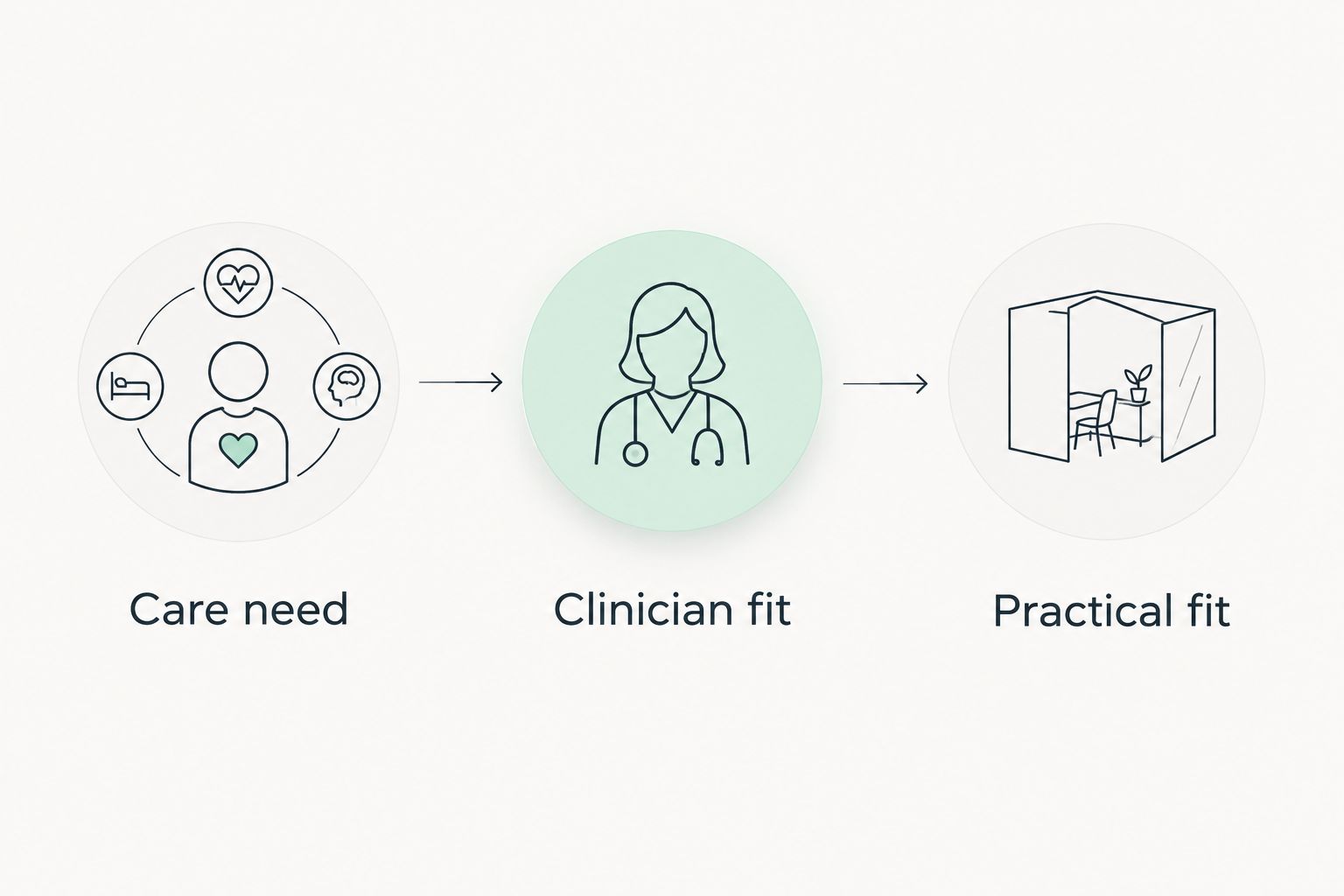
A clear explanation of treatment is useful evidence of fit. A familiar organization name is not a replacement for that conversation. If the proposed service does not match your goal, ask for clarification before proceeding.
Final verdict for 2026
Choose Clear Creek Counseling if your priority is local counseling
Named profile: the Charlotte counseling seeker. You want in-person or virtual therapy for yourself, a child, a teen, a couple, or a family, and your concern matches the practice’s stated counseling scope. Start here, then confirm the individual clinician’s suitability and practical arrangements.
Choose LifeStance Health if your priority includes psychiatry
Named profile: the therapy-and-medication seeker. You want an organization whose service mix includes psychiatric care as well as psychotherapy. Start here, then confirm the appointment type, the clinician’s role, and how separate providers would communicate if both services are involved.
| Dimension | Winner |
|---|---|
| Charlotte-focused counseling search | Clear Creek Counseling |
| National organizational reach | LifeStance Health |
| In-person versus virtual choice | Tie at the service-format level |
| General psychotherapy fit | Tie; assess the individual clinician |
| Explicit couples and family counseling scope | Clear Creek Counseling |
| Psychiatry as a stated organizational service | LifeStance Health |
| Standout service match | Local counseling versus therapy and psychiatry |
| Billing and payment fit | Determine from your clinician, service, and plan |
FAQ
Is Clear Creek Counseling better than LifeStance Health in 2026?
Clear Creek Counseling is the more direct fit for a Charlotte-area counseling search, while LifeStance Health is the better starting point when psychiatric services are central. The individual clinician’s expertise and your practical arrangements still determine the final fit.
Which option should I choose if I need medication?
LifeStance Health is the more direct starting point because its services include psychiatry. Confirm that you are booking with an appropriately authorized prescriber rather than assuming a therapy appointment includes medication evaluation.
Can I get virtual therapy with either option?
Both options offer virtual and in-person care. Confirm the format with the specific clinician and discuss whether your home setting provides enough privacy for treatment.
Which option is better for a child or teen?
Choose the clinician whose experience and approach match the child or teen’s needs, rather than choosing by organization name alone. Both serve younger age groups; ask how caregivers participate and how privacy is handled.
What should I ask before booking couples counseling?
Ask whether the specific clinician provides couples therapy and how they structure participation and communication. Serving adults individually does not by itself establish experience treating couples.
How do I compare the cost of therapy between these options?
Compare the billing terms for your specific clinician, appointment type, and insurance arrangement. Verify benefits with your insurer and request the practice’s payment and cancellation terms before booking.
What if I am unsure whether I need therapy or psychiatry?
Describe your symptoms and goals to a qualified mental health professional and ask what assessment or service fits. Do not assume that needing help automatically means you need medication, or that counseling alone addresses every care need.
One last thing
Ask what would make the clinician recommend a different kind of care. That question tests whether the conversation covers the limits of the proposed service, not just its benefits. A useful treatment discussion includes what the clinician can address and when another professional’s involvement belongs in the plan.


