

Choose Clear Creek Counseling if you want Charlotte-area counseling for yourself, your child, or your family, with in-person and virtual options; choose Thriveworks if you want to search a national provider network or explore counseling alongside psychiatric care. This 2026 comparison separates those service differences from the clinician-level questions that should decide where you book.
- Clear Creek Counseling vs Thriveworks comes down to Charlotte-focused counseling versus a national provider network.
- Thriveworks is the stronger starting point when your search includes psychiatric care, subject to local clinician services.
- Both offer in-person and virtual therapy; the individual clinician matters more than the appointment format.
- Compare relevant experience, treatment approach, and billing terms before choosing either provider.
Why this matters
A provider name does not tell you whether a particular therapist treats your concern, works with your age group, or offers the approach you need. Those details determine whether an appointment is a useful next step.
Clear Creek Counseling is a direct starting point for Charlotte-area children, teens, and adults seeking individual, couples, or family counseling. Thriveworks offers a broader search across a national network, including counseling and psychiatric services. Broader reach and local focus solve different problems; neither establishes better clinical results.
For a 2026 therapy search, separate organizational convenience from clinical fit. First identify the service you need. Then evaluate the person who would actually provide it.
At a glance
| Dimension | Clear Creek Counseling | Thriveworks |
|---|---|---|
| Best for | Charlotte-area individuals, couples, and families seeking counseling | People searching a national network for counseling or psychiatric care |
| Geographic reach | Charlotte, NC area | National provider network; services depend on state and clinician |
| Appointment format | In-person and virtual counseling | In-person and online services; confirm the individual clinician's format |
| Age and household needs | Children, teens, adults, couples, and families | Check each clinician's age range and individual, couples, or family services |
| Counseling concerns | Anxiety, depression, trauma, OCD, and relationship or family concerns | Match your concern to an individual clinician's stated experience |
| Standout service distinction | Explicit Charlotte-area counseling scope across age groups and family needs | Counseling and psychiatric services within a broader network |
| Clinician fit | Assess the assigned or selected therapist's experience and approach | Assess the selected therapist's experience and approach |
| Pricing model and billing | Confirm session billing, insurance arrangements, and administrative terms directly | Confirm session billing, insurance arrangements, and administrative terms directly |
Charlotte-focused counseling favors the local practice
A defined local service area gives you a straightforward starting point when you want counseling in Charlotte. You can ask about the actual office, the therapist you would see, and whether that person's work matches your concern.
That is the local practice's clearest advantage: its stated services directly match a Charlotte-area search for children, teens, adults, couples, and families. You do not need a national search if your goal is to establish care near home.
The limit is equally clear. A Charlotte-area service description does not establish that counseling can continue when you are physically outside North Carolina. For virtual care, confirm that the clinician is authorized to treat you in the state where you will attend.
Best for: A Charlotte resident who wants a local counseling relationship rather than a search across multiple markets. Before booking, confirm the specific office and clinician instead of treating the service area as a substitute for those details.
Thriveworks wins on geographic reach
Thriveworks is the stronger starting point when geographic breadth is part of your search. Its national network gives you a way to investigate providers across different locations rather than beginning with a Charlotte-focused practice.
That matters if you are planning a move or helping family members search in different states. It does not mean the same clinician can treat everyone, or that your therapist can automatically continue care after you relocate.
A national organization also does not make its clinicians interchangeable. A therapist's license, clinical experience, appointment format, and treatment approach still require an individual check.
Best for: Someone whose search extends beyond Charlotte or includes a possible interstate move. Ask about care in the destination state before treating a national footprint as continuity of care.
Both offer in-person and virtual therapy
Neither provider wins merely by offering 2 appointment formats. In-person and virtual counseling are delivery settings, not separate guarantees of treatment quality.
An office appointment gives you a setting outside your home. Virtual counseling removes the trip, but you still need a private place where you can speak openly. For children or family sessions, ask how the therapist structures participation in either setting.
Do not assume that an organization offering both formats means your chosen therapist offers both. Also confirm whether switching formats means staying with the same clinician.
Verdict: Tie on format choice. Choose the arrangement you can attend consistently and discuss honestly. If your home does not allow private conversation, convenience alone is not a sufficient reason to choose virtual sessions.
The local practice makes its age and family scope explicit
The Charlotte practice explicitly provides counseling for children, teens, and adults, along with couples and family therapy. That makes it a direct starting point when you already know who needs to participate.
The advantage is clarity, not proof of better treatment. A practice serving children does not mean every clinician works with every developmental stage. Couples counseling and family therapy also require different arrangements from an individual adult appointment.
With Thriveworks, evaluate the individual clinician's listed services rather than assuming that network membership answers these questions. Identify the relevant age group and session type before comparing therapist profiles.
Best for: Parents or households who want to begin with a practice that explicitly includes their type of counseling. Ask who attends the first meeting, how caregiver involvement works, and how confidentiality is explained to younger clients.
Neither provider wins on a diagnosis label alone
Anxiety, depression, trauma, and OCD are included in the local practice's stated counseling services. Those categories help you start a search, but a category label does not establish the approach an individual therapist uses.
The same standard applies to Thriveworks. Look beyond a profile's list of concerns and ask what treatment would involve for someone with your symptoms and goals.
For OCD, for example, ask whether the clinician provides exposure and response prevention, commonly called ERP. For trauma-related concerns, ask how the therapist assesses readiness, explains treatment choices, and responds when sessions become difficult. These are questions about clinical fit, not reasons to assume a particular service is offered.
Verdict: No organization-level winner on treatment approach. A useful answer explains what you would work on, why that approach fits, and how you would assess progress together. For a more focused search, see the guide to OCD therapists in Charlotte.
Thriveworks wins when psychiatric care is part of the search
Thriveworks includes psychiatric services as well as counseling. That makes it the stronger starting point of these two options when you specifically want to investigate medication evaluation or management alongside therapy.
Psychiatric care and counseling are different services. Do not assume that booking a therapist also establishes a relationship with a prescribing clinician, or that both appointments happen through the same person.
Ask which services the relevant clinician provides, whether separate appointments are needed, and how information is shared with your consent. If you already have a prescriber, ask how a prospective therapist would coordinate with that existing care.
Best for: Someone whose search explicitly includes both psychotherapy and psychiatric assessment. This service distinction does not establish that medication is appropriate for you; that decision belongs in an individual clinical evaluation.
Both require the same clinician-fit check
A provider comparison should end with a clinician comparison. Your actual care comes from a person, not from the breadth of an organization's service list.
Use these 3 questions with either option:
- Relevant experience: Have you worked with people in my age group who have concerns like mine?
- Treatment approach: What would treatment focus on, and how would you explain the options?
- Progress review: How will we decide whether counseling is helping and discuss a change if it is not?
Listen for answers that connect to your situation. A clear explanation is more useful than a long list of techniques without a reason for choosing among them.
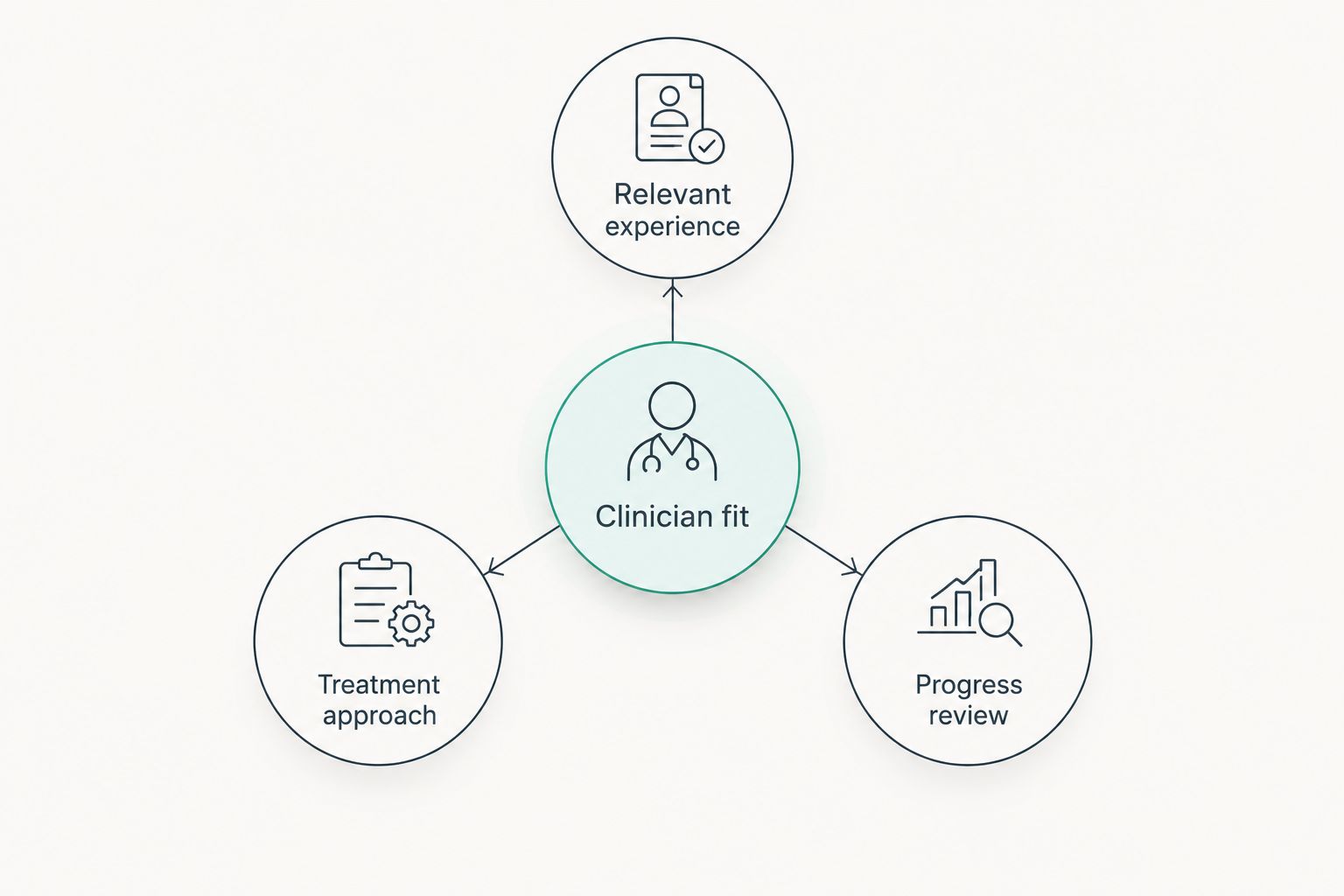
Verdict: Tie on the need for individual assessment. Neither a local address nor a national network replaces this conversation. You can prefer an organization's structure and still decide that a particular therapist is not the right match.
Pricing and billing: compare the same terms
For your 2026 comparison, evaluate the full billing arrangement rather than comparing organizations by name. Confirm how sessions are billed, whether insurance is involved, and which administrative terms apply to your appointment.
Ask both providers the same questions:
- Will this specific clinician bill my insurance plan, or would I pay directly?
- What will I be responsible for under my particular benefits?
- Are individual, couples, and family appointments handled differently?
- What are the cancellation and missed-appointment terms?
- Does changing the appointment format change the billing arrangement?
Insurance participation and your benefits are separate questions. When using insurance, confirm the clinician's status and your coverage with the appropriate parties before relying on an estimate.
Verdict: No blanket billing winner. Predictability comes from understanding the terms for your appointment. Flexibility matters only if the arrangement also fits how you intend to use care.
Final verdict: choose the service scope you actually need
Choose the Charlotte practice if you are a local individual or household
You live in the Charlotte area and want counseling for yourself, your child, your relationship, or your family. The practice's stated service scope matches that search directly, with both office-based and virtual counseling.
Your winner: Clear Creek Counseling, provided the individual clinician's experience, approach, and appointment arrangements fit your needs. The strongest reason to choose it is the match between its stated local counseling services and your actual goal—not an unsupported claim that local care is always better.
Choose Thriveworks if you need a broader search or psychiatric services
You want to investigate providers across locations, or your search includes psychiatric care as well as counseling. Thriveworks gives you a broader organizational starting point for those needs.
Your winner: Thriveworks, provided the relevant clinician offers the service you need and is authorized to treat you where you will attend. The tradeoff is that network breadth still leaves you with an individual matching decision.
One-glance scorecard
| Dimension | Winner |
|---|---|
| Charlotte-focused counseling search | Local practice |
| Geographic reach | Thriveworks |
| In-person and virtual options | Tie; confirm the clinician's formats |
| Explicit local age and family scope | Local practice |
| Diagnosis-specific treatment approach | Clinician-level decision |
| Psychiatric services search | Thriveworks |
| Clinician fit | Tie; assess individually |
| Pricing and billing | Appointment-specific decision |
FAQ
Is Clear Creek Counseling better than Thriveworks in 2026?
Clear Creek Counseling is the more direct starting point for Charlotte-focused counseling; Thriveworks is the stronger starting point for a national search or psychiatric services. Neither organizational difference establishes better clinical outcomes.
Do both providers offer online and in-person therapy?
Both offer in-person and virtual therapy. Confirm the formats offered by the individual clinician and whether you can change formats without changing therapists.
Which option should I consider for my child or teenager?
Start with a clinician who works with your child's age group and concern. Ask about caregiver participation, confidentiality, and how treatment goals will be explained to your child.
Can I find counseling and medication management through Thriveworks?
Thriveworks offers counseling and psychiatric services. Confirm which services the relevant clinicians provide, whether separate appointments are required, and how they coordinate care.
How should I compare therapy costs between these providers?
Compare the billing terms for the actual clinician and appointment type you intend to use. Confirm insurance participation, your benefits, direct-payment arrangements, and cancellation terms rather than relying on an organization-wide assumption.
Can I keep seeing a virtual therapist after moving out of North Carolina?
You must confirm that the clinician is authorized to treat you in the state where you will be physically located. A national network or an existing therapeutic relationship does not by itself establish that authorization.
What should I ask before booking therapy for OCD?
Ask whether the individual clinician provides exposure and response prevention and how they assess OCD. A profile that lists OCD does not, by itself, explain the treatment approach.
One last thing
Before you end your 2026 search, write down what you want help doing differently in daily life. Bring that description to the first conversation and ask the therapist to connect it to a treatment plan.
That answer tells you more than another comparison of organization names. You are choosing a working relationship with a clinician, not simply selecting a provider directory entry.


