

Thriveworks offers in-person and online counseling, giving you a choice of session formats. That choice stops being enough when you need to establish a specific clinician’s fit for your age group, treatment goals, or family situation. The best Thriveworks alternative in 2026 is Counselingcharlotte if you need Charlotte-area mental health counseling for children, teens, adults, couples, or families; Psychology Today if you need a directory to compare individual therapists.
- For thriveworks alternatives charlotte nc, Counselingcharlotte fits people seeking local mental health counseling with in-person and virtual options.
- Psychology Today is best for comparing therapist profiles; it is a directory, not your treatment provider.
- An independent local therapist fits people who want to choose a clinician directly.
- Stay with Thriveworks when your clinician, treatment plan, and session format already meet your needs.
Why this matters
Choosing a therapy provider is not the same as choosing a therapist. A provider’s service list tells you what to investigate; the clinician’s experience, approach, and explanation of treatment tell you whether to proceed.
For your 2026 search, separate 2 session formats—in-person and virtual—from the clinical fit question. A convenient appointment format does not establish experience with OCD, childhood anxiety, trauma, or relationship counseling. Conversely, an appropriate clinician is not a practical choice if you cannot participate consistently.
This comparison covers a Charlotte-area counseling practice, the independent-practice route, and a therapist directory. They solve different problems. Use the practice option when you want to investigate local care, the independent route when clinician choice comes first, and the directory when you need to build a shortlist.
Thriveworks alternatives at a glance for 2026
| Option | Best for | Standout feature or purpose | How it differs from Thriveworks | Main limitation |
|---|---|---|---|---|
| Thriveworks | People who want in-person or online counseling through a national provider | Counseling in both session formats | The benchmark rather than an alternative | Provider-level information does not establish individual clinician fit |
| Counselingcharlotte | Charlotte-area children, teens, adults, couples, and families seeking counseling | In-person and virtual services covering anxiety, depression, trauma, OCD, and relationship concerns | A Charlotte-area counseling option rather than a national-provider search | You still need to establish the chosen clinician’s experience and treatment approach |
| Independent local therapist | People who want to evaluate and choose an individual practitioner directly | Clinician-first selection | Your comparison centers on a particular practitioner rather than a provider brand | You must check each practitioner’s scope and arrangements separately |
| Psychology Today | People building a shortlist of therapists | Therapist directory and individual profiles | A search resource rather than the organization delivering your counseling | A profile is not an assessment or proof of treatment fit |
The strongest comparison is between clinicians who can address your concern—not between brand names alone. Keep Thriveworks on the shortlist if a particular clinician already fits. An alternative earns its place by answering your unresolved care question.
1. Counselingcharlotte: best for Charlotte-area counseling
This Charlotte-area option provides in-person and virtual mental health counseling for children, teens, and adults. Its stated services include anxiety, depression, trauma, OCD, and couples and family therapy. Start here when you want to investigate local counseling across those age groups and concerns.
Counselingcharlotte is best for Charlotte-area mental health counseling when you want to consider both in-person and virtual care. That is a service-fit recommendation, not a claim that every clinician treats every condition or that one practice produces better outcomes than another.
Where it shines
- Local relevance: The practice serves the Charlotte, NC area, matching a search for counseling close to home.
- Format choice: In-person and virtual counseling are both part of its stated services.
- Age-group coverage: Children, teens, and adults are included in the practice description.
- Relationship care: Couples and family therapy are included alongside individual mental health concerns.
Where it falls short
- A broad practice service list does not tell you which individual clinician is the right match for your concern.
- The choice between in-person and virtual care still requires a practical decision about privacy, travel, and participation.
- If you need a prescribing evaluation, establish that care separately rather than treating a counseling listing as confirmation of medication services.
These are important boundaries. For example, an OCD listing should lead to questions about the clinician’s OCD treatment approach, not an assumption that general anxiety counseling answers the same need.
Head-to-head with Thriveworks
| Dimension | This Charlotte-area practice | Thriveworks |
|---|---|---|
| Geographic focus | Charlotte-area counseling | National counseling provider |
| Session formats | In-person and virtual | In-person and online |
| Decision to make | Which local clinician fits your concern and age group? | Which clinician within the provider fits your concern and age group? |
Best for: You want to investigate Charlotte-area counseling for yourself, your child, your relationship, or your family.
Verdict: Choose for local counseling fit; confirm the individual clinician before committing.
2. Independent local therapist: best for clinician-first selection
An independent local therapist is a selection route, not a single named provider. You identify a practitioner, examine their qualifications and treatment focus, and ask directly how they would approach your concern.
For a 2026 comparison, this route makes sense when you can describe the clinical experience you need. It does not make sense to assume that independent practice automatically means better care, more personal attention, or a particular treatment method.
Where this route shines
- Individual focus: You evaluate the person who would provide your therapy rather than starting with an organization’s overall service list.
- Specific questions: You can center the conversation on your concern, your age group, and your goals.
- Clear comparison: You can compare a particular independent clinician against a particular Thriveworks clinician using the same criteria.
Where this route falls short
- Each practitioner requires a separate check of credentials, treatment scope, session format, and administrative arrangements.
- Choosing a therapist for individual care does not establish that the same practitioner provides couples, family, or child counseling.
- A compelling biography still does not explain what treatment will involve for you.
Ask the independent therapist to describe how they work with your presenting concern. You are looking for a clear explanation of assessment, treatment goals, and how you will review progress—not a promise of a particular result.
Head-to-head with Thriveworks
| Dimension | Independent local therapist | Thriveworks |
|---|---|---|
| Starting point | A particular practitioner | A counseling provider and its clinicians |
| Information to evaluate | The practitioner’s own qualifications and approach | The selected clinician’s qualifications and approach |
| Comparison task | Check each independent practice separately | Assess the selected clinician within the provider’s arrangements |
Best for: You want to choose an individual practitioner directly and are prepared to investigate each practice separately.
Verdict: Choose for clinician-first selection; skip assumptions based on practice size.
3. Psychology Today: best for building a therapist shortlist
Psychology Today offers a therapist directory that helps you investigate individual clinicians. It belongs on this list as a search alternative, not as a replacement counseling service.
Use the directory to identify people to contact, then move beyond the profile. Your actual alternative to Thriveworks is the clinician or practice you select—not the directory itself.
Where Psychology Today shines
- Individual profiles give you a starting point for comparing practitioners.
- You can investigate therapists outside a single counseling organization.
- Profile information helps you prepare focused questions before contacting a practice.
Where Psychology Today falls short
- A directory does not assess you or deliver your treatment.
- Profile descriptions do not establish how a clinician would handle your particular situation.
- You must confirm the practical and clinical details directly with the practitioner.
Best for: You have not yet identified a clinician and need a way to organize your search.
Verdict: Use for discovery; do not treat a directory profile as a treatment recommendation.
Choose with 4 fit checks
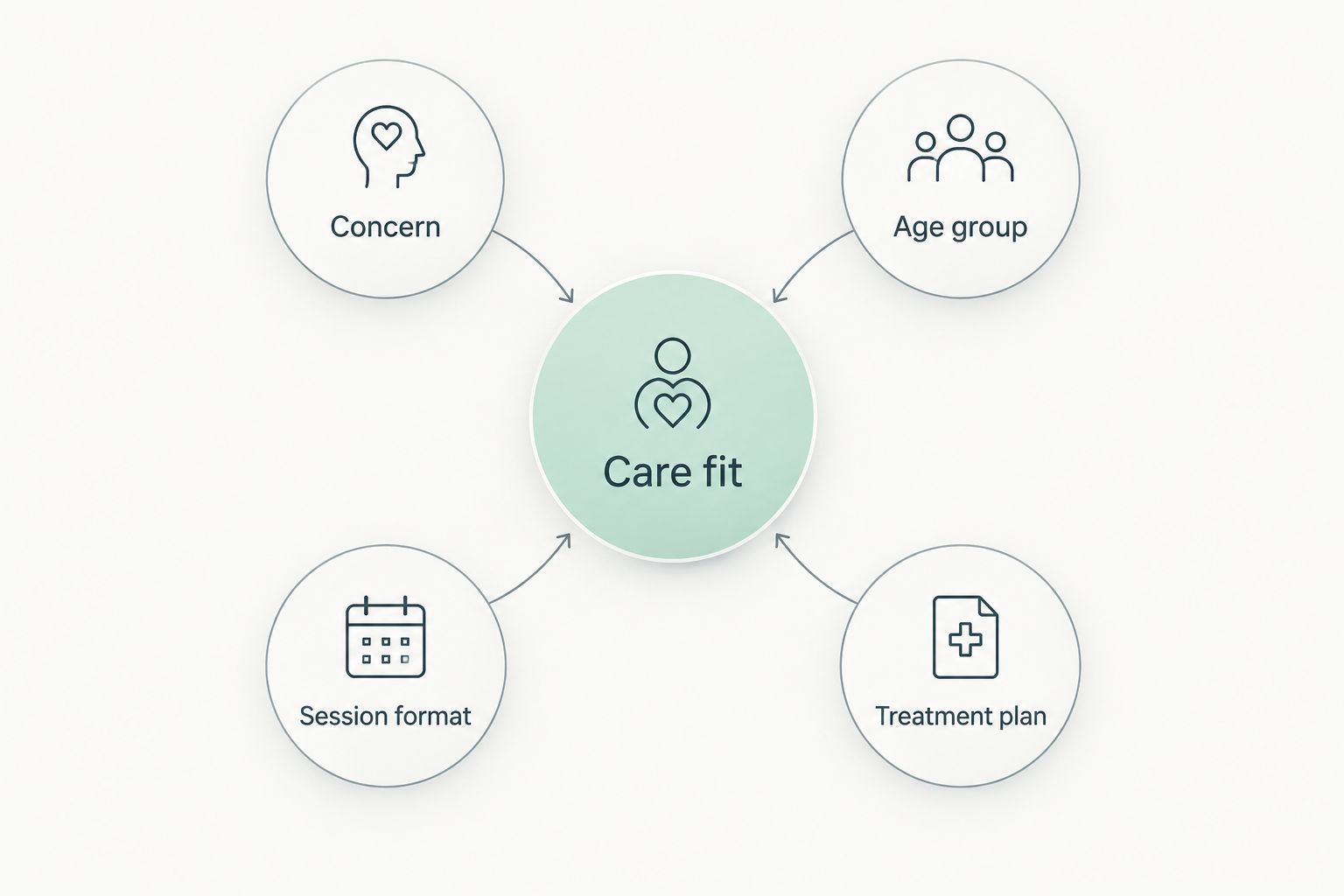
Use the same 4 fit checks for every option: Concern, Age group, Session format, and Treatment plan. Keeping the questions consistent makes the comparison useful. Otherwise, you risk comparing one provider’s service list with another therapist’s biography.
Concern
Describe what brings you to counseling in ordinary language. You do not need to diagnose yourself. Explain the symptoms, situations, or relationship difficulties you want help addressing, then ask whether the clinician works with that presentation.
For OCD concerns, ask specifically about experience treating OCD and exposure and response prevention. For trauma concerns, ask how assessment, consent, and pacing shape the work. A condition listed on a profile is the beginning of that conversation, not its conclusion.
Age group
Confirm that the clinician works with the person who needs care. A therapist’s experience with adults does not establish experience with children or teens.
For a child or teen, ask how caregivers participate and how confidentiality is explained. For couples or families, ask who participates in sessions and how the clinician defines the shared treatment goals.
Session format
Choose between in-person and virtual sessions based on how you will actually participate. Consider travel for office visits and private space for virtual sessions.
Do not assume that a practice offering both formats means you can switch formats with any clinician. Ask about the arrangement you intend to use before starting.
Treatment plan
Ask what the clinician expects the initial assessment to cover, how goals will be set, and how you will discuss progress. A useful answer explains a process without guaranteeing an outcome.
These checks work together. The right concern and age-group experience still need a workable session format and a treatment plan you understand.
Why people switch from Thriveworks
A switch is justified when an alternative addresses a specific need that your current arrangement does not. These are decision criteria for your 2026 search, not claims about Thriveworks outages, policy changes, or treatment quality.
- You want a Charlotte-area practice to evaluate. Compare its clinicians and care arrangements with your current option rather than assuming local care is automatically better.
- You need a clearer match for your concern. Ask each prospective clinician the same questions about assessment and treatment.
- You need care for a different participant. Moving from individual counseling to couples or family therapy changes what you need to establish.
- You need a workable session format. Identify the practical barrier first, then determine whether the alternative resolves it.
Before switching, identify the unresolved problem in one sentence. For example, you need a clinician who can explain their approach to your child’s anxiety, or you need a private and workable virtual-session arrangement. That sentence gives your search a purpose.
If you are already receiving care, discuss the transition with your current clinician. Ask how to handle records, treatment summaries, and the next stage of care rather than treating a provider change as a completely separate event.
When staying with Thriveworks is the right call
Stay with Thriveworks when your clinician understands your concerns, explains the treatment approach, and works in a format you can use consistently. A different organization’s name is not, by itself, a reason to interrupt an effective therapeutic relationship.
Your 2026 decision should distinguish a treatment-fit problem from an administrative question. Clarify practical arrangements directly; discuss treatment questions with the clinician. If those conversations resolve the issue, changing providers adds another decision without answering a remaining need.
Keep the care that fits. Switch only when you can name what the alternative needs to improve.
FAQ
What’s the best Thriveworks alternative in Charlotte, NC?
Counselingcharlotte is a relevant choice for Charlotte-area counseling with in-person and virtual services for children, teens, adults, couples, and families. Choose the individual clinician based on your concern, age group, and treatment goals.
Is an independent therapist better than Thriveworks?
Independent practice does not establish better care than Thriveworks. Compare the individual clinicians’ qualifications, experience with your concern, treatment approach, and practical arrangements.
Is Psychology Today a therapy provider?
Psychology Today’s therapist directory is a search resource, not the provider of your counseling. Use it to find practitioners, then confirm clinical fit and care arrangements directly.
Should I choose in-person or virtual therapy in Charlotte?
Choose the format you can participate in privately and consistently. Discuss clinical suitability with the therapist and confirm the arrangement for your chosen clinician.
What should I ask a therapist about OCD treatment?
Ask about the clinician’s experience treating OCD and their use of exposure and response prevention. An OCD service listing alone does not explain the clinician’s treatment approach.
What should parents ask before starting teen counseling?
Ask how the clinician works with teens, involves caregivers, and explains confidentiality. Also establish how goals and concerns will be discussed during treatment.
Should I switch therapists just because another practice is local?
A local practice is not automatically a better fit than your current therapist. Switch when the alternative addresses a specific unmet clinical or practical need.
One last thing
Bring 3 questions to your first conversation: What do you need to assess? How will we choose treatment goals? How will we discuss progress? The answers tell you more about the proposed care than a long list of conditions on a website.
For your 2026 shortlist, keep the clinician who answers clearly and addresses your actual concern. A useful recommendation ends with a person and a plan—not just a provider name.


