

Grow Therapy helps you find therapists through a provider-search platform, but finding a profile is not the same as finding the right Charlotte office and clinician. The best Grow Therapy alternative in 2026 is Counselingcharlotte if you want a local practice offering in-person counseling; Psychology Today is the better starting point if you want to compare therapists across practices.
- For grow therapy alternatives charlotte searches, Counselingcharlotte is the local-practice option for in-person counseling and virtual therapy.
- Psychology Today suits Charlotte readers who want to compare therapist profiles across practices.
- Headway suits readers who want insurance-related support while searching for a therapist.
- Keep Grow Therapy if your existing therapist, session format, and treatment approach already fit.
Why this matters
Your choice is not simply between therapy websites. It is between a local counseling practice, a therapist directory, and platforms that help connect you with individual providers. Those routes give you different starting points, but none replaces checking the actual clinician.
For in-person care in Charlotte in 2026, start with the office you would attend and the person you would see. A convenient search experience does not establish that a therapist treats your concern, works with your age group, or provides the session format you need.
Use this comparison to choose a search route, not to choose a treatment plan. The right alternative is the one that connects you with an appropriate clinician—not the one with the longest feature list.
Grow Therapy alternatives at a glance
These options serve different purposes. The local practice provides counseling; the directory and platforms help you find providers. Keep that distinction in view when comparing them.
| Option | Best for | Standout distinction | How it differs from Grow Therapy |
|---|---|---|---|
| Grow Therapy | Searching for therapists through a provider platform | Therapist discovery and connection | The benchmark platform, rather than an alternative |
| Counselingcharlotte | Exploring in-person counseling in the Charlotte area | In-person and virtual services for children, teens, and adults | A local counseling practice rather than a broad provider-search platform |
| Psychology Today | Comparing therapists across practices | Therapist profiles in a searchable directory | A directory for researching clinicians rather than the practice providing your care |
| Headway | Making insurance part of the therapist search | A platform connecting patients and therapists with insurance-related support | An alternative provider-search route with an insurance-centered focus |
Do not read a platform-level comparison as a clinician-level endorsement. Two therapists listed on the same platform can have different training, treatment approaches, office arrangements, and patient populations.
1. Counselingcharlotte: best for local in-person counseling
Counselingcharlotte is a Grow Therapy alternative for Charlotte-area patients seeking in-person counseling. Its services include anxiety, depression, trauma, OCD, and couples/family therapy for children, teens, and adults, with both in-person and virtual care.
This route makes sense when you want to begin with a local practice instead of comparing profiles across a broader platform. Your next step is still specific: identify a clinician whose work fits your concern and confirm how that clinician conducts sessions.
Where the local practice shines
- Local-care starting point: You can focus your inquiry on counseling in the Charlotte area.
- Individual and relationship concerns: The stated services include mental health counseling and couples/family therapy.
- Different age groups: The practice serves children, teens, and adults.
- Two session formats: In-person and virtual counseling are both part of its services.
Where the local practice falls short
- A single practice is not a substitute for comparing clinicians across multiple independent practices.
- Charlotte-area in-person care is not the right search route if you need an office elsewhere.
- A service category alone does not establish that a particular clinician uses the treatment approach you want.
For OCD, for example, ask about exposure and response prevention rather than stopping at the word anxiety. For relationship counseling, ask whether the clinician works with couples or families in the circumstances you want to address. Those questions test fit more directly than a general description.
Local practice versus Grow Therapy
| Dimension | Local counseling practice | Grow Therapy |
|---|---|---|
| Starting point | A Charlotte-area practice | A provider-search platform |
| Session format | In-person and virtual services are stated | Confirm the selected provider's format |
| Age groups | Children, teens, and adults are stated | Confirm the selected provider's age range |
| Scope of comparison | Clinicians within one practice | Providers found through the platform |
Best for: You want a local starting point for individual, couples, or family counseling and intend to assess the clinician directly.
Verdict: Choose this route for Charlotte in-person care; compare the clinician before committing.
2. Psychology Today: best for comparing independent therapists
Psychology Today maintains a therapist directory with profiles you can use to research clinicians. It is a useful alternative when you want to compare providers across different practices instead of beginning with one counseling office.
The distinction is simple: the directory helps you research; the clinician or practice provides treatment. You still need to contact the provider and confirm the details that determine whether you can work together.
Where Psychology Today shines
- You can compare how different clinicians describe their work and patient populations.
- Profiles give you a starting point for questions about treatment approach and session format.
- The directory route lets you investigate independent practices rather than selecting one practice first.
Where Psychology Today falls short
- A profile is not a clinical assessment or a guarantee of treatment fit.
- You need to verify office details and session arrangements with the provider.
- Comparing profiles creates a separate research task; it does not make the care decision for you.
For an in-person search in 2026, avoid treating a Charlotte search result as sufficient proof of a workable office location. Ask where appointments take place and whether your sessions would be conducted there.
Psychology Today versus Grow Therapy
| Dimension | Psychology Today | Grow Therapy |
|---|---|---|
| Main role | Therapist directory | Provider-search platform |
| Research starting point | Individual clinician profiles | Providers listed through the platform |
| Treatment provider | The clinician or practice you contact | The clinician you select |
Best for: You want to research therapists across practices and are prepared to contact providers yourself.
Verdict: Choose Psychology Today for comparison breadth, not as a replacement for clinician screening.
3. Headway: best for an insurance-centered search
Headway connects patients with therapists and supports insurance-related aspects of care. It belongs on your shortlist when insurance participation is central to your search, rather than an issue you plan to investigate later.
For Charlotte in-person counseling, the platform is only the starting point. Confirm that the individual provider offers office-based sessions in a location you can attend.
Where Headway shines
- Its insurance-centered role gives your search a clear administrative focus.
- It offers another route to finding a therapist beyond a single local practice.
- It helps you separate provider discovery from the clinical questions you need to ask next.
Where Headway falls short
- Insurance alignment does not establish clinical fit.
- A platform listing does not replace checking the provider's office and session format.
- You still need to ask whether the clinician treats your concern and works with your age group.
| Dimension | Headway | Grow Therapy |
|---|---|---|
| Search route | Therapist platform with insurance-related support | Therapist provider-search platform |
| In-person decision | Confirm with the individual provider | Confirm with the individual provider |
| Clinical fit | Assess the selected clinician | Assess the selected clinician |
Best for: You want insurance questions to shape the provider search from the beginning.
Verdict: Choose Headway as an insurance-centered search route; do not treat it as proof of local clinical fit.
Why people consider switching from Grow Therapy
There is no reason to leave Grow Therapy simply because another option exists. Consider an alternative when your search requirements point toward a different route.
You want to begin with a local practice
If your priority is an office-based counseling relationship in Charlotte, contacting a local practice keeps that requirement at the center of your inquiry. This is a difference in search strategy, not evidence that Grow Therapy cannot connect you with an appropriate therapist.
You want to compare across practices
A directory is useful when you want to investigate clinicians independently and compare their stated approaches. Psychology Today fits that research task. The trade-off is that you take responsibility for confirming the practical details with each provider.
You want insurance questions addressed early
An insurance-centered platform is relevant when administrative fit determines which providers you can consider. Headway offers that type of route. Keep your clinical questions separate: insurance participation alone does not tell you how a therapist treats OCD, trauma, depression, or relationship concerns.
Switch search routes when your current route does not answer your needs—not because a different platform promises a better therapist.
Four checks before choosing in-person care
For a Charlotte counseling search in 2026, use these 4 checks before deciding where to book. They apply equally to a local practice, a directory listing, and a platform-based provider.
Office location
Ask where your sessions would take place. Then consider the actual trip from home, work, or school rather than relying on the city name in a profile.
Clinical fit
Name the concern you want help with and ask how the clinician approaches it. A broad specialty label is a starting point for that conversation, not the complete answer.
Session format
Confirm that the clinician provides in-person sessions for your type of care. If you also want virtual sessions, ask how the clinician handles that arrangement rather than assuming both formats apply to every provider.
Care coordination
For a child, teenager, couple, or family, ask who participates and how the clinician handles communication. Clarify those expectations before treatment begins, especially when several people are involved.
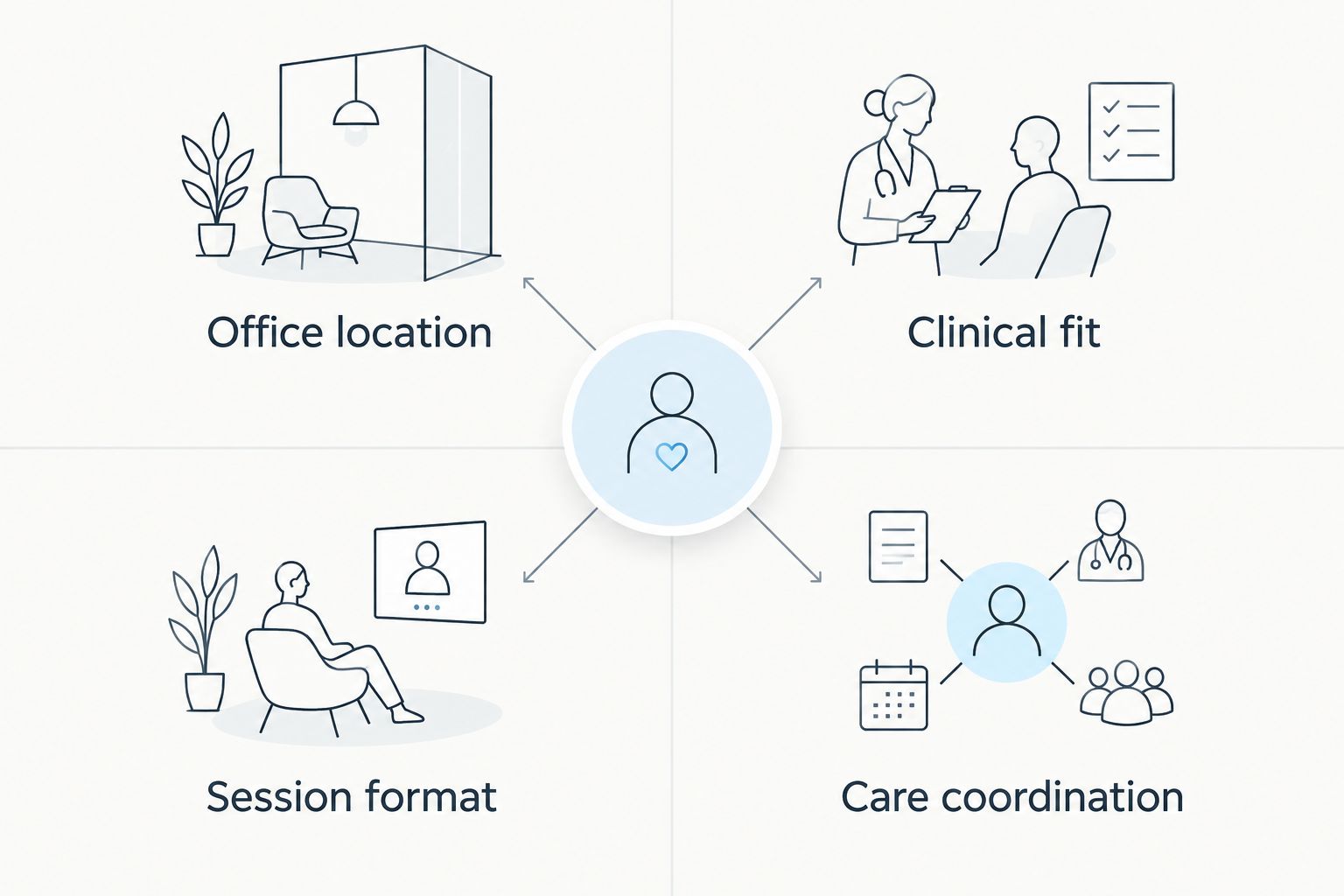
These checks make the comparison concrete. You are evaluating a particular counseling arrangement, not an abstract ranking of websites.
Three questions to ask before your first appointment
Keep your inquiry focused. These 3 questions cover treatment fit, the office-based experience, and what you should understand before starting.
- Do you work with my concern and age group? Describe the issue in your own words, including whether you are seeking individual, couples, or family counseling.
- Where and how would we meet? Ask for the office location and confirmation that the sessions you are seeking are in person.
- How do you approach treatment and review progress? Ask the clinician to explain the approach without requiring you to know clinical terminology beforehand.
If you are seeking OCD treatment, ask directly about exposure and response prevention. It is an established treatment approach for OCD; the general label anxiety counseling does not tell you whether a clinician provides it.
For trauma-related concerns, ask how the clinician discusses treatment options and pacing. For couples or family work, ask how goals are established when participants have different priorities. These are questions for the treating clinician, regardless of how you found that person.
Explore local counseling options
Review Charlotte-area in-person and virtual counseling for individuals, couples, and families.
When staying with Grow Therapy is the right call
Stay with Grow Therapy if it has already connected you with a clinician whose approach, session format, and practical arrangements meet your needs. A different search platform is not, by itself, a reason to change a working therapeutic relationship.
For 2026, evaluate your care rather than the website you used to find it. Discuss concerns about goals, communication, or session format with your therapist. If you need a different clinician or arrangement, use the alternatives above to choose the next search route deliberately.
FAQ
What's the best Grow Therapy alternative for in-person care in Charlotte?
Counselingcharlotte is the local-practice option for Charlotte-area in-person counseling. Its stated services include individual mental health counseling and couples/family therapy for children, teens, and adults; assess the individual clinician before choosing.
Is Psychology Today better than Grow Therapy?
Psychology Today is better suited to comparing therapist profiles across independent practices. Grow Therapy is a provider-search platform; neither route replaces checking the clinician's approach, office location, and session format.
Is Headway a good alternative if insurance matters to me?
Headway is a relevant alternative when you want an insurance-centered therapist search. Confirm the individual provider's arrangements and clinical fit rather than treating platform participation as proof that the therapist meets every requirement.
Can I find an in-person therapist through Grow Therapy?
Ask the selected Grow Therapy provider whether they offer in-person sessions at a Charlotte-area office. Your decision should rest on that provider's actual session arrangements, not the platform name.
How do I choose a therapist for OCD in Charlotte?
Ask whether the clinician provides exposure and response prevention for OCD. Also confirm that the clinician works with your age group and offers the session format you need.
What should I ask before booking counseling for my teenager?
Ask whether the clinician works with teenagers and how they handle parent involvement and confidentiality. Confirm the office location, treatment approach, and expectations for communication before starting.
Should I switch platforms if I already like my therapist?
A different platform is not a reason to leave a therapist whose care meets your needs. Discuss any concerns about treatment goals or practical arrangements with the clinician before deciding to change.
One last thing
You can change how you search without deciding in advance to change therapists. Ask your current provider whether the in-person arrangement or treatment focus you need is possible before starting over elsewhere.
For a new search in 2026, write down your non-negotiable requirement first: the office location, a specific treatment approach, or experience with your age group. That requirement gives you a clearer comparison than any platform ranking.


